
Leadership Is Not Always a Role

Leadership is often treated as a position: a title, a function, or a person at the front of the room who sets direction, makes decisions, communicates the plan, and carries responsibility for change. Sometimes leadership does look like that. Formal authority matters, particularly when priorities must be set, resources allocated, and difficult decisions made.

In sustainability work, however, much of the leadership that determines whether change can continue is less visible. It appears in how conversations are held, tensions are named, roles are clarified, participation is supported, and practical next steps are made possible. It is present when someone connects people who are working in parallel, translates an abstract ambition into everyday work, or creates enough clarity for others to act responsibly.

Leadership is therefore not only about being in charge. It is also about helping a system become more capable of responsible action. That distinction matters because sustainability challenges rarely yield to one leader, one department, one strategy, or one decision. They require learning, coordination, trust, participation, implementation, and adjustment over time. In that kind of work, leadership becomes more than authority. It becomes practice.

Sustainability is frequently framed as a leadership challenge, followed by a call for visionary, bold, and courageous leaders who can drive transformation and inspire others to change. There is truth in this framing. Direction, courage, and responsibility matter, and people in formal leadership positions have real power to open or close possibilities for change.

The heroic image becomes problematic when sustainability appears to depend on exceptional individuals with the right vision, charisma, or answer. It can obscure the quieter work that allows change to continue after the first speech, workshop, strategy, or decision. Most sustainability work is not carried by heroic moments but by repeated, relational, and practical efforts: keeping people connected, translating ambition into action, making participation meaningful, holding direction while allowing adaptation, noticing when energy is fading, bringing missing voices into the room, and making responsibility clearer and more shared.

This work is often difficult to see because it is distributed across roles and embedded in everyday practice. Yet without it, strategies lose contact with implementation, participation becomes symbolic, and initial energy dissipates. The visible decision may begin a process, but the less visible leadership work determines whether it can hold.

If leadership is understood as practice as well as position, the central question changes. Instead of asking only, “Who is leading this?”, we can also ask, “What leadership work is needed here?” The second question opens a wider field because it directs attention to what the situation requires rather than assuming that leadership belongs to one person.

At one moment, the work may involve setting a clear direction. At another, it may mean slowing down a process that is moving too quickly, involving people earlier, clarifying where influence lies, or protecting time for reflection. It may require translating abstract goals into practical routines, coordinating across organisational boundaries, or helping people remain with complexity instead of escaping into simple answers.

This does not make formal leadership less important. It makes leadership more precise. The issue is not merely whether someone occupies a leadership role, but whether the necessary leadership work is being performed, supported, and connected. Nor does a broader view of leadership dissolve differences in power or formal responsibility. Those with authority still carry particular obligations because they can allocate resources, establish mandates, and alter the conditions under which others are expected to act. Leadership becomes less about controlling change from above and more about strengthening the conditions that allow people to move with purpose, responsibility, and direction.

A relational and facilitative understanding of leadership should not be confused with vagueness. Participation does not mean endless openness, and facilitation does not mean avoiding decisions. Sustainability work still needs direction. People need to understand what matters, why it matters, what is fixed, what remains open, and what the work is moving towards. Without sufficient direction, participation can become scattered, reflection circular, and implementation disconnected.

The point is not to remove direction but to make it liveable, workable, and connected to the people who must carry it. A sustainability strategy may define a goal, but people still need to interpret what that goal means for their work. A project may have a clear purpose, but participants need to know how their contribution matters. A team may agree that change is necessary while still requiring support to prioritise, coordinate, and act.

Good leadership therefore holds direction without pretending that the path is fully known. It creates enough clarity to move and enough flexibility to learn. Too little direction creates confusion; too much control can remove ownership and suppress relevant knowledge. Much of sustainability leadership takes place in the ongoing work between these two risks.

Much of the leadership needed for sustainability is practical rather than dramatic. It can be seen in the person who notices that a project has energy but no follow-up, the facilitator who makes space for quieter voices, the coordinator who connects people working in parallel, or the manager who protects time for learning before demanding results. It also appears when a teacher turns concern into inquiry rather than fear, a project lead questions the assumptions built into a plan, a team member articulates a tension everyone can feel, or an organisation changes routines so responsible action becomes easier to repeat.

These actions may not resemble leadership in the traditional sense, yet they shape what becomes possible. They influence whether people feel included or ignored, whether responsibility is clear or diffuse, whether a project gains momentum or loses direction, and whether sustainability remains abstract or becomes part of practice. Leadership should therefore not be understood only as personality, authority, or individual influence. It should also be understood as the work that helps people act together under conditions of uncertainty.

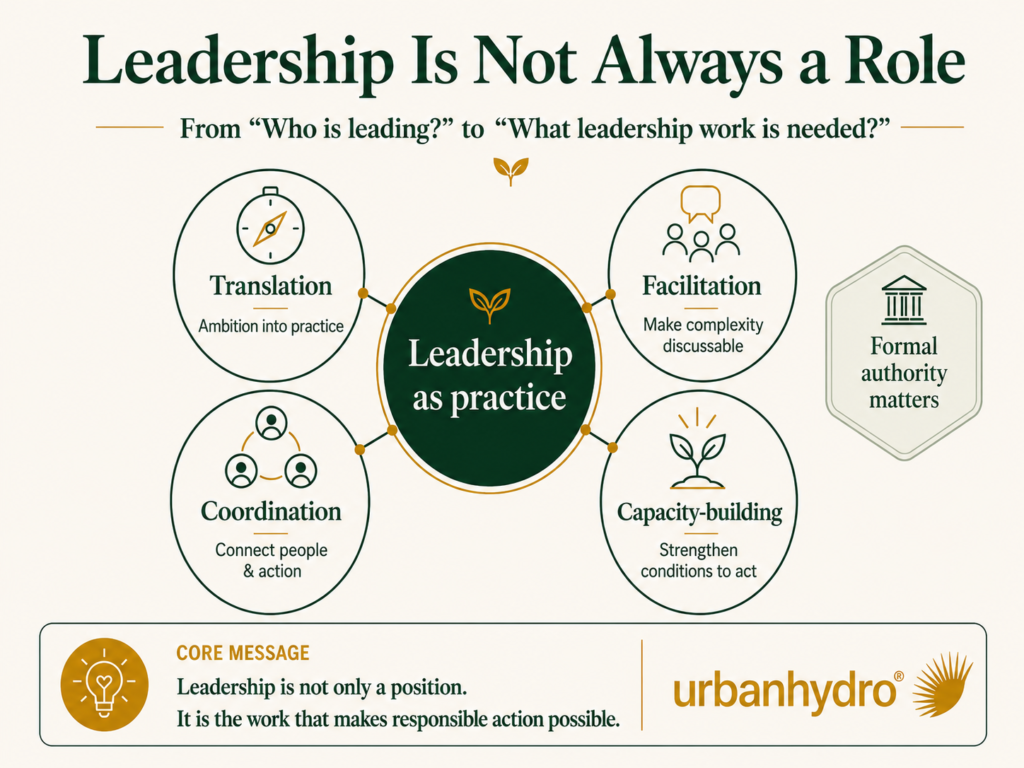
The following practices—translation, facilitation, coordination, and capacity-building—are not separate leadership types or a checklist to be completed in sequence. They are interconnected forms of work. Translation can reveal the need for participation; facilitation can expose a coordination problem; coordination can show where people lack mandate, time, knowledge, or support. Together, they help make the conditions for responsible action visible and workable.

Leadership as practice. Formal authority remains important, but sustainability leadership also takes shape through translation, facilitation, coordination, and capacity-building – the practical work that strengthens conditions for responsible action.

One of the most important forms of sustainability leadership is translation—not primarily between languages, but between levels of reality. Sustainability leadership connects vision with everyday work, strategy with practice, theory with action, values with decisions, long-term goals with immediate constraints, and stated ambitions with what the current system actually makes possible.

This work is necessary because sustainability language can easily become too abstract. Concepts such as transformation, responsibility, participation, resilience, and systems may be meaningful, but they do not automatically guide action. They must be interpreted in relation to concrete situations: What does this value mean in this meeting? What does the goal require from this team? What does participation mean in this project? What does responsibility look like in this decision? How should sustainability affect the allocation of time and resources?

Without translation, sustainability remains distant from practice. With translation, it becomes something people can interpret, discuss, test, and carry forward. Translation is therefore not a secondary communication task. It is leadership work because it creates a usable connection between ambition and action.

Leadership for sustainability is also facilitative, but facilitation should not be reduced to running workshops. It involves creating structured spaces in which people can make sense of complexity together. Sustainability challenges commonly involve uncertainty, disagreement, competing priorities, and different forms of knowledge. People may care about the same overall goal while understanding the problem differently, and they may enter a process with very different levels of power, confidence, responsibility, and access to decisions.

These differences do not disappear when they remain unspoken. They continue to shape the process: some voices dominate, some concerns remain hidden, assumptions go unexamined, and decisions become disconnected from the people who must implement them. Facilitative leadership makes these dynamics more visible and workable. It provides structure for participation, supports dialogue without allowing the process to become vague, and creates room for reflection while maintaining attention to action.

Good facilitation does not remove tension. It treats tension as information. A disagreement may reveal conflicting values, an unclear mandate, a practical limit, an excluded perspective, or an assumption that needs to be tested. Questions such as “What is this tension showing us?”, “What needs to be clarified?”, and “What can be tested now?” help people move from uncertainty towards a direction they can understand and carry together.

Sustainability work frequently crosses boundaries between teams, organisations, disciplines, professions, generations, values, interests, and forms of knowledge. This makes coordination essential. Although coordination can look administrative, it is one of the main ways change becomes possible because it keeps purpose, people, information, resources, decisions, and next steps connected over time.

Without coordination, sustainability work fragments. People act in parallel without learning from one another. Decisions are made in one place but experienced in another. Feedback is collected but not used, energy is created but not carried forward, and responsibility is shared in language while remaining unclear in practice. Good coordination creates coherence by helping people understand where the work stands, what has changed, what requires attention, and how their contribution connects to the wider direction.

This is not minor work. It is leadership work because even strong intentions can dissolve into disconnected activity when no one maintains the relationships and connections on which implementation depends.

Sustainability leadership is not only about completing tasks or delivering outputs. It is also about strengthening the collective conditions for learning, adapting, and acting responsibly over time. Sustainability challenges do not end with one project. New situations arise, priorities shift, consequences become visible, knowledge develops, and organisational conditions change.

A leadership approach focused only on delivery may produce a short-term result without changing what people are actually able to influence afterwards. A capacity-building approach therefore looks beyond individual knowledge or confidence. It asks whether people have the time, mandate, relationships, access to decisions, practical routines, and support needed to use what they learn. It also asks what participants, teams, and organisations will be better able to do because of the process: understand the issue more clearly, participate more meaningfully, test ideas, use feedback, coordinate across boundaries, and make responsibility clearer.

This changes how sustainability work is designed and evaluated. Completing an activity remains important, but it is no longer the only measure of progress. A process should also leave behind stronger conditions for responsible judgement and action. Capacity, in this sense, is not simply something an individual possesses. It is relational and institutional: it depends on what the surrounding system enables people to understand, influence, and sustain in practice.

Leadership for sustainability also requires a different relationship to uncertainty. Organisations often treat uncertainty as something that plans should remove, strategies should control, and leaders should answer. Yet sustainability work involves forms of uncertainty that cannot be eliminated in advance. Effects may be delayed, problems contested, knowledge incomplete, system responses unexpected, and definitions of success different across groups.

This does not make leadership impossible. It makes adaptive leadership necessary. An adaptive approach does not wait for perfect certainty before acting, but neither does it claim to know more than it does. It creates a way of moving forward that can learn from reality. That requires humility—not as weakness, but as recognition that no individual sees the whole system.

Humility makes it possible to listen for what a plan has missed, adjust without losing purpose, and treat feedback as part of the work rather than as a threat to authority. In sustainability work, the ability to say “we need to learn more” can be a form of leadership strength, particularly when it remains connected to responsible action rather than becoming a reason for indefinite delay.

This is where my work with urbanhydro® is focused: the space between sustainability ambition and everyday practice. Rather than beginning with an assumption that people need more motivation, stronger competencies, or a better plan, I begin by examining the conditions that shape what they can understand, influence, take responsibility for, and sustain.

The work begins with practical leadership questions rather than abstract prescriptions. What direction needs to be made clearer? What conditions are shaping the current situation? Who has influence, who needs to be involved, and where is responsibility unclear? What must be translated into practice? Where is the process stuck? What requires facilitation or coordination? What can be tested now, and what must be learned before the next step can be planned responsibly?

These questions connect leadership to the actual work of change: understanding systems, supporting participation, clarifying responsibility, coordinating action, and helping people move forward without pretending that the work is simple. They also shift attention away from searching for a single heroic actor and towards understanding how leadership is enacted across relationships, routines, decisions, and organisational conditions.

Leadership is not always a role. It is also a practice that takes shape through the conditions people create, the questions they ask, the processes they influence, and the ways they help others act with greater clarity, responsibility, and direction. In sustainability work, leadership is not only about having the answer; it is about helping people work productively with the questions that matter.

Nor is leadership only about driving change. It involves creating conditions in which change can be understood, carried, tested, adjusted, and sustained. It is not only an expression of individual influence but a way of strengthening collective capacity. This is why leadership for sustainability must be practical, relational, reflective, and adaptive.

Sustainable change does not depend only on bold visions. It depends on the everyday leadership work that helps people translate vision into practice. Often, that work begins quietly: by making the next responsible step clearer, more shared, and more possible.

Sources and Further Reading

Crevani, L., Lindgren, M., & Packendorff, J. (2010). Leadership, not leaders: On the study of leadership as practices and interactions. Scandinavian Journal of Management, 26(1), 77–86. https://doi.org/10.1016/j.scaman.2009.12.003

Carroll, B., Levy, L., & Richmond, D. (2008). Leadership as practice: Challenging the competency paradigm. Leadership, 4(4), 363–379. https://doi.org/10.1177/1742715008095186

Uhl-Bien, M. (2006). Relational Leadership Theory: Exploring the social processes of leadership and organizing. The Leadership Quarterly, 17(6), 654–676. https://doi.org/10.1016/j.leaqua.2006.10.007

Cunliffe, A. L. (2009). The philosopher leader: On relationalism, ethics and reflexivity—A critical perspective to teaching leadership. Management Learning, 40(1), 87–101. https://doi.org/10.1177/1350507608099315

Ansell, C., & Gash, A. (2008). Collaborative governance in theory and practice. Journal of Public Administration Research and Theory, 18(4), 543–571. https://doi.org/10.1093/jopart/mum032

Westley, F. R., Tjornbo, O., Schultz, L., Olsson, P., Folke, C., Crona, B., & Bodin, Ö. (2013). A theory of transformative agency in linked social-ecological systems. Ecology and Society, 18(3), 27. https://doi.org/10.5751/ES-05072-180327

Seeing the System Before Acting

Why sustainable action becomes stronger when we examine the conditions shaping practice

Many sustainability problems are approached as isolated issues: a behaviour to change, a process to improve, a strategy to update, a target to reach, or a project to implement. This framing is attractive because it makes the problem appear manageable. If awareness is low, provide information. If behaviour is poor, ask people to change. If engagement is weak, invite participation. If implementation is slow, produce a clearer plan.

Sometimes these responses are useful. But sustainability challenges rarely exist in isolation. They are connected to habits, incentives, relationships, assumptions, resources, routines, responsibilities, histories, and decisions distributed across different parts of an organisation or wider system. When those connections are ignored, solutions often remain too shallow. People respond to the visible problem without examining what keeps producing it. A campaign, workshop, policy, tool, or project may create activity while the surrounding conditions continue to pull people back towards the same outcome.

An isolated solution usually rests on a simple diagnosis. A team is not acting because it lacks information. A project has stalled because the plan is unclear. Employees are disengaged because they need greater motivation. A sustainability strategy has not produced results because it has not been communicated strongly enough.

Each diagnosis may contain part of the truth, but it can obscure the conditions surrounding the visible behaviour. A team may need better information, but it may also lack time, authority, coordination, trust, or a clear connection between the sustainability goal and its daily work. A project plan may be unclear, but the deeper difficulty may be overlapping roles, stretched resources, delayed decisions, or unresolved tensions between competing priorities.

An organisation may communicate sustainability convincingly while its budgets, incentives, routines, and leadership signals point in another direction. Employees then receive one message through formal communication and another through the decisions that shape their working day. In such situations, the problem is not only what people know, believe, or intend. It is also what the organisation makes easier, harder, visible, invisible, rewarded, ignored, or repeatedly postponed.

An isolated intervention may still generate movement. A workshop can create ideas, a campaign can attract attention, and a new policy can clarify expectations. The more important question is whether the intervention changes the conditions that made the original problem likely. Activity can be valuable, but activity alone does not demonstrate that practice has changed.

Systems thinking begins with a shift in the question. Instead of asking only what is wrong, we ask what keeps making this outcome likely. That shift moves attention away from individual blame and towards recurring patterns and connected conditions. It helps distinguish between a problem located mainly in behaviour and one produced by structures, incentives, information flows, power, or coordination.

This does not remove individual or organisational responsibility. It makes responsibility more precise. People can begin to see where they have meaningful influence, where they depend on others, and where the surrounding conditions must change. They can also identify when a problem cannot reasonably be solved through individual effort alone.

This distinction matters in sustainability work because responsibility is often placed on people without corresponding agency. Employees may be asked to implement a new ambition without time, authority, support, or clarity about what should change. Citizens may be invited to participate without knowing what they can influence. Teams may be expected to innovate while existing routines reward predictability and speed. A systems perspective connects responsibility to the conditions that make responsible action possible.

Systems thinking is sometimes misunderstood as an argument that everything is too complex to act on. Its purpose is the opposite. It helps people act with a clearer understanding of what their action is connected to. The aim is not to understand everything before doing anything. It is to understand enough to avoid repeatedly treating symptoms as causes.

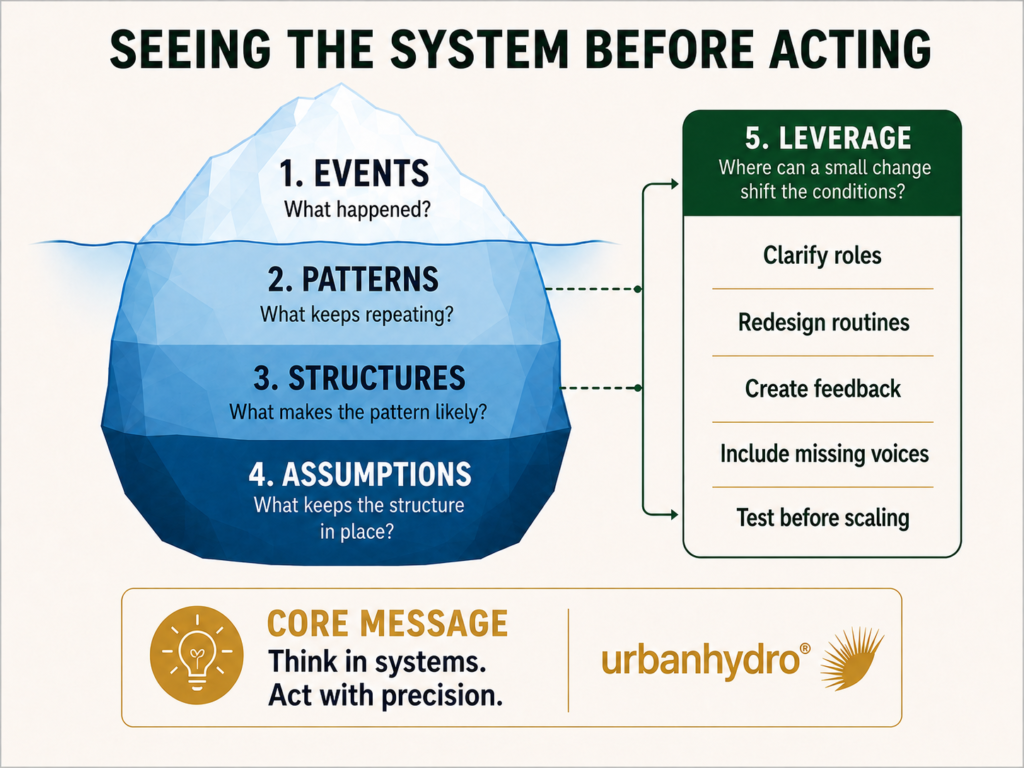
Most organisational problems first appear as events. A project stalls, a target is missed, a decision is delayed, a team becomes disengaged, or a workshop creates energy without meaningful follow-up. Events matter because they show that something has happened. But if attention remains at the event level, organisations can become trapped in repeated reaction. Each delay, conflict, or failure is treated as a new incident rather than part of a continuing pattern.

The next step is therefore to look for repetition. Has this happened before? Do people regularly leave meetings without clarity about the next step? Do new initiatives repeatedly depend on the same few individuals? Does sustainability become highly visible during strategy development but disappear when budgets and operational priorities are decided? Patterns suggest that the event is not random. They indicate that something more persistent is shaping what happens.

The next level is structure. Structure does not refer only to formal organisational charts. It includes roles, routines, incentives, information flows, decision-making processes, available resources, timelines, assumptions, and power relations. A project may repeatedly stall because responsibility for the next decision is unclear. A team may disengage because earlier participation had no visible influence. A sustainability strategy may fade because no one translated it into priorities, resource allocations, routines, and follow-up.

Beneath these structures are often assumptions that have become difficult to see because they are treated as normal. Speed may be valued more highly than reflection. Individual commitment may be expected to compensate for weak coordination. Short-term delivery may consistently outweigh long-term capacity. A particular group may be assumed to have the relevant knowledge, while people closer to the consequences are excluded from the decision.

Seeing the system therefore means moving from the visible event to the recurring pattern, from the pattern to the conditions that sustain it, and from those conditions to the assumptions that make them appear reasonable. Better action begins when these layers become visible and discussable.

Seeing the system before acting. Moving from events to patterns, structures, and assumptions reveals where targeted changes can shift the conditions that keep a problem in place.

Systems are also shaped by feedback. Some forms of feedback strengthen a pattern, while others stabilise or interrupt it. Consider an organisation that rewards speed more strongly than reflection. Employees learn to make decisions quickly. Rushed decisions then produce weak implementation, unclear ownership, or avoidable errors. These difficulties create further pressure to act quickly and regain lost time. The organisation reproduces the very behaviour it says it wants to change.

A similar loop can develop around committed individuals. A project depends heavily on one person who consistently takes responsibility. Because that person always steps in, others become less involved. As others step back, the project becomes even more dependent on the original individual. Commitment is present, but the way responsibility is organised makes the project fragile.

Participation can generate another loop. If people are invited to contribute but never see how their input affects a decision, they may become less willing to participate next time. Lower participation is then interpreted as lack of interest, which can lead decision-makers to involve people even less. The resulting disengagement appears to confirm the original assumption, although the process itself helped produce it.

Feedback loops matter because they show how unwanted outcomes can continue without anyone deliberately choosing them. People may genuinely support change while still reinforcing the old pattern through the way work is organised. The practical questions become: Which actions reinforce the current pattern? What keeps pulling people back? What feedback is missing? What would make the desired behaviour easier to repeat?

Quick action is not necessarily irresponsible. Some situations require an immediate response. The difficulty arises when the response reduces the pressure to investigate the deeper cause. An organisation may respond to weak engagement by arranging another workshop. The workshop may generate temporary energy, but engagement will probably weaken again if participants still lack influence, clarity, or follow-up.

A school may respond to sustainability concerns by introducing a project week. The programme may be valuable, but its longer-term influence will remain limited if it is disconnected from everyday teaching, student agency, leadership priorities, and the school’s normal routines. A team may respond to a failed initiative by producing a more detailed plan, even though the real difficulty is weak ownership, delayed decisions, or poor coordination. In that case, stricter planning may increase pressure without resolving the problem.

The quick fix can then become part of the system that maintains the difficulty. It creates the appearance of action while leaving the underlying pattern largely unchanged. This does not mean that people should stop acting until every relationship and consequence is fully understood. That would create paralysis. It means that action should be connected to learning: act, observe the response, examine what it reveals, adjust the surrounding conditions, and act again with a better understanding.

Systems thinking can become too abstract. It can generate sophisticated diagrams, complex language, and descriptions in which everything appears connected to everything else. If that analysis does not help people decide what to do next, it has limited practical value.

The purpose is not to map the entire system. It is to see enough of the system to act more responsibly. A grounded systems perspective helps people identify which conditions matter most, what is within reach, where collaboration is necessary, and what can be tested before a larger commitment is made. It also helps distinguish between problems that look similar but require different responses.

A relational problem should not automatically be treated as an information problem. A structural problem should not be reduced to a lack of motivation. An implementation problem should not be addressed only through communication, and a learning problem should not be mistaken for a delivery problem. Many sustainability failures begin with this kind of oversimplification: a narrow intervention is applied to a problem whose causes lie elsewhere.

Systems thinking also makes tensions more visible. Sustainability work often requires organisations to navigate short-term efficiency and long-term care, individual action and structural change, participation and decision-making, flexibility and direction, or ambition and available capacity. These tensions cannot always be removed. They can, however, be made explicit so that choices are more deliberate and their consequences easier to examine.

Not every intervention has the same effect. Some actions alter surface behaviour for a short period. Others change conditions that influence many decisions over time. Systems scientist Donella Meadows used the term leverage points to describe places in a system where a relatively modest intervention can produce wider consequences. These points may involve information flows, rules, feedback, goals, or the ability of people within the system to organise differently.

In practical organisational terms, leverage is not always dramatic. A poster may remind people to behave differently, while a change in routine may make the desired behaviour easier. A workshop may create awareness, while a new decision process may allow that awareness to influence what happens next. A sustainability target may communicate direction, while a change in resource allocation may make the target operational.

Practical leverage can take the form of a clearer role, a better meeting structure, a visible feedback process, a shared decision point, a small test before scaling, a resource made available, or a previously absent voice included in the process. These changes may appear modest. Their importance lies in whether they alter the conditions surrounding action.

A small intervention is not valuable simply because it is small. It becomes significant when it is positioned where it can influence a recurring pattern, improve learning, or change what becomes possible afterwards. This is also why large initiatives are not automatically more powerful. The relevant question is not only how much activity an intervention creates, but where it acts and what it changes.

Participation is often proposed as a response to complex sustainability challenges. Bringing more people into the conversation can broaden knowledge, reveal overlooked consequences, and strengthen the relevance of an initiative. But participation is not automatically transformative.

If people are invited only after the central decisions have been made, the process may create the appearance of involvement without meaningful influence. If contributions are collected but no one explains how they will be used, participation can weaken trust rather than strengthen it. If responsibility is transferred to participants without corresponding authority or resources, participation becomes an additional burden.

A systems perspective therefore asks more than who was invited. It examines how participation is connected to information, decisions, resources, and follow-up. What is genuinely open to influence? Who is missing from the process? Which forms of knowledge are recognised? Who has the authority to act on what is learned? How will participants see what happened to their contributions?

These questions help distinguish participation as an activity from participation as part of a functioning decision process. They also show why engagement problems cannot always be solved by inviting people to one more meeting. The difficulty may lie not in people’s willingness to participate, but in the relationship between participation and actual influence.

Systems thinking becomes most useful when it is connected to a concrete situation. A broad sustainability ambition may be important, but it can be difficult to examine directly. A specific recurring challenge provides a more workable starting point: an initiative that repeatedly loses momentum, a decision process in which sustainability is consistently deprioritised, a team that struggles to coordinate across functions, or a participation process that produces input without movement.

People can then examine what happened, whether the same pattern has appeared before, and which conditions make it likely. They can trace where information moves or stops, who has authority, which assumptions guide the current response, who is affected, and what forms of behaviour are rewarded or ignored.

The next step is not necessarily to design a complete solution. It may be to identify one assumption to test, one relationship to strengthen, one routine to change, or one missing decision to clarify. A limited practice experiment can then produce information about the wider system. It can reveal whether the problem was understood correctly, whether people have the authority they need, and what additional coordination or support is required.

A practice experiment is not a way of avoiding ambition. It is a way of connecting ambition with experience. The experiment should be small enough for someone to take responsibility for it, but relevant enough to reveal something about the wider conditions. It should have a clear purpose, a realistic boundary, visible support, and a point at which the learning is reviewed. Without these connections, a pilot can become another isolated activity. With them, it can help an organisation learn how change may become workable.

This creates a different relationship between analysis and implementation. Analysis is not completed before action begins, and action is not reduced to executing a fixed plan. Action becomes a way of testing and improving the organisation’s understanding of the problem.

This is an important focus in my work through urbanhydro. I support people and organisations in slowing down enough to see the conditions shaping a problem and then moving forward with clearer, more grounded action.

The work often begins with a concrete challenge rather than a broad aspiration. What is the visible problem? Has it happened before? Which patterns are repeating? What conditions make those patterns likely? Who is affected, and who is involved in maintaining or changing the current situation?

It also requires attention to the less visible parts of organisational life. Which incentives, routines, habits, or assumptions shape behaviour? Where is responsibility clear, and where is it diffuse? What is rewarded? What is ignored? Where is relevant knowledge missing from the decision process? What could be tested without pretending that one experiment will solve the whole problem?

These questions bring together the central principles of my work: learning must be connected to practice; participation must be connected to influence; responsibility must be matched with agency and support; implementation must allow adaptation; and ambition must be matched with the capacity available to carry it. None of these conditions works in isolation. Their value lies in how they reinforce one another around a concrete piece of work.

This approach does not make action slower by default. It makes action better directed. When people understand the surrounding system more clearly, they can stop treating recurring symptoms as isolated failures. They can also identify where their own influence is meaningful and where change requires support, coordination, or decisions elsewhere in the organisation.

Systems thinking is not about making sustainability more complicated. Sustainability is already complex. Its practical value is to make that complexity more visible, discussable, and workable. It helps people recognise that problems are not located only in individuals, but also in the relationships, routines, incentives, assumptions, and structures that shape what individuals can do.

It helps organisations notice patterns before they repeat them, connect responsibility to actual conditions, and avoid quick fixes that recreate the original problem. It can also reveal where a small, carefully placed intervention may create useful learning or open a different path forward.

Seeing the system does not mean waiting until everything is clear. It means acting with a better understanding of what the action is connected to and remaining attentive to what the response reveals. Sustainable change does not begin only with better intentions, more information, or more detailed plans. It begins when people can see the pattern clearly enough to question the conditions that keep producing it.

The purpose is not to find one final explanation or one perfect point of intervention. It is to develop a more responsible relationship between seeing, acting, learning, and adjusting. When those parts of the work remain connected, new possibilities for action become visible without pretending that complex problems can be solved through a single initiative.

Sources

Chambers, D. A., Glasgow, R. E., & Stange, K. C. (2013). The dynamic sustainability framework: Addressing the paradox of sustainment amid ongoing change. Implementation Science, 8, 117.

Durlak, J. A., & DuPre, E. P. (2008). Implementation matters: A review of research on the influence of implementation on program outcomes and the factors affecting implementation. American Journal of Community Psychology, 41(3-4), 327-350.

Meadows, D. H. (1999). Leverage points: Places to intervene in a system. The Sustainability Institute.

Senge, P. M. (2006). The fifth discipline: The art and practice of the learning organization (Rev. ed.). Doubleday.

Responsibility Without Guilt

Why sustainability needs agency, shared responsibility, and practical capacity

Sustainability often arrives as a burden: a demand to know more, care more, consume better, choose better, work differently, and somehow remain hopeful while facing problems far larger than any one person can solve.

For many people, this creates a difficult tension. They may understand that sustainability matters and genuinely want to act responsibly, yet still struggle to see how their own actions connect to challenges shaped by organisations, institutions, infrastructures, markets, policies, and long histories. The distance between what should change and what seems possible can become overwhelming, and this is often where guilt enters.

Guilt is not necessarily unproductive. It can draw attention to consequences and encourage attempts to repair something we believe we have done wrong. The problem arises when responsibility becomes diffuse moral pressure: when people are made to feel responsible for problems they cannot meaningfully influence, or when concern is disconnected from realistic possibilities for action. Sustainability can then become something people feel they are continually failing at rather than something they can participate in shaping.

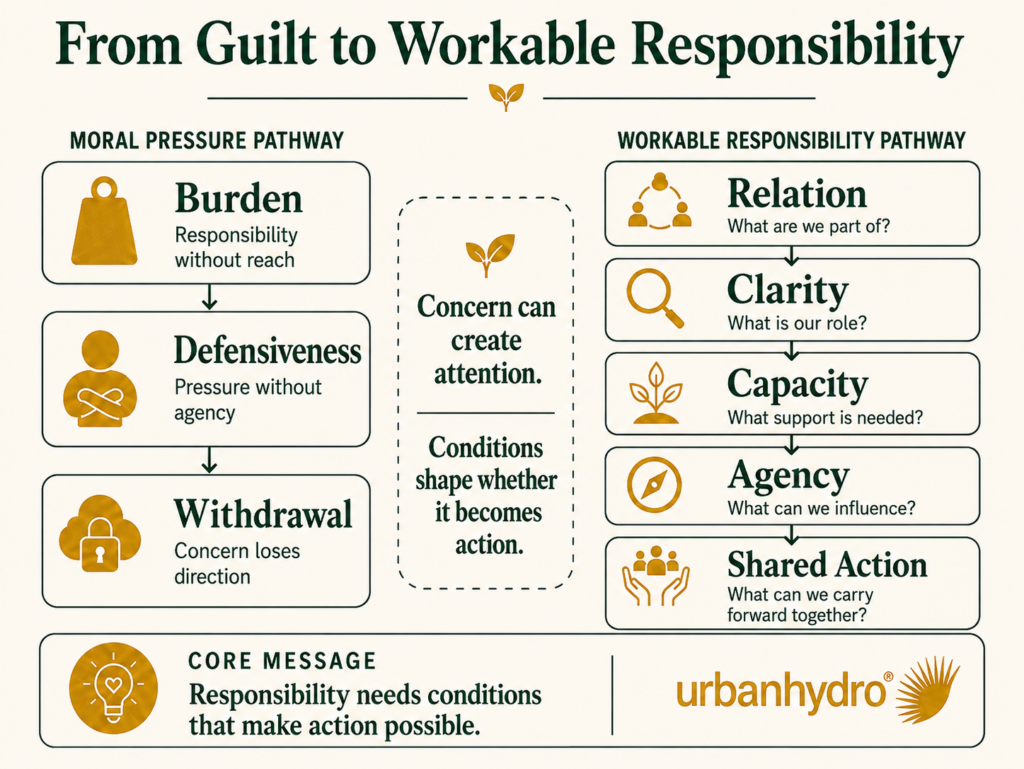
The challenge is not to remove responsibility, but to connect it to agency, influence, support, and the conditions that make responsible action possible.

Responsibility matters because without it sustainability easily remains a collection of good intentions. Commitments have to connect to decisions, priorities, roles, and consequences if they are to mean anything in practice. The problem is not responsibility itself, but how it is framed, distributed, and supported.

When complex sustainability challenges are reduced primarily to individual choices, responsibility becomes too narrow. When every imperfect decision is treated as evidence of personal failure, moral pressure can become too heavy. And when people are warned about serious consequences without being given meaningful opportunities to influence what happens next, concern becomes disconnected from agency.

The same tension appears inside organisations. Employees may be expected to work sustainably without sufficient time, resources, information, or authority. Teams may be encouraged to innovate while routines continue to reward certainty and short-term efficiency. People may be invited to participate after the important decisions have already been made. Young people may be asked to take responsibility for the future while having limited influence over the institutions shaping it.

In each case, responsibility is presented as a demand without being matched by the capacity to act. Individuals are expected to change while much of the surrounding system remains untouched.

This matters because responsibility is not simply something a person possesses. Whether someone can act responsibly depends partly on what they can understand, influence, decide, access, and sustain within the situation they are part of.

A more useful understanding of responsibility begins not with blame, but with relation. Instead of asking only who is at fault, we can ask what we are part of, who is affected by our decisions, what relationships shape the situation, and what becomes possible from where we stand.

This shift widens the field of attention. Blame tends to isolate an individual act or failure. A relational perspective asks how people, organisations, resources, routines, histories, expectations, and consequences are connected. It allows individual responsibility to be examined without pretending that individuals act outside the systems that enable and constrain them.

That does not weaken accountability. It makes accountability more precise because people can recognise both their involvement and their limits. They are neither powerless nor solely responsible. They participate in systems that shape what they can do, while also helping reproduce or change those systems through decisions, priorities, routines, relationships, and collective action.

Agency emerges within this relationship between people and their conditions. It is therefore different from heroism. Sustainability is often narrated as though someone must lead, solve the problem, make the right choice, or demonstrate exceptional courage and consistency. Meaningful agency requires something less dramatic but more practical: sufficient understanding, influence, connection, and support for responsible action to become possible.

This matters because sustainability challenges involve uncertainty, trade-offs, competing needs, different timescales, and consequences that may only become visible later. No one has a complete overview, and no one acts from outside the system. Agency is necessarily situated, while many forms of meaningful change depend on people acting with and through others.

The practical questions therefore become: What can I influence from where I am? What can we shape together? What falls within our role and reach? Where are we dependent on others? Where is authority located? What conditions would need to change for better action to become possible?

These questions do not make responsibility smaller. They make it more specific, and specific responsibility is easier to connect to meaningful action than diffuse guilt about everything.

A systems perspective creates another challenge. If everything is connected, responsibility can become so distributed that no one appears responsible for anything. Shared responsibility must therefore not become avoided responsibility.

Different people and organisations have different forms of influence, obligation, capacity, and power. A student, employee, manager, business owner, supplier, municipality, policymaker, or citizen may all participate in the same sustainability challenge, but they do not participate from equivalent positions. Their resources, mandates, access to decisions, and ability to alter surrounding conditions differ.

A credible approach to shared responsibility has to acknowledge these differences rather than treating responsibility as equal when power is not equal. Responsibility can be distributed across a system while still being differentiated according to position, influence, capacity, and the ability to contribute to change.

This is particularly visible in organisations. A team cannot reasonably be expected to carry a sustainability ambition if leadership provides neither direction nor resources. A manager may have substantial influence within a team while remaining constrained by organisational incentives and budgets. Employees cannot participate meaningfully when the decisions that matter remain inaccessible to them, and projects struggle to sustain responsibility when roles, follow-up, and decision rights remain unclear.

Shared responsibility therefore needs structure. People need to understand what belongs to them, what belongs to others, where responsibilities overlap, and where collective action or structural change is required. Without that clarity, shared responsibility risks becoming a reassuring phrase while responsibility in practice remains concentrated, displaced, or unclear.

Responsibility becomes more useful when it is translated into the situation in which people are expected to act. Instead of relying primarily on broad moral pressure, sustainability work can begin with questions that connect values to choices, relationships, conditions, and consequences.

What are we responsible for here? Who is affected by this decision? What consequences might remain outside our immediate view? Which options are genuinely available? What would make the more responsible option easier to choose? What are we willing to prioritise, and which trade-offs need to be acknowledged? Where can we act now, and where is wider change required?

These questions do not remove complexity. They make complexity possible to engage with. They also reduce the pressure of perfection. If responsibility is treated as purity, people and organisations will inevitably fail because sustainability work takes place inside systems filled with contradictions. A responsible decision may still create costs elsewhere. A promising solution may generate unforeseen effects, while progress in one area may expose limitations in another.

The goal is therefore not to become pure or contradiction-free. It is to become more responsive, reflective, and capable of acting responsibly within complexity. Responsibility becomes less like a permanent moral identity and more like a practice that is interpreted, tested, learned, adjusted, and carried with others over time.

This is where the distinction between moral pressure and practical capacity becomes important. Moral pressure directs attention towards what people should do. Capacity asks what has to be present or strengthened for responsible action to become possible and continue.

People may need clearer information, more time, better coordination, a meaningful role in decisions, practical tools, support from leadership, a shared language, or a smaller first step that allows learning to begin. They may also need evidence that their effort connects to something larger and that responsibility is not simply being transferred to them while others retain the meaningful power to decide.

Looking at capacity shifts sustainability from accusation towards design. It does not excuse inaction. Instead, it asks what currently enables or constrains action and what could realistically be changed.

People act within organisational cultures, rules, technologies, routines, budgets, hierarchies, incentives, relationships, and time pressures. These conditions shape which actions are easy, difficult, rewarded, ignored, or discouraged. A workplace can encourage sustainable behaviour while maintaining procurement systems that make it difficult. An organisation can invite participation while giving employees no time to participate. A municipality can call for citizen responsibility while providing unclear information or limited access to decisions.

In situations like these, lack of action cannot be explained only as a lack of motivation or care. The surrounding conditions are part of the explanation. Motivation and agency matter, but they interact with the environments in which people are expected to exercise them.

Responsibility therefore has to connect to roles, processes, relationships, and structures. Supportive conditions do not guarantee responsible action, but they can make it easier to understand, attempt, coordinate, learn from, and sustain.

From moral pressure to workable responsibility. Responsibility becomes more actionable when concern is connected to relation, clarity, capacity, agency, and shared action. The pathways illustrate a shift in conditions rather than a fixed sequence of steps.

Even where conditions are supportive, responsible action rarely begins with perfect clarity. People learn through experience, dialogue, mistakes, feedback, and adjustment. They discover what matters partly by acting and observing what their actions produce.

This learning dimension is particularly important in sustainability because consequences are often indirect, relational, and delayed. A choice that appears efficient in one part of a system may create pressure elsewhere. A solution may reduce one problem while intensifying another. A participatory process may appear inclusive while leaving important voices outside the room. A strategy may be technically sound but fail because people lack the mandate or practical conditions required to enact it.

Responsibility therefore also requires reflexivity: attention not only to what we intend to do, but to how our assumptions, positions, decisions, and actions interact with wider relationships and consequences. This means remaining open to feedback, noticing unintended effects, questioning what a plan may have overlooked, and adjusting direction when reality reveals something different.

Reflexivity should not become endless self-criticism or another demand for individual perfection. Its practical purpose is to keep action responsive. People and organisations need enough stability to act, but enough openness to learn when experience challenges their original understanding.

The same distinction helps separate accountability from blame. Blame tends to narrow attention towards who should carry fault or shame. Accountability asks who needs to respond, what consequences need to be addressed, what can be repaired, and how future practice should change. It connects action to consequence, role, authority, and learning.

An organisation can acknowledge harm while examining the structures that contributed to it. A leader can accept responsibility without pretending to control every condition. A team can identify failure without treating learning as incompetence, and individuals can recognise their own contribution without assuming responsibility for an entire system.

Accountability remains essential. Its value increases when acknowledging what happened contributes to changed practice rather than ending with blame.

This is an important focus in my work through urbanhydro®. I work in the space between sustainability ambition and everyday practice, where responsibility has to become understandable and actionable rather than remain an abstract expectation.

The starting point is not an assumption that people simply need stronger motivation. It is to examine the situation in which action is expected: what people are already carrying, where influence actually lies, which decisions shape the current conditions, who needs to be involved, where responsibility is unclear, and what forms of support, participation, learning, or coordination are missing.

This means paying attention to frustration and resistance rather than automatically interpreting them as unwillingness. They may point towards unclear roles, insufficient influence, conflicting demands, lack of trust, unrealistic expectations, or organisational conditions that make the desired action difficult to sustain. Understanding those conditions does not remove responsibility; it helps locate where responsibility can be exercised and where the surrounding system also needs attention.

The practical task is to connect what people can influence with what they are responsible for, how their actions affect others, and what needs to be learned as consequences become visible. Organisations, in turn, need to examine whether the conditions around people make responsible action realistic.

This moves responsibility from broad pressure towards practical possibility. People can begin to see what they can act on directly, where they need others, what requires negotiation, and where structures, routines, or decision-making processes need to change.

The purpose is not to make sustainability comfortable or remove its ethical demands. It is to create conditions in which people can remain engaged with difficult questions long enough to understand, act, learn, and carry change forward.

Sustainability needs responsibility, but responsibility cannot be sustained by moral pressure alone. It requires relation, clarity, meaningful influence, supportive conditions, shared direction, and opportunities to learn from what action produces.

Responsibility without guilt is therefore not responsibility without seriousness. Nor does it mean that guilt is always inappropriate or that accountability should be softened. It means refusing to treat guilt as the primary mechanism through which responsible action is expected to emerge.

A more practical approach asks people and organisations to understand where they stand within a wider system, what consequences they contribute to, what lies within their influence, what obligations follow from their position, and where they need to act with others. It also recognises that these responsibilities are not distributed equally because authority, resources, capacity, and power are not distributed equally.

This leaves room for uncertainty without turning uncertainty into an excuse for inaction. Responsible action does not require knowing everything before acting, but it does require remaining attentive to relationships, assumptions, consequences, and what experience reveals.

Agency, responsibility, relationality, and reflexivity come together here. People need the possibility to act, clarity about what is theirs to carry, awareness of the relationships in which their actions take place, and the capacity to learn from what those actions produce. Separating these dimensions makes responsibility either too individual, too abstract, or too static.

Guilt may sometimes draw attention to something that matters. Sustainable responsibility requires something more durable: the capacity to locate ourselves within a situation, recognise what we can influence, take responsibility for what is ours to carry, remain responsive to consequences, and strengthen the conditions that allow responsible action to become shared and sustained.

That is where responsibility becomes workable—and where sustainability can move from moral pressure towards practice.

Sources and Further Reading

Bandura, A. (2001). Social cognitive theory: An agentic perspective. Annual Review of Psychology, 52, 1–26. https://doi.org/10.1146/annurev.psych.52.1.1

Deci, E. L., & Ryan, R. M. (2000). The “what” and “why” of goal pursuits: Human needs and the self-determination of behavior. Psychological Inquiry, 11(4), 227–268. https://doi.org/10.1207/S15327965PLI1104_01

Deci, E. L., Olafsen, A. H., & Ryan, R. M. (2017). Self-determination theory in work organizations: The state of a science. Annual Review of Organizational Psychology and Organizational Behavior, 4, 19–43. https://doi.org/10.1146/annurev-orgpsych-032516-113108

Ryan, R. M., & Deci, E. L. (2020). Intrinsic and extrinsic motivation from a self-determination theory perspective: Definitions, theory, practices, and future directions. Contemporary Educational Psychology, 61, 101860. https://doi.org/10.1016/j.cedpsych.2020.101860

Tangney, J. P., Stuewig, J., & Mashek, D. J. (2007). Moral emotions and moral behavior. Annual Review of Psychology, 58, 345–372. https://doi.org/10.1146/annurev.psych.56.091103.070145

Wiltsey Stirman, S., Kimberly, J., Cook, N., Calloway, A., Castro, F., & Charns, M. (2012). The sustainability of new programs and innovations: A review of the empirical literature and recommendations for future research. Implementation Science, 7, 17. https://doi.org/10.1186/1748-5908-7-17

Young, I. M. (2006). Responsibility and global justice: A social connection model. Social Philosophy and Policy, 23(1), 102–130. https://doi.org/10.1017/S0265052506060043

Implementation Is Not Just Execution

Why sustainability work needs structure, learning, coordination, and adaptation

Good ideas rarely fail at the moment they are conceived. They lose strength in the transition from intention to practice. A strategy may be clear on paper. A workshop may generate genuine energy. A project plan may present a convincing sequence of actions. People may agree on the problem, support the ambition, and feel ready to begin.

Then the work meets reality.

Time becomes scarce. Responsibilities overlap. Communication fragments. Existing routines compete with new priorities. Resources prove tighter than expected. People interpret the same goal differently. Decisions take longer, momentum weakens, and the connection between the original ambition and everyday work begins to fade. This is where sustainability work is truly tested.

Implementation is often treated as the final stage of a project: first we develop the idea, then we create the strategy, and finally someone implements it. But implementation is not what happens after the thinking has finished. It is where the thinking is tested, challenged, and refined. It is where assumptions become visible, ideas are translated into practice, and people discover whether a proposed change can survive the realities of everyday organisational life.

The question is therefore not only whether an idea is good. The real test is whether people can understand it, make it workable, coordinate action around it, and sustain it when initial enthusiasm meets everyday reality.

When Good Ideas Lose Momentum

Many sustainability initiatives begin with genuine commitment. A problem has been recognised. There is a desire to act. Funding may have been secured, a partnership established, or a strategy approved. A group of people may be willing to contribute their knowledge and energy.

At the beginning, momentum can feel almost automatic. The purpose appears clear, meetings are active, the language is ambitious, and people are optimistic about what the initiative could achieve. Gradually, however, the pressures of practice begin to appear.

Roles remain undefined.

Meetings become less focused.

Decisions are postponed.

Important information stays within individual teams.

Participants are unsure what is expected of them.

The project becomes dependent on a small number of committed people.

New tasks are added without older responsibilities being removed.

Eventually, the initiative may still exist formally, but its energy has changed. What began as a meaningful effort becomes another task competing for attention. This does not necessarily mean the original idea was wrong. It may mean that the conditions needed to carry the idea were never sufficiently developed. Good intentions cannot compensate indefinitely for unclear responsibility, weak coordination, limited resources, or a lack of connection to everyday practice.

Implementation as a Learning Process

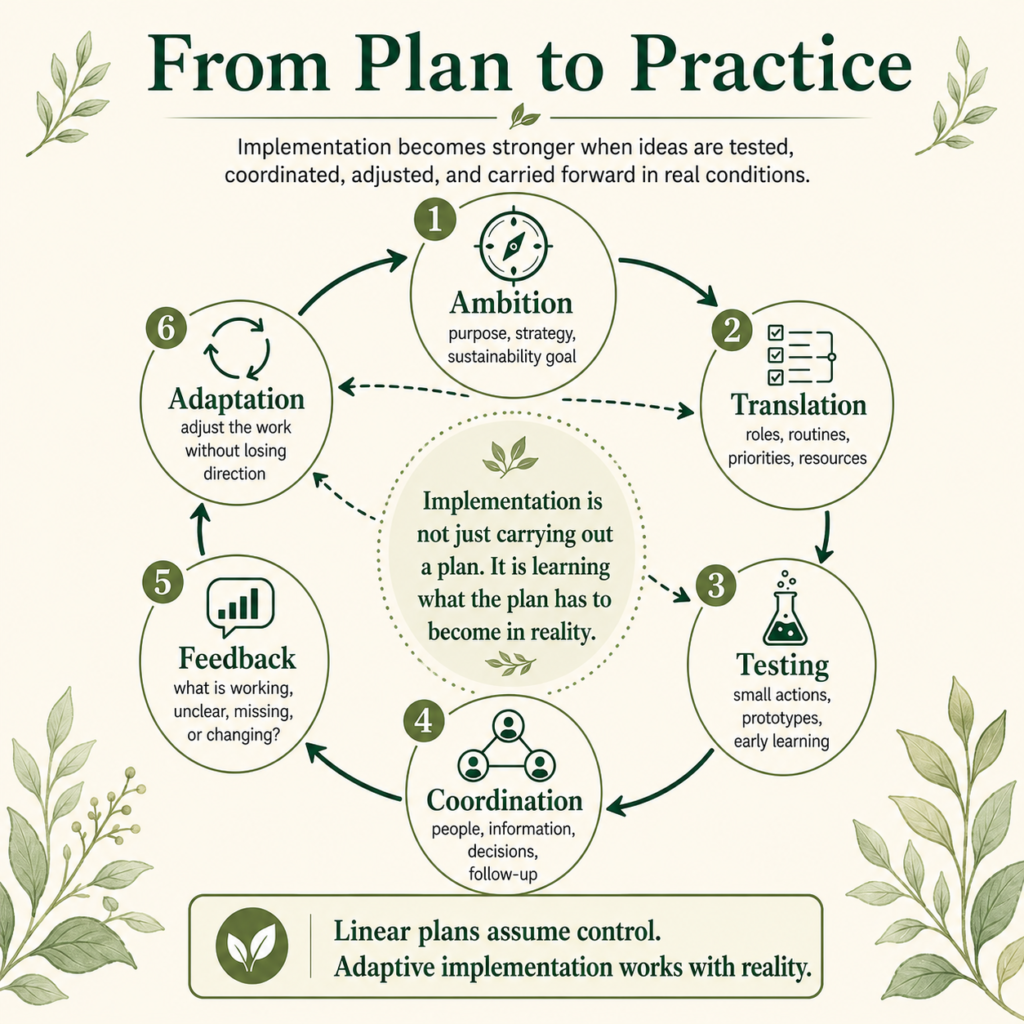
Implementation is not simply the act of following a plan. It is the process of learning what the plan needs to become when it meets reality. This distinction changes how challenges are interpreted. When implementation is understood only as execution, any departure from the original plan can appear to be a failure. Delays suggest poor management. Questions are interpreted as resistance. Adjustments look like a lack of preparation.  But when implementation is treated as a learning process, practical difficulties become sources of information.

A delay may reveal that an important resource is missing.

Resistance may indicate that the purpose has not been made sufficiently clear.

Confusion may point to weak communication or uncertain responsibilities.

A failed test may expose an assumption that should have been examined earlier.

Low participation may reveal that people cannot see how the initiative connects to their work.

A practical obstacle may indicate that the process requires redesign rather than additional pressure. This does not mean abandoning structure whenever a problem appears. It means creating a structure capable of learning. The purpose of implementation is not to defend the original plan against reality. It is to use reality to improve the work without losing sight of its purpose.

Beyond the Linear Plan

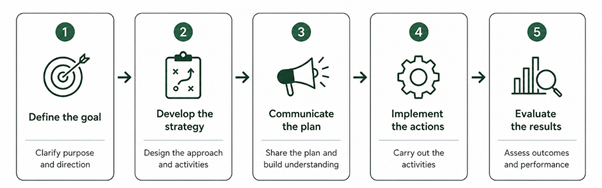
Projects are often organised through a familiar sequence:

This sequence is useful. It creates direction, supports coordination, and helps people organise complex work. The difficulty arises when the sequence is mistaken for a description of how change actually happens.

Real implementation is rarely linear.

People interpret objectives differently. Institutional conditions change. New stakeholders become involved. Resources shift. Unexpected tensions emerge. Some activities work better than anticipated, while others create very little movement. What seemed straightforward during planning often becomes more complex once people begin acting.

A plan can therefore support implementation, but it cannot remove uncertainty.

Problems arise when following the plan becomes more important than learning from the work. A sustainability plan should not become a cage. It should function as a structure for movement. It should help people act, observe, learn, and adjust. It should provide enough direction to prevent fragmentation, but enough flexibility to respond to new information.

This is structured flexibility. Without structure, implementation becomes scattered. Without flexibility, it becomes rigid. Effective implementation requires both.

Translating Ambition into Practice

Sustainability ambitions are often expressed through broad concepts such as transformation, resilience, inclusion, circularity, participation, responsibility, or long-term value. These concepts can provide direction, but they do not automatically explain what people should do differently. Implementation therefore requires translation.

A goal must be translated into roles, routines, decisions, communication, resources, milestones, and follow-up. Without this translation, sustainability remains too abstract to guide everyday action. People may agree with the ambition but remain uncertain about what it means for their own work.

They may support the strategy but not know which decisions need to change.

They may want to contribute but be unable to see where their contribution fits.

They may attend meetings without understanding how the discussion connects to their responsibilities. Implementation becomes more workable when practical questions are answered:

What does this ambition mean in this specific context?

What are we trying to change?

Who is responsible for which part of the work?

What needs to happen first?

What can be tested now?

Which resources are actually available?

What must be postponed, reduced, or removed?

What would meaningful progress look like?

How will we know whether the work is moving in the right direction?

These questions do not make the ambition smaller – they make it possible to act on. A more adaptive understanding of implementation can be represented as a continuing cycle rather than a fixed sequence.

Coordination Is Part of the Change

Implementation depends heavily on coordination, yet coordination is often underestimated. It may be described as administration: arranging meetings, updating documents, sharing information, or keeping track of deadlines. But coordination is more than task management. It is the work of keeping purpose, people, information, resources, decisions, and next steps connected over time.

This is particularly important in sustainability work because projects often cross organisational and professional boundaries. A single initiative may involve different departments, organisations, disciplines, public authorities, businesses, educators, citizens, students, or civil society groups. Each participant may bring a different language, mandate, timescale, and understanding of success. These differences can strengthen a project, but they also create friction.

Without coordination, people may work in parallel without connecting their efforts. Decisions may be made without involving those expected to carry them out. Important information may remain within one part of the system. Responsibility may be assumed rather than clarified. Energy is then lost not because people oppose the project, but because no one is holding the process together. Good coordination maintains coherence.

It keeps the purpose visible.

It clarifies what has been decided.

It shows what has changed.

It makes the next step concrete.

It creates continuity between meetings.

It helps people understand how their contribution connects to the wider direction.

Coordination is often almost invisible when it works well. When it is absent, everyone notices.

Test Before You Scale

One of the most effective ways to strengthen implementation is to test an idea before expanding it. Sustainability projects often carry considerable ambition. People want broad change, long-term impact, and visible results. That ambition is necessary, but it can also create pressure to develop too much too quickly.

A programme may be expanded before anyone knows whether it works under everyday conditions.

A process may be designed in detail before the people affected by it have had an opportunity to respond.

A solution may be presented as finished before its basic assumptions have been tested.

Small-scale testing creates an alternative, showing whether an idea is understandable, relevant, realistic, and workable. It can identify where instructions are unclear, where the process is too demanding, where responsibilities are missing, or where participants see possibilities the designers had not considered.

Testing turns abstract discussion into practical learning. People can respond to something they have experienced rather than something they have only imagined. This also makes participation more meaningful – participants are no longer being asked only whether they support a general ambition. They can contribute to improving a concrete activity, process, or solution.

Testing is not evidence of weak ambition – it is evidence that the project respects reality.

The aim is not to test indefinitely but to learn early enough for the learning to influence what happens next.

Feedback Must Be Built into the Work

Implementation requires feedback throughout the process, not only during the final evaluation. Waiting until the end may produce useful documentation, but it does not necessarily help the people who are still trying to make the project work.

Ongoing feedback connects action with learning.

It allows difficulties to be identified while there is still time to respond. It shows whether people understand the purpose, whether activities are producing movement, and whether the work is creating unintended burdens or exclusions. But feedback must be usable. If it is too vague, people cannot act on it.

If it arrives too late, the opportunity for adjustment may have passed.

If it is collected but never acknowledged, trust declines.

If it focuses only on success, important learning is hidden. Useful implementation feedback asks practical questions:

What is currently working?

What remains unclear?

What is taking more time or energy than expected?

Who is missing from the process?

What are people actually doing differently?

Which barriers are appearing?

What should be adjusted before the next stage?

What should remain unchanged?

These questions help prevent projects from continuing along an ineffective path simply because that path was included in the original plan.

The objective is not constant change – it is intelligent adjustment.

Implementation Also Requires Energy

Structure alone does not move a project forward; implementation also depends on energy.

Energy comes from relevance, ownership, relationships, visible progress, and a shared understanding of why the work matters. Without it, even a well-organised project can become mechanical. People may attend meetings, complete assigned tasks, and follow procedures while becoming progressively less connected to the purpose of the work.

This matters in sustainability projects because the challenges are often complex, long-term, and emotionally demanding. Progress can be difficult to see, and the distance between an individual action and a wider outcome may feel considerable. People therefore need more than instructions – they need to understand why their contribution matters, where progress is possible, and how their work connects to something larger. This does not mean that every project must feel inspiring at every moment. Implementation inevitably involves routine, compromise, and periods of uncertainty. It means that motivation should be treated as a practical condition rather than a personal bonus.

Where is there commitment?

Where is there frustration?

Where is there initiative?

Where is there confusion?

Where is there fatigue?

Where are people already creating movement?

These signals indicate whether the project is genuinely being carried by people or merely being administered around them.

Making Implementation More Workable

This is an important focus in my work through urbanhydro.

I support people and organisations in moving from sustainability ambition towards grounded practice through facilitation, learning design, consultancy, project implementation support, and structured process development. The objective is not to make complex change appear simple. It is to make the work more understandable, coordinated, and workable. That often begins by examining the conditions surrounding implementation:

What are we trying to move from intention into practice?

Which assumptions are built into the current plan?

Who will need to carry the work in their everyday roles?

Which resources are genuinely available?

What should be tested before it is expanded?

Where is stronger coordination required?

What feedback will help guide the next step?

What must remain fixed, and what can be adapted?

These questions allow a project to become more realistic without becoming less ambitious. They help reduce the distance between what is promised and what can actually be carried, maintained, and developed over time.

Where Sustainability Becomes Real

Implementation is not just execution. It is where sustainability work becomes accountable to reality—where ideas encounter people, routines, resources, institutional conditions, competing priorities, and uncertainty. It is where plans must become practices, and where learning must continue after the strategy has been approved.

Effective implementation requires direction without rigidity, planning without the illusion of control, participation without endless openness, and feedback without constant reaction. It depends on coordination, energy, practical translation, and the ability to adapt without losing purpose.

Ideas matter. Strategies matter. Plans matter. But implementation is where we discover whether people can actually carry them forward. Sustainable change does not emerge from forcing reality to conform to a perfect plan. It develops when people have the conditions, relationships, structures, and practical opportunities needed to test, learn, coordinate, adjust, and continue.

That is how ambition becomes practice—and how change begins to take root.

Mitt arbete befinner sig i skärningspunkten mellan hållbarhet, lärande, facilitering och praktiskt genomförande

Så började urbanhydro®

urbanhydro® började med en praktisk fråga: Hur kan hållbara idéer bli mer tillgängliga, meningsfulla och möjliga att arbeta med i vardagen?

Utgångspunkten växte fram ur innovation och entreprenörskap, konceptutveckling, Lean Startup-tänkande, ansvarsfull innovation och tidigt arbete med hållbar odling. Med tiden utvecklades detta till ett bredare fokus på hållbarhet, lärande, facilitering och praktiskt förankrad förändring.

Från praktik till hållbarhet

Innan jag fördjupade mig i utbildning för hållbar utveckling och hållbarhetsledarskap arbetade jag under många år med service, koordinering, drift, utbildning och människonära ledarskap. Den erfarenheten präglar fortfarande mitt sätt att arbeta.

Den lärde mig att idéer får verklig betydelse först när de fungerar i konkreta situationer: med verkliga människor, begränsade resurser, skiftande prioriteringar och vardagens praktiska krav.

Mina studier i International Hospitality Management gav mig ett bredare perspektiv på människor, platser, kommunikation och gemenskap. Genom akademiskt arbete och en kommunikationspraktik hos Visit Skellefteå i norra Sverige arbetade jag med destinationsutveckling, integration av inflyttare, gemenskapsbyggande, hållbar stadsutveckling och kommunikationens roll i att skapa tillhörighet och gemensam riktning.

Utbildning, ledarskap och lärande

Mina masterstudier i Education for Sustainable Development och Leadership for Sustainability förde samman dessa olika spår. De stärkte mitt fokus på systemtänkande, delaktighet, reflexivitet, utbildning för hållbar utveckling, relationell facilitering och organisatorisk förändring.

Genom detta arbete blev jag särskilt intresserad av hur människor och organisationer kan gå från kunskap och ambition till meningsfull, praktiskt förankrad handling.

Det är den bro jag arbetar utifrån i dag: mellan teori och praktik, vision och genomförande, reflektion och handling.

Så arbetar jag i dag

Min ansats är analytisk, relationell och praktisk. Jag hjälper individer, team och organisationer att skapa tydlighet, förstå komplexitet, stärka samarbete och utveckla de förutsättningar som gör förändring möjlig.

Det kan omfatta coaching, workshops, facilitering, rådgivning, projektstöd, hållbarhetskommunikation, digitala lärmaterial och lärandedesign.

Jag arbetar inte med hållbarhet som skuld, perfektion eller abstrakta ideal. Jag ser hållbarhet som en process som präglas av lärande, ansvar, anpassning och praktiskt förankrad handling.

Meningsfull förändring kräver struktur, men inte rigiditet. Den kräver reflektion, men inte handlingsförlamning. Den kräver ambition, men också förmågan att prioritera resurser, justera riktning och hantera osäkerhet.

Kärnan i mitt arbete är en enkel övertygelse: Hållbar utveckling börjar när idéer kopplas samman med människor, praktik, ansvar och de förutsättningar som gör det möjligt för bättre framtider att slå rot.

För mer information, kontakta mig på spc@urbanhydro.dk

urbanhydro® | Lärande, facilitering och praktiskt förankrad hållbar förändring

urbanhydro hjälper människor och organisationer att omsätta hållbarhetsambitioner i praktisk handling. Mitt arbete befinner sig i skärningspunkten mellan hållbarhet, lärande, facilitering och praktiskt genomförande, med fokus på att skapa de förutsättningar som gör ansvarsfullt handlande möjligt under osäkerhet.

Grow Good

Genom coaching, workshops, facilitering, rådgivning och projektstöd hjälper jag människor och organisationer att omsätta hållbarhetsambitioner i praktisk handling.

Det handlar om att skapa utrymme för tydlighet, reflektion, delaktighet och gemensam riktning, samtidigt som visioner, processer, teori och praktiska realiteter balanseras. God utveckling uppstår när lärande, relationer och praktiskt handlande börjar förstärka varandra.

Learn Deep

Verklig förändring kräver mer än information. Den kräver att vi sänker tempot, ser djupare och förstår de system, antaganden, relationer och osäkerheter som formar våra val.

Jag skapar öppna och reflekterande lärmiljöer där individer, team och organisationer kan utforska komplexitet, dela perspektiv och tillsammans utveckla praktiska vägar framåt. Lärandet blir djupare när det sker i samverkan, är förankrat i levda erfarenheter och knyts till de verkligheter där människor arbetar och lever.

Live Life

Hållbarhet måste kunna levas, fungera i praktiken och vara förenlig med vardagens och arbetslivets realiteter. Det handlar inte om skuld eller abstrakta ideal, utan om att utveckla rytmer, relationer, val och projekt som kan hålla över tid.

Genom facilitering, coaching och strategiskt projektstöd hjälper jag till att omsätta intention i handling, handling i framdrift och framdrift i meningsfull förändring.

Min ansats

Jag ser hållbarhet som något mer än miljömedvetenhet, strategi eller individuellt beteende. Hållbarhet formas av de sociala, ekologiska, ekonomiska, relationella och organisatoriska förutsättningar som människor lever och arbetar inom.

Mitt arbete fokuserar på att skapa de förutsättningar som gör ansvarsfullt handlande möjligt: tydlighet, reflektion, delaktighet, gemensam riktning, kapacitet, flexibilitet och praktiskt genomförande.

Det särskilda med min ansats är bron mellan akademiskt arbete inom utbildning för hållbar utveckling och ledarskap, och praktisk erfarenhet av service, koordinering, facilitering, entreprenörskap, kommunikation och projektgenomförande.

Jag arbetar mellan teori och praktik, vision och genomförande, reflektion och handling – inte för att leverera färdiga svar utifrån, utan för att hjälpa människor att utveckla bättre frågor, en tydligare riktning, starkare samarbete och praktiska vägar framåt.

Hållbar utveckling börjar när idéer kopplas samman med människor, praktik, ansvar och de förutsättningar som gör det möjligt för bättre framtider att slå rot.

Vill du utforska hur detta kan stödja ditt arbete, projekt eller din organisation?

Kontakta mig på spc@urbanhydro.dk

Participation Is Not Automatic. It Has to Be Designed.

Meaningful participation requires more than invitations. It requires clarity, facilitation, time, trust, and a genuine connection between people’s contributions and what happens next.

Participation is one of the most frequently used words in sustainability work.

It appears in strategies, projects, workshops, community processes, educational programmes, organisational change initiatives, and public-sector plans. People are invited toParticipation Is Not Automatic. It Has to Be Designed.

Participation has become part of the standard language of sustainability. It appears in strategies, projects, organisational change, education, community processes, and public-sector initiatives. Stakeholders are invited to workshops, employees are asked for input, citizens are consulted, and students or local communities are encouraged to contribute their perspectives.

Yet participation does not happen simply because people have been invited. A meeting, workshop, survey, or consultation can create an opportunity to participate, but none guarantees that participation will be meaningful. People can be present without being heard, consulted without having influence, or asked to contribute after the direction has already been decided. A process may therefore look participatory from the outside while feeling passive or symbolic to the people involved.

Meaningful participation begins when people can understand what is happening, contribute knowledge that matters, influence what remains open, and see how their contribution connects to what happens next. The difference is not only about communication. It is about how the process has been designed.

That distinction matters particularly in sustainability work, where implementation depends on connecting broad ambitions with the knowledge, responsibilities, relationships, and everyday practices of the people expected to carry change forward.

Sustainability challenges rarely belong to one person, profession, organisation, or plan. They cross boundaries between people, places, resources, routines, values, responsibilities, and competing priorities. They also raise practical and ethical questions about what should change, who should act, who carries the costs, who receives the benefits, and whose knowledge matters in deciding what happens next.

Expertise, strategy, and formal leadership remain important, but they are not sufficient on their own. When people affected by change are excluded from making sense of it, the connection between ambition and practice weakens. A strategic objective may appear coherent at organisational level while making little sense in a particular workplace or community. Employees may understand barriers that have not been visible to decision-makers. Citizens may recognise local consequences that a formal plan has missed. Practitioners may know why an apparently simple change will conflict with existing routines, resources, or responsibilities.

Participation creates a way of bringing this situated knowledge into the work before plans become too fixed. It also gives people an opportunity to understand what a sustainability ambition means for their own role and where their contribution can make a difference.

Without that connection, sustainability risks becoming something people are told to implement rather than something they can help interpret, shape, and carry into practice. Participation is therefore not a decorative addition to strategy. It is one of the conditions through which strategy can become workable.

The quality of participation depends less on whether people have been invited than on what becomes possible after they enter the process.

Symbolic participation primarily asks people to react to something that has already been developed. Views may be collected and opinions recorded, but the central direction remains largely unchanged. Meaningful participation creates genuine space for contribution. Experience, disagreement, practical knowledge, uncertainty, and different forms of expertise are allowed to affect how the issue is understood and what happens next.

This does not mean that everybody must decide everything. Participatory processes always have boundaries. Budgets, legal requirements, political decisions, organisational responsibilities, deadlines, and existing commitments may limit what is open for change. Pretending otherwise creates false expectations and eventually weakens trust.

The task is therefore not to maximise openness, but to make the relationship between openness and constraint visible. People need to know what has already been decided, what remains open, where their contribution can have influence, and who ultimately carries responsibility for decisions.

Too little structure can leave participation unfocused. Too much predetermined structure can make it performative. Meaningful participation requires enough direction for people to move together and enough openness for their knowledge to change what the process is able to see.

One of the most common weaknesses in participatory work is inviting people after the decisions that matter most have already been made. A process may still ask for comments or feedback, but the actual space for influence is limited. Participants are being asked to respond to a direction rather than help shape it.

People usually recognise this quickly. When participation repeatedly asks them to confirm, legitimise, or refine decisions that are effectively fixed, trust can weaken. Contributions may become safer and less honest because participants no longer expect them to matter. Resistance may then appear during implementation, not necessarily because people oppose the overall ambition, but because concerns and practical knowledge were not engaged while there was still room to respond.

This is particularly costly in sustainability work because the people closest to implementation often hold knowledge that cannot be produced from a strategy document alone. They know where routines break down, where resources are already stretched, what has failed before, which language makes sense locally, and where motivation, uncertainty, resistance, or practical opportunity actually exist.

Earlier involvement does not eliminate disagreement. It gives disagreement a better chance of becoming useful by allowing tensions, assumptions, and competing needs to become visible while the process is still capable of learning from them.

Inviting people earlier is not enough. Participation does not organise itself.

People enter shared processes with different roles, experiences, expectations, levels of confidence, forms of knowledge, and degrees of power. Some are accustomed to being heard; others are not. Some respond quickly in discussion, while others need time to reflect. Some carry formal authority, while others hold practical or lived knowledge without equivalent institutional influence.

These differences continue to shape the process even when nobody names them. Without facilitation, familiar voices may dominate, uncertainty may be mistaken for resistance, safer ideas may crowd out more difficult insights, and important tensions may remain unspoken. A process can become so tightly controlled that little new knowledge can emerge, or so open that participants struggle to understand what the conversation is for.

Facilitation provides structure for working across these differences. It helps people understand why they are present, what is open to influence, how they can contribute, and what will happen with what emerges. It can also create enough space for disagreement and uncertainty to become informative rather than disruptive.

The purpose is not to make everyone comfortable or eliminate difference. It is to make different forms of knowledge, experience, and responsibility usable within a shared process.

Across these processes, five conditions are particularly important: clarity, time, trust, structure, and influence. They are not independent ingredients or a fixed sequence. They interact and shape what participation can become.

Participation is not automatic. Invitation creates the opportunity, while clarity, time, trust, structure, and influence shape whether participation becomes meaningful and connected to action.

Clarity establishes the boundaries of the process. People need to understand why they are being involved, what is at stake, what they can influence, what has already been decided, who makes the final decision, and what will happen afterwards. Without that clarity, people may contribute without knowing how their input relates to the work.

Time determines whether participation can move beyond immediate reaction. Participants need enough space to understand the issue, connect it to their own experience, encounter other perspectives, and reconsider assumptions. This does not mean that every participatory process has to be long, but meaningful contribution cannot always be produced instantly.

Trust develops when the process is honest about both its possibilities and its limits. It grows when participants can see that their contributions have been treated seriously and when decision-makers explain what changed, what did not, and why. When people repeatedly contribute and never hear what happened afterwards, participation can begin to feel performative.

Structure gives participation a usable form. Open dialogue alone is not a method. Different purposes may require individual reflection, small-group discussion, visual mapping, prioritisation, experimentation, or repeated feedback. The method should help participants engage with the actual issue rather than simply fill the agenda.

Influence connects the other conditions to action. Participants do not need control over every outcome, but there needs to be a credible relationship between contribution and what happens next. Input might change a decision, reveal a neglected issue, reshape a priority, improve implementation, or generate further investigation. Without some meaningful connection to influence, even a well-facilitated process can remain largely symbolic.

Together, these conditions help explain why participation cannot be reduced to attendance or voice. The deeper question is whether a process creates genuine possibilities for people to contribute to shared understanding and action.

Participation is often described as giving people a voice, but voice alone is insufficient. People can speak without being heard, be heard without being taken seriously, or be taken seriously without being able to influence anything.

The deeper issue is agency: the possibility of understanding a situation, recognising where action is possible, relating to others, and contributing to what happens next. Agency does not mean acting alone or assuming individual responsibility for problems created through much larger systems. It is shaped through relationships between people, knowledge, resources, structures, responsibilities, and opportunities to act.

This is particularly important in sustainability, where calls for participation can easily become calls for individual responsibility. People are frequently told that everyone must contribute to sustainable change, yet responsibility without meaningful influence, resources, or support can become burdensome rather than enabling.

Meaningful participation can help make responsibility more specific and shared. People begin to see where their experience matters, how their role relates to the wider issue, what they can influence directly, where they depend on others, and where responsibility sits elsewhere in the system.

Participation therefore does more than collect perspectives. It helps locate agency and responsibility within actual relationships and conditions. That movement from concern to contribution is one of the reasons participation matters.

Participation also has practical value because people close to a situation often recognise constraints, relationships, and possibilities that are difficult to see from a distance. They understand where routines fail, which assumptions are unrealistic, what language creates confusion, and where apparently sensible plans are likely to encounter practical barriers or unintended consequences.

When this knowledge is absent, sustainability initiatives can remain coherent in principle but weak in practice. Strategies may define ambitious goals without establishing the conditions needed to enact them, while technically strong plans can remain disconnected from the routines and relationships through which they must eventually operate.

Participation allows ideas to encounter reality before plans become too fixed. It can reveal dependencies, tensions, overlooked consequences, and practical opportunities while there is still time to adapt. Research on environmental governance suggests that participation can strengthen governance outcomes, but its effects depend considerably on how participation is designed and on the context in which it occurs.

Its value is therefore not that participation guarantees agreement, better outcomes, or the removal of uncertainty. It creates a stronger basis for judgement and action by widening what the process is able to know before decisions become difficult to change.

This is where my work through urbanhydro® is focused: designing and facilitating the space between sustainability ambition and everyday practice so that participation becomes connected to learning, decisions, responsibility, and action.

The work begins by asking who needs to be involved, why their involvement matters, when they should enter the process, and what they can genuinely influence. It also means examining whose knowledge is already present, whose is missing, where formal and informal power sit, what tensions need to become visible, and how contributions will be interpreted and carried forward.

These questions move participation from intention to design. They also make clear why a single workshop rarely constitutes a participatory process on its own.

What happens before a workshop affects who arrives, how prepared they are, and whether they trust the invitation. What happens during it shapes whose knowledge becomes visible, which assumptions can be questioned, and what possibilities emerge. What happens afterwards determines whether participation connects to decisions and action.

Preparation, dialogue, decisions, action, feedback, and adjustment therefore need to remain connected. Without those connections, participation produces moments of involvement. With them, it can contribute to sustained movement and learning.

Participation is not automatic. It has to be intentionally connected to the conditions that allow people to understand what is happening, contribute meaningfully, recognise their influence, and remain involved as action develops.

That requires more than inviting people into a room. It requires clarity about purpose and decision boundaries, sufficient time to understand and reflect, trust that contributions will be treated seriously, structures that allow different forms of knowledge to emerge, and a credible relationship between contribution and influence.

When those conditions are present, participation can do more than increase inclusion. It can make knowledge more situated, responsibility more precise and shared, decisions more realistic, and implementation more adaptive. It can also create the reflexive space needed to notice assumptions, tensions, and consequences that were not visible at the beginning of the process.

Participation does not remove complexity. Its value is that it gives people a way to work with complexity together without pretending that everyone has equal responsibility, equal power, or the same knowledge.

This is why participation should not be treated as a soft addition to the serious work of sustainability. It is part of that work. Sustainable change becomes more possible when the people connected to it can understand the direction, question assumptions, contribute relevant knowledge, influence what remains open, and see how their participation connects to what happens next.

Participation becomes meaningful not simply when people enter the room, but when their presence changes what the room is able to see, understand, decide, and do.

Sources and Further Reading

Arnstein, S. R. (1969). A ladder of citizen participation. Journal of the American Institute of Planners, 35(4), 216–224. doi: 10.1080/01944366908977225.
Foundational source on the distinction between nominal participation and meaningful influence.

Bandura, A. (2001). Social cognitive theory: An agentic perspective. Annual Review of Psychology, 52, 1–26. doi: 10.1146/annurev.psych.52.1.1.
Foundational source for the understanding of agency as situated rather than simply individual action.

Delozier, J. L., & Burbach, M. E. (2021). Boundary spanning: Its role in trust development between stakeholders in integrated water resource management. Current Research in Environmental Sustainability, 3, 100027. doi: 10.1016/j.crsust.2021.100027.

Fudge, M., Alexander, K., Ogier, E., Leith, P., & Haward, M. (2021). A critique of the participation norm in marine governance: Bringing legitimacy into the frame. Environmental Science & Policy, 126, 31–38. doi: 10.1016/j.envsci.2021.09.015.

Carrick, J., Bell, D., Fitzsimmons, C., Gray, T., & Stewart, G. (2023). Principles and practical criteria for effective participatory environmental planning and decision-making. Journal of Environmental Planning and Management, 66(14), 2854–2877. doi: 10.1080/09640568.2022.2086857.

Newig, J., Jager, N. W., Challies, E., & Kochskämper, E. (2023). Does stakeholder participation improve environmental governance? Evidence from a meta-analysis of 305 case studies. Global Environmental Change, 82, 102705. doi: 10.1016/j.gloenvcha.2023.102705.

Wade, B., Bharadwaj, B., Kambo, A., Jensen, M., Witt, K., Weder, F., Phelan, A., & Ashworth, P. (2024). Stakeholder engagement: The role of facilitators and gender in ‘opening up’ conversations and enabling participation. Australasian Journal of Environmental Management. doi: 10.1080/14486563.2023.2298195.

From Ambition to Action: Making Sustainability Work in Real Conditions

Information can explain a problem.

It can describe what is happening, show why it matters, and make visible what would otherwise remain hidden. Information can give us data, facts, warnings, targets, reports, and arguments. In sustainability work, information is necessary. Without it, we cannot understand the scale of climate change, resource use, biodiversity loss, social inequality, or the organisational habits that keep unsustainable practices in place.

But information rarely changes a practice by itself.

Most people already know that sustainability matters. Many people know that climate change is real. Many know that consumption, production, energy, transport, food systems, social conditions, and everyday routines are connected. Many organisations already have sustainability strategies, values, policies, and targets.

Still, knowing is not the same as being able to act.

This is one of the central challenges in sustainability work. We often assume that if people receive better information, clearer facts, stronger warnings, or more convincing arguments, change will follow. Sometimes it does. More often, people return to the same routines, pressures, uncertainties, and systems that shaped their behaviour before.

That does not make information useless.

It means information is only the beginning.

The deeper question is not only what people know. It is how they make sense of what they know, how they connect it to their own situation, and how they find practical ways to act within the conditions they are part of.

That is where learning begins.

When Knowledge Stays Abstract

Sustainability can easily become abstract.

It can become a set of reports, goals, values, frameworks, strategies, or future visions. These may be necessary. They help create direction. They give language to ambition. They make responsibility visible. But they rarely create change if they remain detached from people’s lived experience.

A team may understand a sustainability goal but not know what it means for their daily work.

A student may understand a climate issue but feel powerless in relation to its scale.

A manager may support a new strategy but lack the time, confidence, or organisational structure needed to work differently.

A project group may agree on the importance of sustainability but avoid the difficult conversations about trade-offs, resources, responsibility, or implementation.

In these situations, the problem is not simply a lack of knowledge. The problem is that knowledge has not yet become connected to responsibility, relationships, choices, and action.

Information has entered the room.

But learning has not yet happened.

This matters because abstract sustainability can create a gap between what people say and what people are able to do. An organisation can have ambitious language and still operate through old routines. A project can use strong sustainability concepts and still reproduce familiar patterns. A group can agree that change is needed and still be unsure where to begin.

The challenge is not only to communicate sustainability better.

The challenge is to help people work with it.

Information Is Not the Same as Learning

Information tells people what is happening.

Learning changes how people understand their role in what happens next.

That difference matters.

Information can be delivered. Learning has to be worked through – it requires reflection, dialogue, experience, uncertainty, disagreement, and connection to real situations. It asks people not only to receive knowledge, but to examine assumptions, recognise patterns, understand relationships, and consider what responsible action could look like in practice.

This is why sustainability learning cannot be reduced to awareness.

Awareness may create concern. It may make people care. It may help them recognise that something is wrong. But concern alone does not automatically lead to action. People can be concerned and still feel stuck. They can agree with the problem and still lack direction. They can want change and still be shaped by systems that make change difficult.

Deeper learning helps people move from concern to judgement, from judgement to participation, and from participation to action.

It helps people ask: What does this mean here? What does it mean for us? What are we already doing? What are we avoiding? What choices are actually available? What needs to change in the way we work, decide, organise, or collaborate?

These questions move sustainability from general agreement into situated practice.

Why Slowing Down Can Move Things Forward

In organisations, schools, projects, and communities, there is often pressure to move quickly. People want solutions, plans, deliverables, decisions, and visible progress. That pressure is understandable. Sustainability challenges are urgent, and many people are tired of talking without action.

But when problems are complex, moving too quickly can create weak solutions.

People may solve the wrong problem. They may repeat familiar patterns. They may design actions that look good on paper but do not fit the people, resources, culture, or everyday conditions involved. They may use sustainability language to describe a change that has not really changed the system underneath.

Sometimes the most practical thing is to slow down enough to understand what is really going on. That does not mean overthinking. It means creating enough reflective space to ask better questions before rushing into action.

What assumptions are shaping this problem?

Who is affected but not involved?

What resources are actually available?

What tensions are being avoided?

What makes the current behaviour easier than the desired behaviour?

What would make responsible action more possible?

These questions do not delay change. They improve the quality of action. Action without reflection can reproduce the same system under a new name. But reflection without movement can become paralysis.

The work is to connect the two.

A useful sustainability process does not stop at reflection. It uses reflection to support better action. It helps people see more clearly, decide more responsibly, and move with greater awareness of the conditions they are working within.

Learning as a Shared Process

Sustainability is not only individual. It is relational.

People act within teams, organisations, institutions, cultures, places, routines, expectations, and material conditions. This means learning also has to become shared. It cannot only happen inside one person’s head.

A single person may understand the problem. But if the wider team does not share the language, the direction, or the responsibility, little changes. A leader may want to act differently. But if the organisational routines reward speed, control, and short-term outputs, sustainability remains difficult to practise. A group may care deeply. But without structure, participation, and shared meaning, concern can remain scattered.

People need spaces where different perspectives can meet.

They need to hear how others understand the same situation.

They need to see where their own assumptions are limited.

They need to explore tensions without immediately closing them down.

They need to develop language for complexity that does not make action impossible.

This is where facilitation matters.

Good facilitation is not about controlling a conversation. It is not about forcing agreement or producing quick consensus. It is about creating the conditions where people can think more clearly together.

A facilitated learning space can help people move from scattered concern to shared direction. It can make hidden assumptions visible. It can connect lived experience with wider systems. It can help a group identify what is possible now, what needs to be tested, and what requires further work.

In that sense, facilitation is not separate from sustainability work.

It is one of the ways sustainability becomes possible.

From Passive Understanding to Active Participation

One risk in sustainability communication is that people become passive recipients of problems.

They are told what is wrong.

They are told what should happen.

They are told what they ought to care about.

But if people are not invited into the process of interpretation, decision-making, and action, their role remains weak. They may agree, but not feel ownership. They may listen, but not participate. They may care, but not know where to begin.

Learning becomes deeper when people are invited to participate.

Participation does not mean that everyone decides everything. It does not mean that all perspectives are equally responsible for every decision. It does not remove the need for leadership, expertise, structure, or direction.

Participation means that people are given real opportunities to contribute to meaning, direction, and practice. Their experience is taken seriously. Their questions matter. Their knowledge of everyday conditions becomes part of the process. The process is open enough for insight to emerge, but structured enough for action to follow. This balance is important.

Too much control kills participation.

Too much openness creates confusion.

A good learning process needs both structure and space.

Structure gives direction.

Space allows people to think, connect, and contribute.

When this balance works, people are not simply being informed about sustainability. They are helping shape what sustainability means in practice.

Learning That Leads to Practice

For learning to matter, it has to move somewhere.

Not every workshop needs to end with a full plan. Not every conversation needs to produce immediate transformation. Not every learning process can solve a complex challenge at once. But learning should create movement. It should help people see something more clearly, ask better questions, make a more responsible decision, test a new action, or adjust the way a project is being carried forward.

Practical learning can take many forms.

It can be a workshop where a team maps the conditions shaping a sustainability challenge.

It can be a coaching process where an individual clarifies values, choices, and next steps.

It can be a project session where people identify assumptions, stakeholders, resources, and possible experiments.

It can be a learning design where participants move from experience to reflection, from reflection to insight, and from insight to action.

The point is not to turn every moment into a task. The point is to make learning useful. Useful learning helps people act with more awareness, responsibility, and purpose. It does not promise simple answers to complex problems. It does not pretend that change is easy. But it helps people move from abstract ambition toward grounded action.

That movement matters.

Sustainability cannot remain only a message. It has to become something people can work with, question, translate, practise, and improve over time.

The Practical Work of Facilitation

This is where my work with Urbanhydro is focused.

I create open, reflective learning spaces where individuals, teams, and organisations can explore complexity, share perspectives, and co-create practical ways forward. The aim is not to deliver fixed answers from the outside. It is to support people in developing better questions, clearer direction, stronger collaboration, and actions that fit the realities they work and live within.

This work often begins with simple but important questions.

What do we already know?

What are we assuming?

What are we not seeing?

Who needs to be part of the conversation?

Where is there tension?

Where is there energy?

What would make action easier?

What is one responsible next step?

These questions help turn information into reflection, reflection into shared understanding, and shared understanding into grounded action. They also help avoid one of the common traps in sustainability work: the belief that change happens when the right message is delivered clearly enough.

Messages matter. But people also need time, language, structure, confidence, participation, and practical pathways. They need to understand not only the problem, but their own role within it. They need to see where they have agency, where they depend on others, and where the system itself needs to be questioned.

That is why facilitation is not just a soft addition to sustainability work. It is a practical method for helping people move through complexity without becoming stuck.

A More Workable Understanding of Learning

Real change requires more than information. It requires learning that is reflective, participatory, relational, and connected to lived experience.

It also requires spaces where people can slow down without becoming stuck, and conversations that can hold complexity without making action impossible. This means having the courage to examine assumptions, the discipline to connect insight with practice, and the humility to keep learning as reality responds.

Information can tell us that change is needed. Learning helps us understand how change becomes possible.

That is where the deeper work begins: when sustainability is no longer received as an abstract message, but shaped as a shared practice capable of changing what people actually do.

Good Intentions Do Not Change Systems. The Right Conditions Do.

Why sustainability becomes real only when ambition is connected to everyday conditions

Most sustainability strategies do not fail in the future. They lose strength when they meet everyday work: on Monday morning, during the early shift, in the meeting room, on the shop floor, in the kitchen, in the classroom, on the route, at the service counter, or in the middle of a busy project.

They meet unclear priorities, limited time, stretched resources, old routines, missing information, and decisions in which sustainability matters in principle but not enough to shape what happens next. This is rarely because people do not care. Many people care deeply, and many organisations have strong values, serious ambitions, and teams that genuinely want to work in more responsible, sustainable, and future-oriented ways.

But care alone does not redesign a system. Good intentions can start a conversation, open a door, and create commitment. If the conditions around people remain unchanged, however, most actions will remain unchanged too.

Sustainability therefore cannot be treated only as a question of awareness, motivation, or moral commitment. It must also be understood as a question of structure, relationships, learning, participation, resources, and everyday practice. The central question is not only whether people want change, but whether the conditions around them make change possible.

This is the shift: stop asking only why people are not changing, and start asking what conditions keep producing the same behaviour.

A person may want to act more sustainably. A team may want to work differently. An organisation may want to take greater responsibility. Intention alone will not carry the change if roles are unclear, resources are stretched, decisions are fragmented, and responsibility is spread so widely that no one can act with confidence.

This is where sustainability often becomes too abstract. We speak about transformation, responsibility, values, green transition, and better futures. These concepts matter because they create direction. Unless they are translated into routines, decisions, projects, communication, resource allocation, and follow-up, they remain suspended above the work they are meant to influence.

People may agree with sustainability in principle and still struggle to enact it in practice. That is not necessarily hypocrisy. It often shows that the ambition has not yet been connected to the conditions under which people actually work.

A sustainability goal does not change behaviour by itself. A workshop does not change a culture by itself, and a strategy document does not change an organisation by itself. Change becomes more likely when people understand what the ambition means in their own context, participate in shaping the process, and work within structures that support the desired direction.

Sustainability is often communicated through guilt, urgency, or fear. This can create attention, but attention is not the same as sustained action. When sustainability feels overwhelming, moralising, distant, or impossible to influence, people may become defensive, tired, or quietly resigned. They may still care, but caring becomes heavy because it is not connected to a realistic path forward.

This does not mean responsibility should be softened until it means nothing. It means responsibility must be made workable.

People are more likely to remain engaged when they understand why something matters, feel capable of contributing, and experience that they are not acting alone. Sustainability work therefore has to support purpose, competence, connection, and practical agency. It must help people see possible next steps, not only the scale of the problem.

Responsibility without support becomes burden. Responsibility connected to the right conditions becomes agency.

The conditions that support change are often simple to describe but difficult to establish. They include clearer direction, so people know what matters most when everything cannot be done at once. They include participation, so people are not only informed about change but involved in shaping it. They include realistic awareness of resources, because sustainability work always depends on time, money, knowledge, capacity, energy, and organisational limits.

They also include reflection, because people need space to examine assumptions, habits, and patterns before rushing into familiar solutions. They include feedback, because projects need to be tested, adjusted, and improved as reality responds. They require structured flexibility: enough structure to create direction and coordination, but not so much rigidity that people cannot adapt when conditions change.

Without structure, change fragments. Without flexibility, it becomes rigid. Sustainable implementation requires both.

This is where practical methods matter. Not because one framework contains the answer, but because people often need ways to make change tangible. Sometimes that means starting with a vision and working backwards to the conditions it requires. Sometimes it means understanding the people affected by a problem before designing a response. Sometimes it means testing a limited idea, learning from what happens, and adjusting the next step.

The common thread is that people do not wait for perfect certainty. They begin with what they know, what they have, and what they can learn next. These approaches do not solve sustainability alone, but they help move the conversation from “we should” towards “what can we do next, with what we have, in the situation we are actually in?”

The conditions for lasting change. Sustainable change depends not only on intention, but on the conditions that connect ambition to grounded practice, learning, adaptation, and sustained action.

That movement matters because ambition becomes useful only when it can enter practice.

Sustainability requires more than expert solutions delivered from the outside. People are not passive recipients of change. They are part of the system that must change, and their experience, constraints, knowledge, habits, concerns, and relationships shape what becomes possible.

Participation cannot therefore be decorative. It is not enough to ask for input after the important decisions have already been made. It is not enough to invite people into a room and call it co-creation. Participation has to be designed, facilitated, supported, and connected to real influence.

When participation is meaningful, people can see that their perspective matters. They can understand the trade-offs involved, contribute to direction rather than merely respond to it, and begin to carry the work because they have helped shape it.

That is when learning becomes deeper, responsibility becomes more shared, and action becomes more realistic.

This is where my work through urbanhydro is focused. Through coaching, workshops, facilitation, consultancy, learning design, and implementation support, I help people and organisations connect sustainability ambitions to grounded practice.

The work often begins with practical questions: What are we actually trying to change? What conditions are shaping the problem? Who needs to be involved? What resources are genuinely available? What assumptions are we making? Where is energy already present? What small step could create useful learning? What needs structure, and what needs flexibility?

These questions are not abstract. They help people slow down enough to see the situation more clearly, but not so much that action disappears. Reflection without movement can become paralysis, while action without reflection can reproduce the same patterns under a new name.

The work is to connect reflection and action so that each strengthens the other.

For me, sustainability must be liveable, workable, and connected to the realities of everyday life and work. It is not about guilt or perfection, and it is not only about ideals, strategies, or future visions. It is about developing decisions, relationships, routines, and projects that can be carried, examined, and improved over time.

That requires learning, participation, systems thinking, and practical design. It requires the courage to act before everything is certain and the humility to adjust when reality teaches us something new.

Good intentions may open the door. The right conditions help people walk through it together.

Sustainable change begins when ideas become connected to people, practice, responsibility, and the conditions that allow better futures to take root.

Sources and further reading

Meadows, D. H. (1999). Leverage Points: Places to Intervene in a System. The Sustainability Institute.

Ryan, R. M., & Deci, E. L. (2020). Intrinsic and extrinsic motivation from a self-determination theory perspective: Definitions, theory, practices, and future directions. Contemporary Educational Psychology, 61, 101860.

Deci, E. L., Olafsen, A. H., & Ryan, R. M. (2017). Self-determination theory in work organizations: The state of a science. Annual Review of Organizational Psychology and Organizational Behavior, 4, 19–43.

Durlak, J. A., & DuPre, E. P. (2008). Implementation matters: A review of research on the influence of implementation on program outcomes and the factors affecting implementation. American Journal of Community Psychology, 41(3–4), 327–350.

Wiltsey Stirman, S., Kimberly, J., Cook, N., Calloway, A., Castro, F., & Charns, M. (2012). The sustainability of new programs and innovations: A review of the empirical literature and recommendations for future research. Implementation Science, 7, 17.

United Nations. (2015). Transforming our world: The 2030 Agenda for Sustainable Development.