


Why sustainability needs agency, shared responsibility, and practical capacity
Sustainability often arrives as a burden: a demand to know more, care more, consume better, choose better, work differently, and somehow remain hopeful while facing problems far larger than any one person can solve.
For many people, this creates a difficult tension. They may understand that sustainability matters and genuinely want to act responsibly, yet still struggle to see how their own actions connect to challenges shaped by organisations, institutions, infrastructures, markets, policies, and long histories. The distance between what should change and what seems possible can become overwhelming, and this is often where guilt enters.
Guilt is not necessarily unproductive. It can draw attention to consequences and encourage attempts to repair something we believe we have done wrong. The problem arises when responsibility becomes diffuse moral pressure: when people are made to feel responsible for problems they cannot meaningfully influence, or when concern is disconnected from realistic possibilities for action. Sustainability can then become something people feel they are continually failing at rather than something they can participate in shaping.
The challenge is not to remove responsibility, but to connect it to agency, influence, support, and the conditions that make responsible action possible.
When Responsibility Becomes Too Heavy
Responsibility matters because without it sustainability easily remains a collection of good intentions. Commitments have to connect to decisions, priorities, roles, and consequences if they are to mean anything in practice. The problem is not responsibility itself, but how it is framed, distributed, and supported.
When complex sustainability challenges are reduced primarily to individual choices, responsibility becomes too narrow. When every imperfect decision is treated as evidence of personal failure, moral pressure can become too heavy. And when people are warned about serious consequences without being given meaningful opportunities to influence what happens next, concern becomes disconnected from agency.
The same tension appears inside organisations. Employees may be expected to work sustainably without sufficient time, resources, information, or authority. Teams may be encouraged to innovate while routines continue to reward certainty and short-term efficiency. People may be invited to participate after the important decisions have already been made. Young people may be asked to take responsibility for the future while having limited influence over the institutions shaping it.
In each case, responsibility is presented as a demand without being matched by the capacity to act. Individuals are expected to change while much of the surrounding system remains untouched.
This matters because responsibility is not simply something a person possesses. Whether someone can act responsibly depends partly on what they can understand, influence, decide, access, and sustain within the situation they are part of.
From Blame to Relation and Situated Agency
A more useful understanding of responsibility begins not with blame, but with relation. Instead of asking only who is at fault, we can ask what we are part of, who is affected by our decisions, what relationships shape the situation, and what becomes possible from where we stand.
This shift widens the field of attention. Blame tends to isolate an individual act or failure. A relational perspective asks how people, organisations, resources, routines, histories, expectations, and consequences are connected. It allows individual responsibility to be examined without pretending that individuals act outside the systems that enable and constrain them.
That does not weaken accountability. It makes accountability more precise because people can recognise both their involvement and their limits. They are neither powerless nor solely responsible. They participate in systems that shape what they can do, while also helping reproduce or change those systems through decisions, priorities, routines, relationships, and collective action.
Agency emerges within this relationship between people and their conditions. It is therefore different from heroism. Sustainability is often narrated as though someone must lead, solve the problem, make the right choice, or demonstrate exceptional courage and consistency. Meaningful agency requires something less dramatic but more practical: sufficient understanding, influence, connection, and support for responsible action to become possible.
This matters because sustainability challenges involve uncertainty, trade-offs, competing needs, different timescales, and consequences that may only become visible later. No one has a complete overview, and no one acts from outside the system. Agency is necessarily situated, while many forms of meaningful change depend on people acting with and through others.
The practical questions therefore become: What can I influence from where I am? What can we shape together? What falls within our role and reach? Where are we dependent on others? Where is authority located? What conditions would need to change for better action to become possible?
These questions do not make responsibility smaller. They make it more specific, and specific responsibility is easier to connect to meaningful action than diffuse guilt about everything.
Shared Responsibility Requires Clarity About Power
A systems perspective creates another challenge. If everything is connected, responsibility can become so distributed that no one appears responsible for anything. Shared responsibility must therefore not become avoided responsibility.
Different people and organisations have different forms of influence, obligation, capacity, and power. A student, employee, manager, business owner, supplier, municipality, policymaker, or citizen may all participate in the same sustainability challenge, but they do not participate from equivalent positions. Their resources, mandates, access to decisions, and ability to alter surrounding conditions differ.
A credible approach to shared responsibility has to acknowledge these differences rather than treating responsibility as equal when power is not equal. Responsibility can be distributed across a system while still being differentiated according to position, influence, capacity, and the ability to contribute to change.
This is particularly visible in organisations. A team cannot reasonably be expected to carry a sustainability ambition if leadership provides neither direction nor resources. A manager may have substantial influence within a team while remaining constrained by organisational incentives and budgets. Employees cannot participate meaningfully when the decisions that matter remain inaccessible to them, and projects struggle to sustain responsibility when roles, follow-up, and decision rights remain unclear.
Shared responsibility therefore needs structure. People need to understand what belongs to them, what belongs to others, where responsibilities overlap, and where collective action or structural change is required. Without that clarity, shared responsibility risks becoming a reassuring phrase while responsibility in practice remains concentrated, displaced, or unclear.
From Moral Pressure to Practical Responsibility
Responsibility becomes more useful when it is translated into the situation in which people are expected to act. Instead of relying primarily on broad moral pressure, sustainability work can begin with questions that connect values to choices, relationships, conditions, and consequences.
What are we responsible for here? Who is affected by this decision? What consequences might remain outside our immediate view? Which options are genuinely available? What would make the more responsible option easier to choose? What are we willing to prioritise, and which trade-offs need to be acknowledged? Where can we act now, and where is wider change required?
These questions do not remove complexity. They make complexity possible to engage with. They also reduce the pressure of perfection. If responsibility is treated as purity, people and organisations will inevitably fail because sustainability work takes place inside systems filled with contradictions. A responsible decision may still create costs elsewhere. A promising solution may generate unforeseen effects, while progress in one area may expose limitations in another.
The goal is therefore not to become pure or contradiction-free. It is to become more responsive, reflective, and capable of acting responsibly within complexity. Responsibility becomes less like a permanent moral identity and more like a practice that is interpreted, tested, learned, adjusted, and carried with others over time.
Capacity and Conditions Shape What Becomes Possible
This is where the distinction between moral pressure and practical capacity becomes important. Moral pressure directs attention towards what people should do. Capacity asks what has to be present or strengthened for responsible action to become possible and continue.
People may need clearer information, more time, better coordination, a meaningful role in decisions, practical tools, support from leadership, a shared language, or a smaller first step that allows learning to begin. They may also need evidence that their effort connects to something larger and that responsibility is not simply being transferred to them while others retain the meaningful power to decide.
Looking at capacity shifts sustainability from accusation towards design. It does not excuse inaction. Instead, it asks what currently enables or constrains action and what could realistically be changed.
People act within organisational cultures, rules, technologies, routines, budgets, hierarchies, incentives, relationships, and time pressures. These conditions shape which actions are easy, difficult, rewarded, ignored, or discouraged. A workplace can encourage sustainable behaviour while maintaining procurement systems that make it difficult. An organisation can invite participation while giving employees no time to participate. A municipality can call for citizen responsibility while providing unclear information or limited access to decisions.
In situations like these, lack of action cannot be explained only as a lack of motivation or care. The surrounding conditions are part of the explanation. Motivation and agency matter, but they interact with the environments in which people are expected to exercise them.
Responsibility therefore has to connect to roles, processes, relationships, and structures. Supportive conditions do not guarantee responsible action, but they can make it easier to understand, attempt, coordinate, learn from, and sustain.
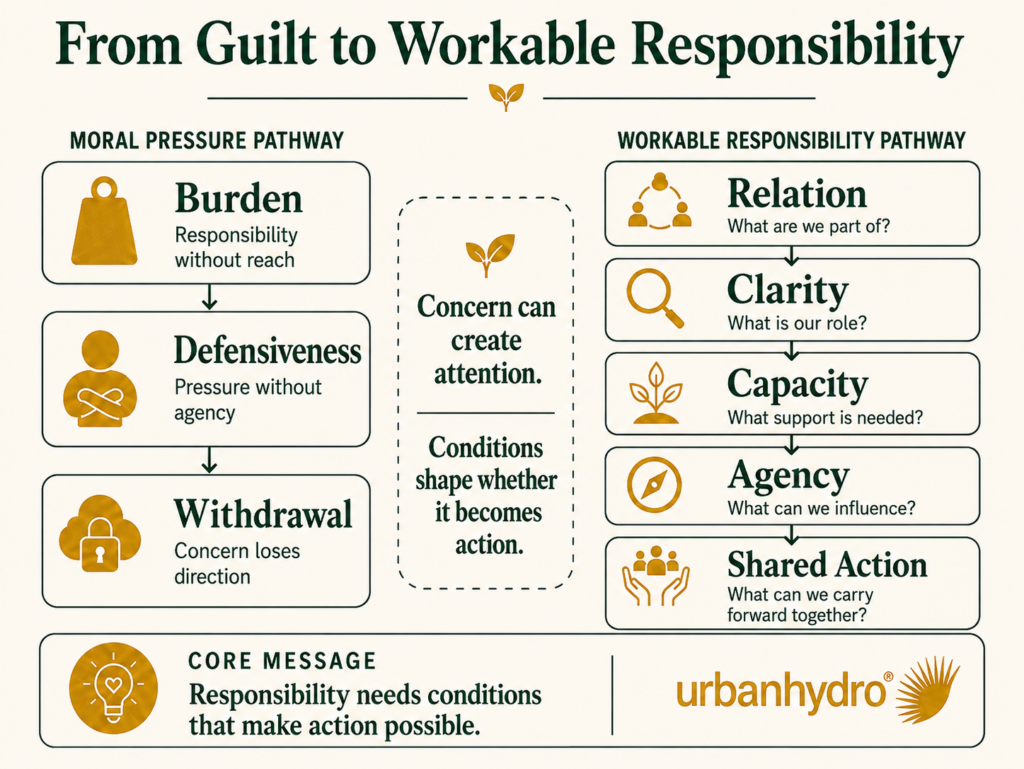
From moral pressure to workable responsibility. Responsibility becomes more actionable when concern is connected to relation, clarity, capacity, agency, and shared action. The pathways illustrate a shift in conditions rather than a fixed sequence of steps.
Responsibility Develops Through Learning
Even where conditions are supportive, responsible action rarely begins with perfect clarity. People learn through experience, dialogue, mistakes, feedback, and adjustment. They discover what matters partly by acting and observing what their actions produce.
This learning dimension is particularly important in sustainability because consequences are often indirect, relational, and delayed. A choice that appears efficient in one part of a system may create pressure elsewhere. A solution may reduce one problem while intensifying another. A participatory process may appear inclusive while leaving important voices outside the room. A strategy may be technically sound but fail because people lack the mandate or practical conditions required to enact it.
Responsibility therefore also requires reflexivity: attention not only to what we intend to do, but to how our assumptions, positions, decisions, and actions interact with wider relationships and consequences. This means remaining open to feedback, noticing unintended effects, questioning what a plan may have overlooked, and adjusting direction when reality reveals something different.
Reflexivity should not become endless self-criticism or another demand for individual perfection. Its practical purpose is to keep action responsive. People and organisations need enough stability to act, but enough openness to learn when experience challenges their original understanding.
The same distinction helps separate accountability from blame. Blame tends to narrow attention towards who should carry fault or shame. Accountability asks who needs to respond, what consequences need to be addressed, what can be repaired, and how future practice should change. It connects action to consequence, role, authority, and learning.
An organisation can acknowledge harm while examining the structures that contributed to it. A leader can accept responsibility without pretending to control every condition. A team can identify failure without treating learning as incompetence, and individuals can recognise their own contribution without assuming responsibility for an entire system.
Accountability remains essential. Its value increases when acknowledging what happened contributes to changed practice rather than ending with blame.
The Practical Work of Responsibility
This is an important focus in my work through urbanhydro®. I work in the space between sustainability ambition and everyday practice, where responsibility has to become understandable and actionable rather than remain an abstract expectation.
The starting point is not an assumption that people simply need stronger motivation. It is to examine the situation in which action is expected: what people are already carrying, where influence actually lies, which decisions shape the current conditions, who needs to be involved, where responsibility is unclear, and what forms of support, participation, learning, or coordination are missing.
This means paying attention to frustration and resistance rather than automatically interpreting them as unwillingness. They may point towards unclear roles, insufficient influence, conflicting demands, lack of trust, unrealistic expectations, or organisational conditions that make the desired action difficult to sustain. Understanding those conditions does not remove responsibility; it helps locate where responsibility can be exercised and where the surrounding system also needs attention.
The practical task is to connect what people can influence with what they are responsible for, how their actions affect others, and what needs to be learned as consequences become visible. Organisations, in turn, need to examine whether the conditions around people make responsible action realistic.
This moves responsibility from broad pressure towards practical possibility. People can begin to see what they can act on directly, where they need others, what requires negotiation, and where structures, routines, or decision-making processes need to change.
The purpose is not to make sustainability comfortable or remove its ethical demands. It is to create conditions in which people can remain engaged with difficult questions long enough to understand, act, learn, and carry change forward.
A More Workable Understanding of Responsibility
Sustainability needs responsibility, but responsibility cannot be sustained by moral pressure alone. It requires relation, clarity, meaningful influence, supportive conditions, shared direction, and opportunities to learn from what action produces.
Responsibility without guilt is therefore not responsibility without seriousness. Nor does it mean that guilt is always inappropriate or that accountability should be softened. It means refusing to treat guilt as the primary mechanism through which responsible action is expected to emerge.
A more practical approach asks people and organisations to understand where they stand within a wider system, what consequences they contribute to, what lies within their influence, what obligations follow from their position, and where they need to act with others. It also recognises that these responsibilities are not distributed equally because authority, resources, capacity, and power are not distributed equally.
This leaves room for uncertainty without turning uncertainty into an excuse for inaction. Responsible action does not require knowing everything before acting, but it does require remaining attentive to relationships, assumptions, consequences, and what experience reveals.
Agency, responsibility, relationality, and reflexivity come together here. People need the possibility to act, clarity about what is theirs to carry, awareness of the relationships in which their actions take place, and the capacity to learn from what those actions produce. Separating these dimensions makes responsibility either too individual, too abstract, or too static.
Guilt may sometimes draw attention to something that matters. Sustainable responsibility requires something more durable: the capacity to locate ourselves within a situation, recognise what we can influence, take responsibility for what is ours to carry, remain responsive to consequences, and strengthen the conditions that allow responsible action to become shared and sustained.
That is where responsibility becomes workable—and where sustainability can move from moral pressure towards practice.
Sources and Further Reading
Bandura, A. (2001). Social cognitive theory: An agentic perspective. Annual Review of Psychology, 52, 1–26. https://doi.org/10.1146/annurev.psych.52.1.1
Deci, E. L., & Ryan, R. M. (2000). The “what” and “why” of goal pursuits: Human needs and the self-determination of behavior. Psychological Inquiry, 11(4), 227–268. https://doi.org/10.1207/S15327965PLI1104_01
Deci, E. L., Olafsen, A. H., & Ryan, R. M. (2017). Self-determination theory in work organizations: The state of a science. Annual Review of Organizational Psychology and Organizational Behavior, 4, 19–43. https://doi.org/10.1146/annurev-orgpsych-032516-113108
Ryan, R. M., & Deci, E. L. (2020). Intrinsic and extrinsic motivation from a self-determination theory perspective: Definitions, theory, practices, and future directions. Contemporary Educational Psychology, 61, 101860. https://doi.org/10.1016/j.cedpsych.2020.101860
Tangney, J. P., Stuewig, J., & Mashek, D. J. (2007). Moral emotions and moral behavior. Annual Review of Psychology, 58, 345–372. https://doi.org/10.1146/annurev.psych.56.091103.070145
Wiltsey Stirman, S., Kimberly, J., Cook, N., Calloway, A., Castro, F., & Charns, M. (2012). The sustainability of new programs and innovations: A review of the empirical literature and recommendations for future research. Implementation Science, 7, 17. https://doi.org/10.1186/1748-5908-7-17
Young, I. M. (2006). Responsibility and global justice: A social connection model. Social Philosophy and Policy, 23(1), 102–130. https://doi.org/10.1017/S0265052506060043