


Meaningful participation requires more than invitations. It requires clarity, facilitation, time, trust, and a genuine connection between people’s contributions and what happens next.
Participation is one of the most frequently used words in sustainability work.
It appears in strategies, projects, workshops, community processes, educational programmes, organisational change initiatives, and public-sector plans. People are invited toParticipation Is Not Automatic. It Has to Be Designed.
Meaningful participation requires clarity, time, trust, structure, and influence.
Participation has become part of the standard language of sustainability. It appears in strategies, projects, organisational change, education, community processes, and public-sector initiatives. Stakeholders are invited to workshops, employees are asked for input, citizens are consulted, and students or local communities are encouraged to contribute their perspectives.
Yet participation does not happen simply because people have been invited. A meeting, workshop, survey, or consultation can create an opportunity to participate, but none guarantees that participation will be meaningful. People can be present without being heard, consulted without having influence, or asked to contribute after the direction has already been decided. A process may therefore look participatory from the outside while feeling passive or symbolic to the people involved.
Meaningful participation begins when people can understand what is happening, contribute knowledge that matters, influence what remains open, and see how their contribution connects to what happens next. The difference is not only about communication. It is about how the process has been designed.
That distinction matters particularly in sustainability work, where implementation depends on connecting broad ambitions with the knowledge, responsibilities, relationships, and everyday practices of the people expected to carry change forward.
Why Participation Matters
Sustainability challenges rarely belong to one person, profession, organisation, or plan. They cross boundaries between people, places, resources, routines, values, responsibilities, and competing priorities. They also raise practical and ethical questions about what should change, who should act, who carries the costs, who receives the benefits, and whose knowledge matters in deciding what happens next.
Expertise, strategy, and formal leadership remain important, but they are not sufficient on their own. When people affected by change are excluded from making sense of it, the connection between ambition and practice weakens. A strategic objective may appear coherent at organisational level while making little sense in a particular workplace or community. Employees may understand barriers that have not been visible to decision-makers. Citizens may recognise local consequences that a formal plan has missed. Practitioners may know why an apparently simple change will conflict with existing routines, resources, or responsibilities.
Participation creates a way of bringing this situated knowledge into the work before plans become too fixed. It also gives people an opportunity to understand what a sustainability ambition means for their own role and where their contribution can make a difference.
Without that connection, sustainability risks becoming something people are told to implement rather than something they can help interpret, shape, and carry into practice. Participation is therefore not a decorative addition to strategy. It is one of the conditions through which strategy can become workable.
From Invitation to Influence
The quality of participation depends less on whether people have been invited than on what becomes possible after they enter the process.
Symbolic participation primarily asks people to react to something that has already been developed. Views may be collected and opinions recorded, but the central direction remains largely unchanged. Meaningful participation creates genuine space for contribution. Experience, disagreement, practical knowledge, uncertainty, and different forms of expertise are allowed to affect how the issue is understood and what happens next.
This does not mean that everybody must decide everything. Participatory processes always have boundaries. Budgets, legal requirements, political decisions, organisational responsibilities, deadlines, and existing commitments may limit what is open for change. Pretending otherwise creates false expectations and eventually weakens trust.
The task is therefore not to maximise openness, but to make the relationship between openness and constraint visible. People need to know what has already been decided, what remains open, where their contribution can have influence, and who ultimately carries responsibility for decisions.
Too little structure can leave participation unfocused. Too much predetermined structure can make it performative. Meaningful participation requires enough direction for people to move together and enough openness for their knowledge to change what the process is able to see.
Timing Changes What Participation Can Do
One of the most common weaknesses in participatory work is inviting people after the decisions that matter most have already been made. A process may still ask for comments or feedback, but the actual space for influence is limited. Participants are being asked to respond to a direction rather than help shape it.
People usually recognise this quickly. When participation repeatedly asks them to confirm, legitimise, or refine decisions that are effectively fixed, trust can weaken. Contributions may become safer and less honest because participants no longer expect them to matter. Resistance may then appear during implementation, not necessarily because people oppose the overall ambition, but because concerns and practical knowledge were not engaged while there was still room to respond.
This is particularly costly in sustainability work because the people closest to implementation often hold knowledge that cannot be produced from a strategy document alone. They know where routines break down, where resources are already stretched, what has failed before, which language makes sense locally, and where motivation, uncertainty, resistance, or practical opportunity actually exist.
Earlier involvement does not eliminate disagreement. It gives disagreement a better chance of becoming useful by allowing tensions, assumptions, and competing needs to become visible while the process is still capable of learning from them.
Participation Has to Be Facilitated
Inviting people earlier is not enough. Participation does not organise itself.
People enter shared processes with different roles, experiences, expectations, levels of confidence, forms of knowledge, and degrees of power. Some are accustomed to being heard; others are not. Some respond quickly in discussion, while others need time to reflect. Some carry formal authority, while others hold practical or lived knowledge without equivalent institutional influence.
These differences continue to shape the process even when nobody names them. Without facilitation, familiar voices may dominate, uncertainty may be mistaken for resistance, safer ideas may crowd out more difficult insights, and important tensions may remain unspoken. A process can become so tightly controlled that little new knowledge can emerge, or so open that participants struggle to understand what the conversation is for.
Facilitation provides structure for working across these differences. It helps people understand why they are present, what is open to influence, how they can contribute, and what will happen with what emerges. It can also create enough space for disagreement and uncertainty to become informative rather than disruptive.
The purpose is not to make everyone comfortable or eliminate difference. It is to make different forms of knowledge, experience, and responsibility usable within a shared process.
Five Conditions for Meaningful Participation
Across these processes, five conditions are particularly important: clarity, time, trust, structure, and influence. They are not independent ingredients or a fixed sequence. They interact and shape what participation can become.
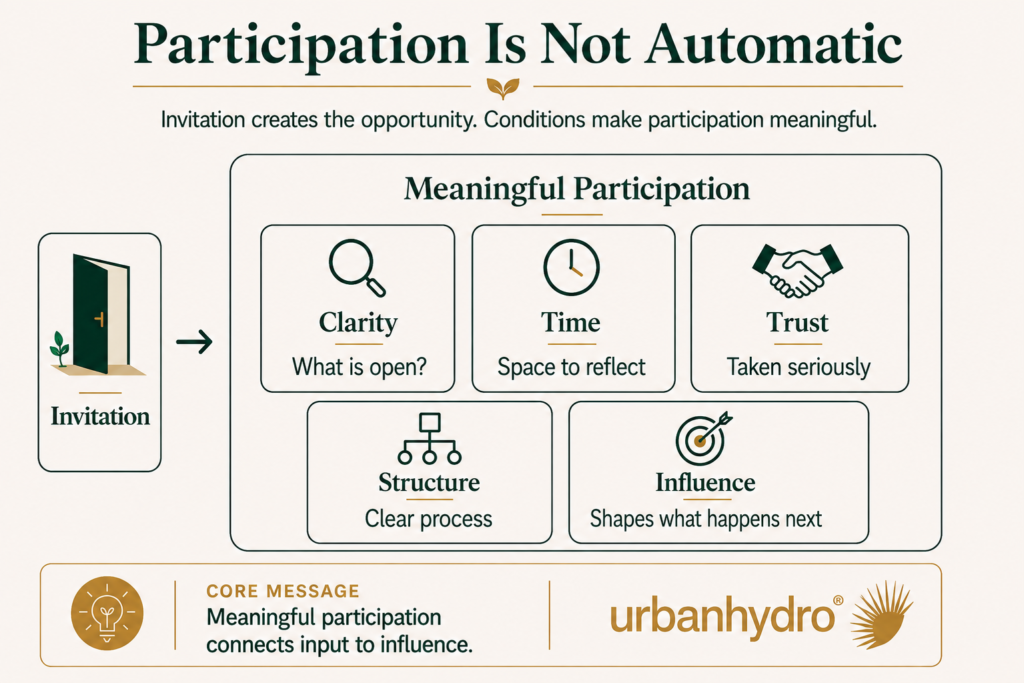
Participation is not automatic. Invitation creates the opportunity, while clarity, time, trust, structure, and influence shape whether participation becomes meaningful and connected to action.
Clarity establishes the boundaries of the process. People need to understand why they are being involved, what is at stake, what they can influence, what has already been decided, who makes the final decision, and what will happen afterwards. Without that clarity, people may contribute without knowing how their input relates to the work.
Time determines whether participation can move beyond immediate reaction. Participants need enough space to understand the issue, connect it to their own experience, encounter other perspectives, and reconsider assumptions. This does not mean that every participatory process has to be long, but meaningful contribution cannot always be produced instantly.
Trust develops when the process is honest about both its possibilities and its limits. It grows when participants can see that their contributions have been treated seriously and when decision-makers explain what changed, what did not, and why. When people repeatedly contribute and never hear what happened afterwards, participation can begin to feel performative.
Structure gives participation a usable form. Open dialogue alone is not a method. Different purposes may require individual reflection, small-group discussion, visual mapping, prioritisation, experimentation, or repeated feedback. The method should help participants engage with the actual issue rather than simply fill the agenda.
Influence connects the other conditions to action. Participants do not need control over every outcome, but there needs to be a credible relationship between contribution and what happens next. Input might change a decision, reveal a neglected issue, reshape a priority, improve implementation, or generate further investigation. Without some meaningful connection to influence, even a well-facilitated process can remain largely symbolic.
Together, these conditions help explain why participation cannot be reduced to attendance or voice. The deeper question is whether a process creates genuine possibilities for people to contribute to shared understanding and action.
From Voice to Agency
Participation is often described as giving people a voice, but voice alone is insufficient. People can speak without being heard, be heard without being taken seriously, or be taken seriously without being able to influence anything.
The deeper issue is agency: the possibility of understanding a situation, recognising where action is possible, relating to others, and contributing to what happens next. Agency does not mean acting alone or assuming individual responsibility for problems created through much larger systems. It is shaped through relationships between people, knowledge, resources, structures, responsibilities, and opportunities to act.
This is particularly important in sustainability, where calls for participation can easily become calls for individual responsibility. People are frequently told that everyone must contribute to sustainable change, yet responsibility without meaningful influence, resources, or support can become burdensome rather than enabling.
Meaningful participation can help make responsibility more specific and shared. People begin to see where their experience matters, how their role relates to the wider issue, what they can influence directly, where they depend on others, and where responsibility sits elsewhere in the system.
Participation therefore does more than collect perspectives. It helps locate agency and responsibility within actual relationships and conditions. That movement from concern to contribution is one of the reasons participation matters.
Participation Can Strengthen Decisions
Participation also has practical value because people close to a situation often recognise constraints, relationships, and possibilities that are difficult to see from a distance. They understand where routines fail, which assumptions are unrealistic, what language creates confusion, and where apparently sensible plans are likely to encounter practical barriers or unintended consequences.
When this knowledge is absent, sustainability initiatives can remain coherent in principle but weak in practice. Strategies may define ambitious goals without establishing the conditions needed to enact them, while technically strong plans can remain disconnected from the routines and relationships through which they must eventually operate.
Participation allows ideas to encounter reality before plans become too fixed. It can reveal dependencies, tensions, overlooked consequences, and practical opportunities while there is still time to adapt. Research on environmental governance suggests that participation can strengthen governance outcomes, but its effects depend considerably on how participation is designed and on the context in which it occurs.
Its value is therefore not that participation guarantees agreement, better outcomes, or the removal of uncertainty. It creates a stronger basis for judgement and action by widening what the process is able to know before decisions become difficult to change.
Participation Is a Process, Not an Event
This is where my work through urbanhydro® is focused: designing and facilitating the space between sustainability ambition and everyday practice so that participation becomes connected to learning, decisions, responsibility, and action.
The work begins by asking who needs to be involved, why their involvement matters, when they should enter the process, and what they can genuinely influence. It also means examining whose knowledge is already present, whose is missing, where formal and informal power sit, what tensions need to become visible, and how contributions will be interpreted and carried forward.
These questions move participation from intention to design. They also make clear why a single workshop rarely constitutes a participatory process on its own.
What happens before a workshop affects who arrives, how prepared they are, and whether they trust the invitation. What happens during it shapes whose knowledge becomes visible, which assumptions can be questioned, and what possibilities emerge. What happens afterwards determines whether participation connects to decisions and action.
Preparation, dialogue, decisions, action, feedback, and adjustment therefore need to remain connected. Without those connections, participation produces moments of involvement. With them, it can contribute to sustained movement and learning.
Designing Participation for Sustainable Change
Participation is not automatic. It has to be intentionally connected to the conditions that allow people to understand what is happening, contribute meaningfully, recognise their influence, and remain involved as action develops.
That requires more than inviting people into a room. It requires clarity about purpose and decision boundaries, sufficient time to understand and reflect, trust that contributions will be treated seriously, structures that allow different forms of knowledge to emerge, and a credible relationship between contribution and influence.
When those conditions are present, participation can do more than increase inclusion. It can make knowledge more situated, responsibility more precise and shared, decisions more realistic, and implementation more adaptive. It can also create the reflexive space needed to notice assumptions, tensions, and consequences that were not visible at the beginning of the process.
Participation does not remove complexity. Its value is that it gives people a way to work with complexity together without pretending that everyone has equal responsibility, equal power, or the same knowledge.
This is why participation should not be treated as a soft addition to the serious work of sustainability. It is part of that work. Sustainable change becomes more possible when the people connected to it can understand the direction, question assumptions, contribute relevant knowledge, influence what remains open, and see how their participation connects to what happens next.
Participation becomes meaningful not simply when people enter the room, but when their presence changes what the room is able to see, understand, decide, and do.
Sources and Further Reading
Arnstein, S. R. (1969). A ladder of citizen participation. Journal of the American Institute of Planners, 35(4), 216–224. doi: 10.1080/01944366908977225.
Foundational source on the distinction between nominal participation and meaningful influence.
Bandura, A. (2001). Social cognitive theory: An agentic perspective. Annual Review of Psychology, 52, 1–26. doi: 10.1146/annurev.psych.52.1.1.
Foundational source for the understanding of agency as situated rather than simply individual action.
Delozier, J. L., & Burbach, M. E. (2021). Boundary spanning: Its role in trust development between stakeholders in integrated water resource management. Current Research in Environmental Sustainability, 3, 100027. doi: 10.1016/j.crsust.2021.100027.
Fudge, M., Alexander, K., Ogier, E., Leith, P., & Haward, M. (2021). A critique of the participation norm in marine governance: Bringing legitimacy into the frame. Environmental Science & Policy, 126, 31–38. doi: 10.1016/j.envsci.2021.09.015.
Carrick, J., Bell, D., Fitzsimmons, C., Gray, T., & Stewart, G. (2023). Principles and practical criteria for effective participatory environmental planning and decision-making. Journal of Environmental Planning and Management, 66(14), 2854–2877. doi: 10.1080/09640568.2022.2086857.
Newig, J., Jager, N. W., Challies, E., & Kochskämper, E. (2023). Does stakeholder participation improve environmental governance? Evidence from a meta-analysis of 305 case studies. Global Environmental Change, 82, 102705. doi: 10.1016/j.gloenvcha.2023.102705.
Wade, B., Bharadwaj, B., Kambo, A., Jensen, M., Witt, K., Weder, F., Phelan, A., & Ashworth, P. (2024). Stakeholder engagement: The role of facilitators and gender in ‘opening up’ conversations and enabling participation. Australasian Journal of Environmental Management. doi: 10.1080/14486563.2023.2298195.