

Leadership Is Not Always a Role

Leadership is often treated as a position: a title, a function, or a person at the front of the room who sets direction, makes decisions, communicates the plan, and carries responsibility for change. Sometimes leadership does look like that. Formal authority matters, particularly when priorities must be set, resources allocated, and difficult decisions made.

In sustainability work, however, much of the leadership that determines whether change can continue is less visible. It appears in how conversations are held, tensions are named, roles are clarified, participation is supported, and practical next steps are made possible. It is present when someone connects people who are working in parallel, translates an abstract ambition into everyday work, or creates enough clarity for others to act responsibly.

Leadership is therefore not only about being in charge. It is also about helping a system become more capable of responsible action. That distinction matters because sustainability challenges rarely yield to one leader, one department, one strategy, or one decision. They require learning, coordination, trust, participation, implementation, and adjustment over time. In that kind of work, leadership becomes more than authority. It becomes practice.

Sustainability is frequently framed as a leadership challenge, followed by a call for visionary, bold, and courageous leaders who can drive transformation and inspire others to change. There is truth in this framing. Direction, courage, and responsibility matter, and people in formal leadership positions have real power to open or close possibilities for change.

The heroic image becomes problematic when sustainability appears to depend on exceptional individuals with the right vision, charisma, or answer. It can obscure the quieter work that allows change to continue after the first speech, workshop, strategy, or decision. Most sustainability work is not carried by heroic moments but by repeated, relational, and practical efforts: keeping people connected, translating ambition into action, making participation meaningful, holding direction while allowing adaptation, noticing when energy is fading, bringing missing voices into the room, and making responsibility clearer and more shared.

This work is often difficult to see because it is distributed across roles and embedded in everyday practice. Yet without it, strategies lose contact with implementation, participation becomes symbolic, and initial energy dissipates. The visible decision may begin a process, but the less visible leadership work determines whether it can hold.

If leadership is understood as practice as well as position, the central question changes. Instead of asking only, “Who is leading this?”, we can also ask, “What leadership work is needed here?” The second question opens a wider field because it directs attention to what the situation requires rather than assuming that leadership belongs to one person.

At one moment, the work may involve setting a clear direction. At another, it may mean slowing down a process that is moving too quickly, involving people earlier, clarifying where influence lies, or protecting time for reflection. It may require translating abstract goals into practical routines, coordinating across organisational boundaries, or helping people remain with complexity instead of escaping into simple answers.

This does not make formal leadership less important. It makes leadership more precise. The issue is not merely whether someone occupies a leadership role, but whether the necessary leadership work is being performed, supported, and connected. Nor does a broader view of leadership dissolve differences in power or formal responsibility. Those with authority still carry particular obligations because they can allocate resources, establish mandates, and alter the conditions under which others are expected to act. Leadership becomes less about controlling change from above and more about strengthening the conditions that allow people to move with purpose, responsibility, and direction.

A relational and facilitative understanding of leadership should not be confused with vagueness. Participation does not mean endless openness, and facilitation does not mean avoiding decisions. Sustainability work still needs direction. People need to understand what matters, why it matters, what is fixed, what remains open, and what the work is moving towards. Without sufficient direction, participation can become scattered, reflection circular, and implementation disconnected.

The point is not to remove direction but to make it liveable, workable, and connected to the people who must carry it. A sustainability strategy may define a goal, but people still need to interpret what that goal means for their work. A project may have a clear purpose, but participants need to know how their contribution matters. A team may agree that change is necessary while still requiring support to prioritise, coordinate, and act.

Good leadership therefore holds direction without pretending that the path is fully known. It creates enough clarity to move and enough flexibility to learn. Too little direction creates confusion; too much control can remove ownership and suppress relevant knowledge. Much of sustainability leadership takes place in the ongoing work between these two risks.

Much of the leadership needed for sustainability is practical rather than dramatic. It can be seen in the person who notices that a project has energy but no follow-up, the facilitator who makes space for quieter voices, the coordinator who connects people working in parallel, or the manager who protects time for learning before demanding results. It also appears when a teacher turns concern into inquiry rather than fear, a project lead questions the assumptions built into a plan, a team member articulates a tension everyone can feel, or an organisation changes routines so responsible action becomes easier to repeat.

These actions may not resemble leadership in the traditional sense, yet they shape what becomes possible. They influence whether people feel included or ignored, whether responsibility is clear or diffuse, whether a project gains momentum or loses direction, and whether sustainability remains abstract or becomes part of practice. Leadership should therefore not be understood only as personality, authority, or individual influence. It should also be understood as the work that helps people act together under conditions of uncertainty.

The following practices—translation, facilitation, coordination, and capacity-building—are not separate leadership types or a checklist to be completed in sequence. They are interconnected forms of work. Translation can reveal the need for participation; facilitation can expose a coordination problem; coordination can show where people lack mandate, time, knowledge, or support. Together, they help make the conditions for responsible action visible and workable.
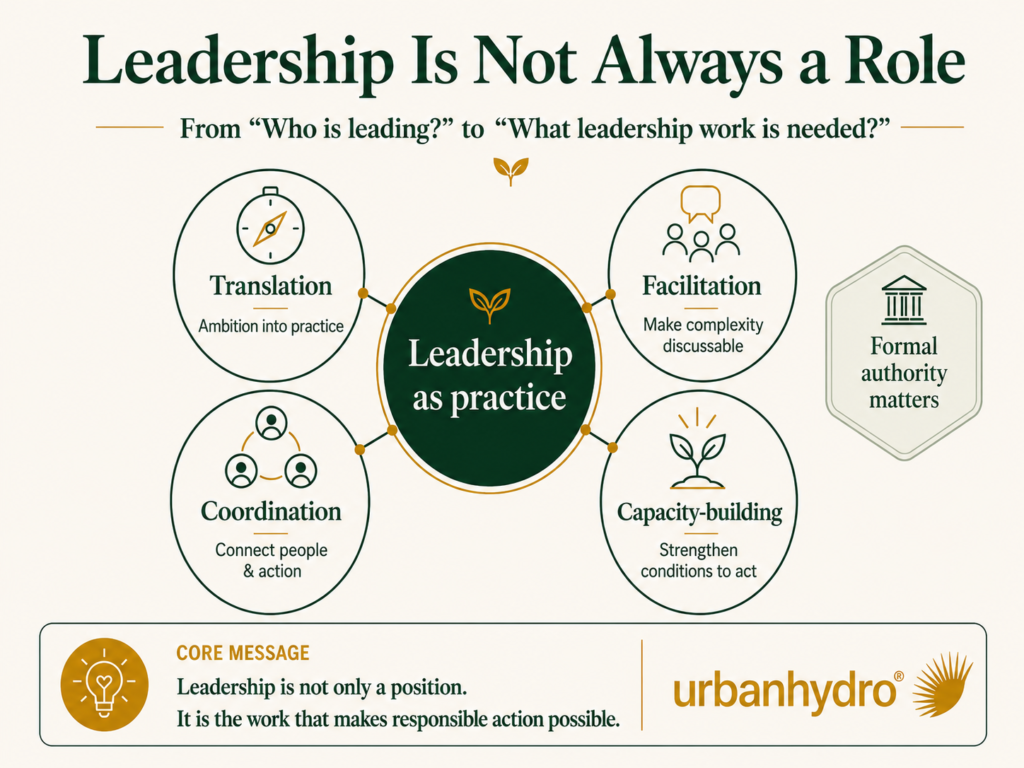
Leadership as practice. Formal authority remains important, but sustainability leadership also takes shape through translation, facilitation, coordination, and capacity-building – the practical work that strengthens conditions for responsible action.

One of the most important forms of sustainability leadership is translation—not primarily between languages, but between levels of reality. Sustainability leadership connects vision with everyday work, strategy with practice, theory with action, values with decisions, long-term goals with immediate constraints, and stated ambitions with what the current system actually makes possible.

This work is necessary because sustainability language can easily become too abstract. Concepts such as transformation, responsibility, participation, resilience, and systems may be meaningful, but they do not automatically guide action. They must be interpreted in relation to concrete situations: What does this value mean in this meeting? What does the goal require from this team? What does participation mean in this project? What does responsibility look like in this decision? How should sustainability affect the allocation of time and resources?

Without translation, sustainability remains distant from practice. With translation, it becomes something people can interpret, discuss, test, and carry forward. Translation is therefore not a secondary communication task. It is leadership work because it creates a usable connection between ambition and action.

Leadership for sustainability is also facilitative, but facilitation should not be reduced to running workshops. It involves creating structured spaces in which people can make sense of complexity together. Sustainability challenges commonly involve uncertainty, disagreement, competing priorities, and different forms of knowledge. People may care about the same overall goal while understanding the problem differently, and they may enter a process with very different levels of power, confidence, responsibility, and access to decisions.

These differences do not disappear when they remain unspoken. They continue to shape the process: some voices dominate, some concerns remain hidden, assumptions go unexamined, and decisions become disconnected from the people who must implement them. Facilitative leadership makes these dynamics more visible and workable. It provides structure for participation, supports dialogue without allowing the process to become vague, and creates room for reflection while maintaining attention to action.

Good facilitation does not remove tension. It treats tension as information. A disagreement may reveal conflicting values, an unclear mandate, a practical limit, an excluded perspective, or an assumption that needs to be tested. Questions such as “What is this tension showing us?”, “What needs to be clarified?”, and “What can be tested now?” help people move from uncertainty towards a direction they can understand and carry together.

Sustainability work frequently crosses boundaries between teams, organisations, disciplines, professions, generations, values, interests, and forms of knowledge. This makes coordination essential. Although coordination can look administrative, it is one of the main ways change becomes possible because it keeps purpose, people, information, resources, decisions, and next steps connected over time.

Without coordination, sustainability work fragments. People act in parallel without learning from one another. Decisions are made in one place but experienced in another. Feedback is collected but not used, energy is created but not carried forward, and responsibility is shared in language while remaining unclear in practice. Good coordination creates coherence by helping people understand where the work stands, what has changed, what requires attention, and how their contribution connects to the wider direction.

This is not minor work. It is leadership work because even strong intentions can dissolve into disconnected activity when no one maintains the relationships and connections on which implementation depends.

Sustainability leadership is not only about completing tasks or delivering outputs. It is also about strengthening the collective conditions for learning, adapting, and acting responsibly over time. Sustainability challenges do not end with one project. New situations arise, priorities shift, consequences become visible, knowledge develops, and organisational conditions change.

A leadership approach focused only on delivery may produce a short-term result without changing what people are actually able to influence afterwards. A capacity-building approach therefore looks beyond individual knowledge or confidence. It asks whether people have the time, mandate, relationships, access to decisions, practical routines, and support needed to use what they learn. It also asks what participants, teams, and organisations will be better able to do because of the process: understand the issue more clearly, participate more meaningfully, test ideas, use feedback, coordinate across boundaries, and make responsibility clearer.

This changes how sustainability work is designed and evaluated. Completing an activity remains important, but it is no longer the only measure of progress. A process should also leave behind stronger conditions for responsible judgement and action. Capacity, in this sense, is not simply something an individual possesses. It is relational and institutional: it depends on what the surrounding system enables people to understand, influence, and sustain in practice.

Leadership for sustainability also requires a different relationship to uncertainty. Organisations often treat uncertainty as something that plans should remove, strategies should control, and leaders should answer. Yet sustainability work involves forms of uncertainty that cannot be eliminated in advance. Effects may be delayed, problems contested, knowledge incomplete, system responses unexpected, and definitions of success different across groups.

This does not make leadership impossible. It makes adaptive leadership necessary. An adaptive approach does not wait for perfect certainty before acting, but neither does it claim to know more than it does. It creates a way of moving forward that can learn from reality. That requires humility—not as weakness, but as recognition that no individual sees the whole system.

Humility makes it possible to listen for what a plan has missed, adjust without losing purpose, and treat feedback as part of the work rather than as a threat to authority. In sustainability work, the ability to say “we need to learn more” can be a form of leadership strength, particularly when it remains connected to responsible action rather than becoming a reason for indefinite delay.

This is where my work with urbanhydro® is focused: the space between sustainability ambition and everyday practice. Rather than beginning with an assumption that people need more motivation, stronger competencies, or a better plan, I begin by examining the conditions that shape what they can understand, influence, take responsibility for, and sustain.

The work begins with practical leadership questions rather than abstract prescriptions. What direction needs to be made clearer? What conditions are shaping the current situation? Who has influence, who needs to be involved, and where is responsibility unclear? What must be translated into practice? Where is the process stuck? What requires facilitation or coordination? What can be tested now, and what must be learned before the next step can be planned responsibly?

These questions connect leadership to the actual work of change: understanding systems, supporting participation, clarifying responsibility, coordinating action, and helping people move forward without pretending that the work is simple. They also shift attention away from searching for a single heroic actor and towards understanding how leadership is enacted across relationships, routines, decisions, and organisational conditions.

Leadership is not always a role. It is also a practice that takes shape through the conditions people create, the questions they ask, the processes they influence, and the ways they help others act with greater clarity, responsibility, and direction. In sustainability work, leadership is not only about having the answer; it is about helping people work productively with the questions that matter.

Nor is leadership only about driving change. It involves creating conditions in which change can be understood, carried, tested, adjusted, and sustained. It is not only an expression of individual influence but a way of strengthening collective capacity. This is why leadership for sustainability must be practical, relational, reflective, and adaptive.

Sustainable change does not depend only on bold visions. It depends on the everyday leadership work that helps people translate vision into practice. Often, that work begins quietly: by making the next responsible step clearer, more shared, and more possible.

Sources and Further Reading

Crevani, L., Lindgren, M., & Packendorff, J. (2010). Leadership, not leaders: On the study of leadership as practices and interactions. Scandinavian Journal of Management, 26(1), 77–86. https://doi.org/10.1016/j.scaman.2009.12.003

Carroll, B., Levy, L., & Richmond, D. (2008). Leadership as practice: Challenging the competency paradigm. Leadership, 4(4), 363–379. https://doi.org/10.1177/1742715008095186

Uhl-Bien, M. (2006). Relational Leadership Theory: Exploring the social processes of leadership and organizing. The Leadership Quarterly, 17(6), 654–676. https://doi.org/10.1016/j.leaqua.2006.10.007

Cunliffe, A. L. (2009). The philosopher leader: On relationalism, ethics and reflexivity—A critical perspective to teaching leadership. Management Learning, 40(1), 87–101. https://doi.org/10.1177/1350507608099315

Ansell, C., & Gash, A. (2008). Collaborative governance in theory and practice. Journal of Public Administration Research and Theory, 18(4), 543–571. https://doi.org/10.1093/jopart/mum032

Westley, F. R., Tjornbo, O., Schultz, L., Olsson, P., Folke, C., Crona, B., & Bodin, Ö. (2013). A theory of transformative agency in linked social-ecological systems. Ecology and Society, 18(3), 27. https://doi.org/10.5751/ES-05072-180327

Participation Is Not Automatic. It Has to Be Designed.

Meaningful participation requires more than invitations. It requires clarity, facilitation, time, trust, and a genuine connection between people’s contributions and what happens next.

Participation is one of the most frequently used words in sustainability work.

It appears in strategies, projects, workshops, community processes, educational programmes, organisational change initiatives, and public-sector plans. People are invited toParticipation Is Not Automatic. It Has to Be Designed.

Participation has become part of the standard language of sustainability. It appears in strategies, projects, organisational change, education, community processes, and public-sector initiatives. Stakeholders are invited to workshops, employees are asked for input, citizens are consulted, and students or local communities are encouraged to contribute their perspectives.

Yet participation does not happen simply because people have been invited. A meeting, workshop, survey, or consultation can create an opportunity to participate, but none guarantees that participation will be meaningful. People can be present without being heard, consulted without having influence, or asked to contribute after the direction has already been decided. A process may therefore look participatory from the outside while feeling passive or symbolic to the people involved.

Meaningful participation begins when people can understand what is happening, contribute knowledge that matters, influence what remains open, and see how their contribution connects to what happens next. The difference is not only about communication. It is about how the process has been designed.

That distinction matters particularly in sustainability work, where implementation depends on connecting broad ambitions with the knowledge, responsibilities, relationships, and everyday practices of the people expected to carry change forward.

Sustainability challenges rarely belong to one person, profession, organisation, or plan. They cross boundaries between people, places, resources, routines, values, responsibilities, and competing priorities. They also raise practical and ethical questions about what should change, who should act, who carries the costs, who receives the benefits, and whose knowledge matters in deciding what happens next.

Expertise, strategy, and formal leadership remain important, but they are not sufficient on their own. When people affected by change are excluded from making sense of it, the connection between ambition and practice weakens. A strategic objective may appear coherent at organisational level while making little sense in a particular workplace or community. Employees may understand barriers that have not been visible to decision-makers. Citizens may recognise local consequences that a formal plan has missed. Practitioners may know why an apparently simple change will conflict with existing routines, resources, or responsibilities.

Participation creates a way of bringing this situated knowledge into the work before plans become too fixed. It also gives people an opportunity to understand what a sustainability ambition means for their own role and where their contribution can make a difference.

Without that connection, sustainability risks becoming something people are told to implement rather than something they can help interpret, shape, and carry into practice. Participation is therefore not a decorative addition to strategy. It is one of the conditions through which strategy can become workable.

The quality of participation depends less on whether people have been invited than on what becomes possible after they enter the process.

Symbolic participation primarily asks people to react to something that has already been developed. Views may be collected and opinions recorded, but the central direction remains largely unchanged. Meaningful participation creates genuine space for contribution. Experience, disagreement, practical knowledge, uncertainty, and different forms of expertise are allowed to affect how the issue is understood and what happens next.

This does not mean that everybody must decide everything. Participatory processes always have boundaries. Budgets, legal requirements, political decisions, organisational responsibilities, deadlines, and existing commitments may limit what is open for change. Pretending otherwise creates false expectations and eventually weakens trust.

The task is therefore not to maximise openness, but to make the relationship between openness and constraint visible. People need to know what has already been decided, what remains open, where their contribution can have influence, and who ultimately carries responsibility for decisions.

Too little structure can leave participation unfocused. Too much predetermined structure can make it performative. Meaningful participation requires enough direction for people to move together and enough openness for their knowledge to change what the process is able to see.

One of the most common weaknesses in participatory work is inviting people after the decisions that matter most have already been made. A process may still ask for comments or feedback, but the actual space for influence is limited. Participants are being asked to respond to a direction rather than help shape it.

People usually recognise this quickly. When participation repeatedly asks them to confirm, legitimise, or refine decisions that are effectively fixed, trust can weaken. Contributions may become safer and less honest because participants no longer expect them to matter. Resistance may then appear during implementation, not necessarily because people oppose the overall ambition, but because concerns and practical knowledge were not engaged while there was still room to respond.

This is particularly costly in sustainability work because the people closest to implementation often hold knowledge that cannot be produced from a strategy document alone. They know where routines break down, where resources are already stretched, what has failed before, which language makes sense locally, and where motivation, uncertainty, resistance, or practical opportunity actually exist.

Earlier involvement does not eliminate disagreement. It gives disagreement a better chance of becoming useful by allowing tensions, assumptions, and competing needs to become visible while the process is still capable of learning from them.

Inviting people earlier is not enough. Participation does not organise itself.

People enter shared processes with different roles, experiences, expectations, levels of confidence, forms of knowledge, and degrees of power. Some are accustomed to being heard; others are not. Some respond quickly in discussion, while others need time to reflect. Some carry formal authority, while others hold practical or lived knowledge without equivalent institutional influence.

These differences continue to shape the process even when nobody names them. Without facilitation, familiar voices may dominate, uncertainty may be mistaken for resistance, safer ideas may crowd out more difficult insights, and important tensions may remain unspoken. A process can become so tightly controlled that little new knowledge can emerge, or so open that participants struggle to understand what the conversation is for.

Facilitation provides structure for working across these differences. It helps people understand why they are present, what is open to influence, how they can contribute, and what will happen with what emerges. It can also create enough space for disagreement and uncertainty to become informative rather than disruptive.

The purpose is not to make everyone comfortable or eliminate difference. It is to make different forms of knowledge, experience, and responsibility usable within a shared process.

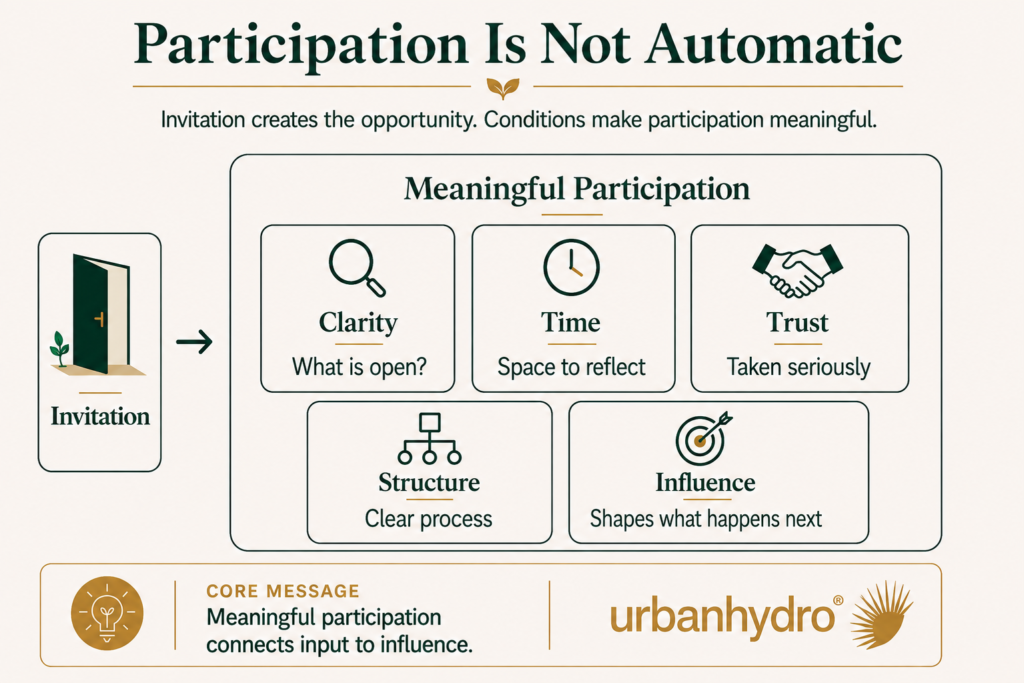
Across these processes, five conditions are particularly important: clarity, time, trust, structure, and influence. They are not independent ingredients or a fixed sequence. They interact and shape what participation can become.

Participation is not automatic. Invitation creates the opportunity, while clarity, time, trust, structure, and influence shape whether participation becomes meaningful and connected to action.

Clarity establishes the boundaries of the process. People need to understand why they are being involved, what is at stake, what they can influence, what has already been decided, who makes the final decision, and what will happen afterwards. Without that clarity, people may contribute without knowing how their input relates to the work.

Time determines whether participation can move beyond immediate reaction. Participants need enough space to understand the issue, connect it to their own experience, encounter other perspectives, and reconsider assumptions. This does not mean that every participatory process has to be long, but meaningful contribution cannot always be produced instantly.

Trust develops when the process is honest about both its possibilities and its limits. It grows when participants can see that their contributions have been treated seriously and when decision-makers explain what changed, what did not, and why. When people repeatedly contribute and never hear what happened afterwards, participation can begin to feel performative.

Structure gives participation a usable form. Open dialogue alone is not a method. Different purposes may require individual reflection, small-group discussion, visual mapping, prioritisation, experimentation, or repeated feedback. The method should help participants engage with the actual issue rather than simply fill the agenda.

Influence connects the other conditions to action. Participants do not need control over every outcome, but there needs to be a credible relationship between contribution and what happens next. Input might change a decision, reveal a neglected issue, reshape a priority, improve implementation, or generate further investigation. Without some meaningful connection to influence, even a well-facilitated process can remain largely symbolic.

Together, these conditions help explain why participation cannot be reduced to attendance or voice. The deeper question is whether a process creates genuine possibilities for people to contribute to shared understanding and action.

Participation is often described as giving people a voice, but voice alone is insufficient. People can speak without being heard, be heard without being taken seriously, or be taken seriously without being able to influence anything.

The deeper issue is agency: the possibility of understanding a situation, recognising where action is possible, relating to others, and contributing to what happens next. Agency does not mean acting alone or assuming individual responsibility for problems created through much larger systems. It is shaped through relationships between people, knowledge, resources, structures, responsibilities, and opportunities to act.

This is particularly important in sustainability, where calls for participation can easily become calls for individual responsibility. People are frequently told that everyone must contribute to sustainable change, yet responsibility without meaningful influence, resources, or support can become burdensome rather than enabling.

Meaningful participation can help make responsibility more specific and shared. People begin to see where their experience matters, how their role relates to the wider issue, what they can influence directly, where they depend on others, and where responsibility sits elsewhere in the system.

Participation therefore does more than collect perspectives. It helps locate agency and responsibility within actual relationships and conditions. That movement from concern to contribution is one of the reasons participation matters.

Participation also has practical value because people close to a situation often recognise constraints, relationships, and possibilities that are difficult to see from a distance. They understand where routines fail, which assumptions are unrealistic, what language creates confusion, and where apparently sensible plans are likely to encounter practical barriers or unintended consequences.

When this knowledge is absent, sustainability initiatives can remain coherent in principle but weak in practice. Strategies may define ambitious goals without establishing the conditions needed to enact them, while technically strong plans can remain disconnected from the routines and relationships through which they must eventually operate.

Participation allows ideas to encounter reality before plans become too fixed. It can reveal dependencies, tensions, overlooked consequences, and practical opportunities while there is still time to adapt. Research on environmental governance suggests that participation can strengthen governance outcomes, but its effects depend considerably on how participation is designed and on the context in which it occurs.

Its value is therefore not that participation guarantees agreement, better outcomes, or the removal of uncertainty. It creates a stronger basis for judgement and action by widening what the process is able to know before decisions become difficult to change.

This is where my work through urbanhydro® is focused: designing and facilitating the space between sustainability ambition and everyday practice so that participation becomes connected to learning, decisions, responsibility, and action.

The work begins by asking who needs to be involved, why their involvement matters, when they should enter the process, and what they can genuinely influence. It also means examining whose knowledge is already present, whose is missing, where formal and informal power sit, what tensions need to become visible, and how contributions will be interpreted and carried forward.

These questions move participation from intention to design. They also make clear why a single workshop rarely constitutes a participatory process on its own.

What happens before a workshop affects who arrives, how prepared they are, and whether they trust the invitation. What happens during it shapes whose knowledge becomes visible, which assumptions can be questioned, and what possibilities emerge. What happens afterwards determines whether participation connects to decisions and action.

Preparation, dialogue, decisions, action, feedback, and adjustment therefore need to remain connected. Without those connections, participation produces moments of involvement. With them, it can contribute to sustained movement and learning.

Participation is not automatic. It has to be intentionally connected to the conditions that allow people to understand what is happening, contribute meaningfully, recognise their influence, and remain involved as action develops.

That requires more than inviting people into a room. It requires clarity about purpose and decision boundaries, sufficient time to understand and reflect, trust that contributions will be treated seriously, structures that allow different forms of knowledge to emerge, and a credible relationship between contribution and influence.

When those conditions are present, participation can do more than increase inclusion. It can make knowledge more situated, responsibility more precise and shared, decisions more realistic, and implementation more adaptive. It can also create the reflexive space needed to notice assumptions, tensions, and consequences that were not visible at the beginning of the process.

Participation does not remove complexity. Its value is that it gives people a way to work with complexity together without pretending that everyone has equal responsibility, equal power, or the same knowledge.

This is why participation should not be treated as a soft addition to the serious work of sustainability. It is part of that work. Sustainable change becomes more possible when the people connected to it can understand the direction, question assumptions, contribute relevant knowledge, influence what remains open, and see how their participation connects to what happens next.

Participation becomes meaningful not simply when people enter the room, but when their presence changes what the room is able to see, understand, decide, and do.

Sources and Further Reading

Arnstein, S. R. (1969). A ladder of citizen participation. Journal of the American Institute of Planners, 35(4), 216–224. doi: 10.1080/01944366908977225.
Foundational source on the distinction between nominal participation and meaningful influence.

Bandura, A. (2001). Social cognitive theory: An agentic perspective. Annual Review of Psychology, 52, 1–26. doi: 10.1146/annurev.psych.52.1.1.
Foundational source for the understanding of agency as situated rather than simply individual action.

Delozier, J. L., & Burbach, M. E. (2021). Boundary spanning: Its role in trust development between stakeholders in integrated water resource management. Current Research in Environmental Sustainability, 3, 100027. doi: 10.1016/j.crsust.2021.100027.

Fudge, M., Alexander, K., Ogier, E., Leith, P., & Haward, M. (2021). A critique of the participation norm in marine governance: Bringing legitimacy into the frame. Environmental Science & Policy, 126, 31–38. doi: 10.1016/j.envsci.2021.09.015.

Carrick, J., Bell, D., Fitzsimmons, C., Gray, T., & Stewart, G. (2023). Principles and practical criteria for effective participatory environmental planning and decision-making. Journal of Environmental Planning and Management, 66(14), 2854–2877. doi: 10.1080/09640568.2022.2086857.

Newig, J., Jager, N. W., Challies, E., & Kochskämper, E. (2023). Does stakeholder participation improve environmental governance? Evidence from a meta-analysis of 305 case studies. Global Environmental Change, 82, 102705. doi: 10.1016/j.gloenvcha.2023.102705.

Wade, B., Bharadwaj, B., Kambo, A., Jensen, M., Witt, K., Weder, F., Phelan, A., & Ashworth, P. (2024). Stakeholder engagement: The role of facilitators and gender in ‘opening up’ conversations and enabling participation. Australasian Journal of Environmental Management. doi: 10.1080/14486563.2023.2298195.

From Ambition to Action: Making Sustainability Work in Real Conditions

Information can explain a problem.

It can describe what is happening, show why it matters, and make visible what would otherwise remain hidden. Information can give us data, facts, warnings, targets, reports, and arguments. In sustainability work, information is necessary. Without it, we cannot understand the scale of climate change, resource use, biodiversity loss, social inequality, or the organisational habits that keep unsustainable practices in place.

But information rarely changes a practice by itself.

Most people already know that sustainability matters. Many people know that climate change is real. Many know that consumption, production, energy, transport, food systems, social conditions, and everyday routines are connected. Many organisations already have sustainability strategies, values, policies, and targets.

Still, knowing is not the same as being able to act.

This is one of the central challenges in sustainability work. We often assume that if people receive better information, clearer facts, stronger warnings, or more convincing arguments, change will follow. Sometimes it does. More often, people return to the same routines, pressures, uncertainties, and systems that shaped their behaviour before.

That does not make information useless.

It means information is only the beginning.

The deeper question is not only what people know. It is how they make sense of what they know, how they connect it to their own situation, and how they find practical ways to act within the conditions they are part of.

That is where learning begins.

When Knowledge Stays Abstract

Sustainability can easily become abstract.

It can become a set of reports, goals, values, frameworks, strategies, or future visions. These may be necessary. They help create direction. They give language to ambition. They make responsibility visible. But they rarely create change if they remain detached from people’s lived experience.

A team may understand a sustainability goal but not know what it means for their daily work.

A student may understand a climate issue but feel powerless in relation to its scale.

A manager may support a new strategy but lack the time, confidence, or organisational structure needed to work differently.

A project group may agree on the importance of sustainability but avoid the difficult conversations about trade-offs, resources, responsibility, or implementation.

In these situations, the problem is not simply a lack of knowledge. The problem is that knowledge has not yet become connected to responsibility, relationships, choices, and action.

Information has entered the room.

But learning has not yet happened.

This matters because abstract sustainability can create a gap between what people say and what people are able to do. An organisation can have ambitious language and still operate through old routines. A project can use strong sustainability concepts and still reproduce familiar patterns. A group can agree that change is needed and still be unsure where to begin.

The challenge is not only to communicate sustainability better.

The challenge is to help people work with it.

Information Is Not the Same as Learning

Information tells people what is happening.

Learning changes how people understand their role in what happens next.

That difference matters.

Information can be delivered. Learning has to be worked through – it requires reflection, dialogue, experience, uncertainty, disagreement, and connection to real situations. It asks people not only to receive knowledge, but to examine assumptions, recognise patterns, understand relationships, and consider what responsible action could look like in practice.

This is why sustainability learning cannot be reduced to awareness.

Awareness may create concern. It may make people care. It may help them recognise that something is wrong. But concern alone does not automatically lead to action. People can be concerned and still feel stuck. They can agree with the problem and still lack direction. They can want change and still be shaped by systems that make change difficult.

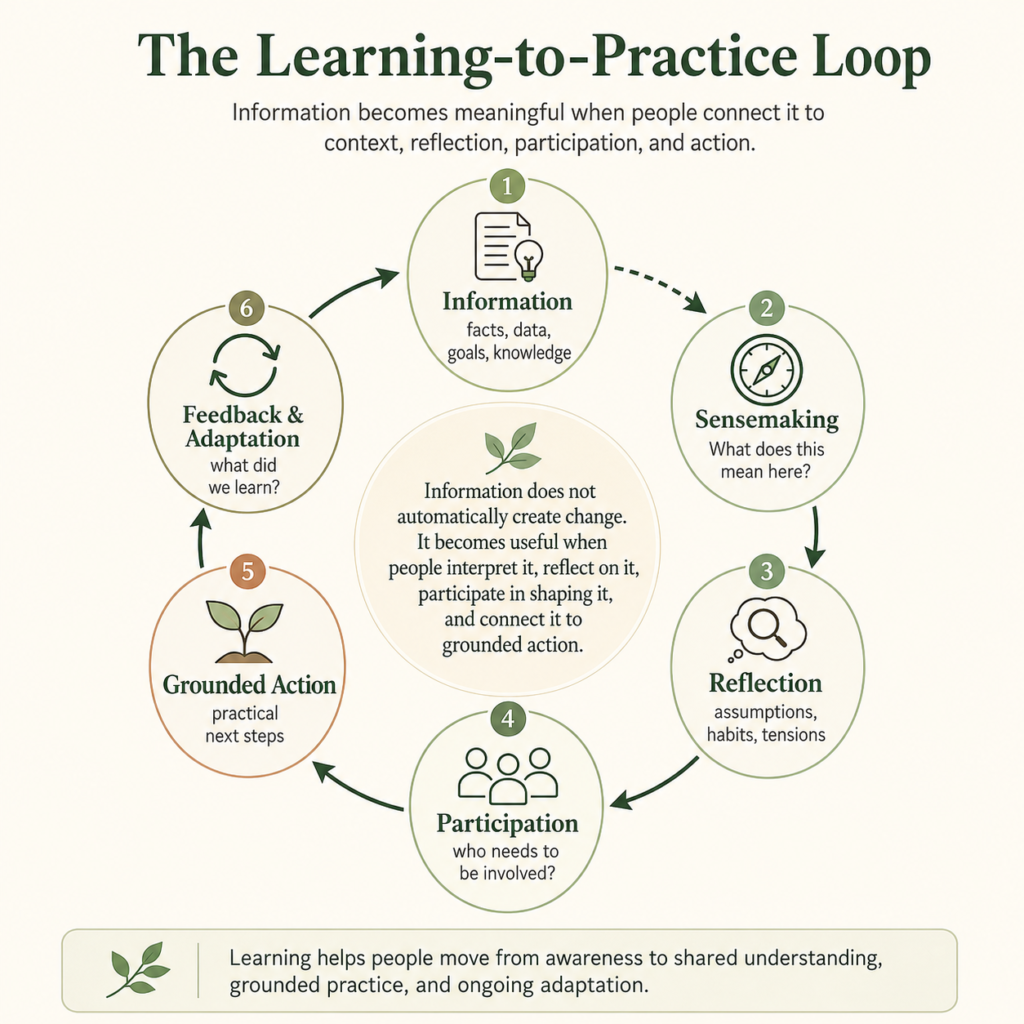
Deeper learning helps people move from concern to judgement, from judgement to participation, and from participation to action.

It helps people ask: What does this mean here? What does it mean for us? What are we already doing? What are we avoiding? What choices are actually available? What needs to change in the way we work, decide, organise, or collaborate?

These questions move sustainability from general agreement into situated practice.

Why Slowing Down Can Move Things Forward

In organisations, schools, projects, and communities, there is often pressure to move quickly. People want solutions, plans, deliverables, decisions, and visible progress. That pressure is understandable. Sustainability challenges are urgent, and many people are tired of talking without action.

But when problems are complex, moving too quickly can create weak solutions.

People may solve the wrong problem. They may repeat familiar patterns. They may design actions that look good on paper but do not fit the people, resources, culture, or everyday conditions involved. They may use sustainability language to describe a change that has not really changed the system underneath.

Sometimes the most practical thing is to slow down enough to understand what is really going on. That does not mean overthinking. It means creating enough reflective space to ask better questions before rushing into action.

What assumptions are shaping this problem?

Who is affected but not involved?

What resources are actually available?

What tensions are being avoided?

What makes the current behaviour easier than the desired behaviour?

What would make responsible action more possible?

These questions do not delay change. They improve the quality of action. Action without reflection can reproduce the same system under a new name. But reflection without movement can become paralysis.

The work is to connect the two.

A useful sustainability process does not stop at reflection. It uses reflection to support better action. It helps people see more clearly, decide more responsibly, and move with greater awareness of the conditions they are working within.

Learning as a Shared Process

Sustainability is not only individual. It is relational.

People act within teams, organisations, institutions, cultures, places, routines, expectations, and material conditions. This means learning also has to become shared. It cannot only happen inside one person’s head.

A single person may understand the problem. But if the wider team does not share the language, the direction, or the responsibility, little changes. A leader may want to act differently. But if the organisational routines reward speed, control, and short-term outputs, sustainability remains difficult to practise. A group may care deeply. But without structure, participation, and shared meaning, concern can remain scattered.

People need spaces where different perspectives can meet.

They need to hear how others understand the same situation.

They need to see where their own assumptions are limited.

They need to explore tensions without immediately closing them down.

They need to develop language for complexity that does not make action impossible.

This is where facilitation matters.

Good facilitation is not about controlling a conversation. It is not about forcing agreement or producing quick consensus. It is about creating the conditions where people can think more clearly together.

A facilitated learning space can help people move from scattered concern to shared direction. It can make hidden assumptions visible. It can connect lived experience with wider systems. It can help a group identify what is possible now, what needs to be tested, and what requires further work.

In that sense, facilitation is not separate from sustainability work.

It is one of the ways sustainability becomes possible.

From Passive Understanding to Active Participation

One risk in sustainability communication is that people become passive recipients of problems.

They are told what is wrong.

They are told what should happen.

They are told what they ought to care about.

But if people are not invited into the process of interpretation, decision-making, and action, their role remains weak. They may agree, but not feel ownership. They may listen, but not participate. They may care, but not know where to begin.

Learning becomes deeper when people are invited to participate.

Participation does not mean that everyone decides everything. It does not mean that all perspectives are equally responsible for every decision. It does not remove the need for leadership, expertise, structure, or direction.

Participation means that people are given real opportunities to contribute to meaning, direction, and practice. Their experience is taken seriously. Their questions matter. Their knowledge of everyday conditions becomes part of the process. The process is open enough for insight to emerge, but structured enough for action to follow. This balance is important.

Too much control kills participation.

Too much openness creates confusion.

A good learning process needs both structure and space.

Structure gives direction.

Space allows people to think, connect, and contribute.

When this balance works, people are not simply being informed about sustainability. They are helping shape what sustainability means in practice.

Learning That Leads to Practice

For learning to matter, it has to move somewhere.

Not every workshop needs to end with a full plan. Not every conversation needs to produce immediate transformation. Not every learning process can solve a complex challenge at once. But learning should create movement. It should help people see something more clearly, ask better questions, make a more responsible decision, test a new action, or adjust the way a project is being carried forward.

Practical learning can take many forms.

It can be a workshop where a team maps the conditions shaping a sustainability challenge.

It can be a coaching process where an individual clarifies values, choices, and next steps.

It can be a project session where people identify assumptions, stakeholders, resources, and possible experiments.

It can be a learning design where participants move from experience to reflection, from reflection to insight, and from insight to action.

The point is not to turn every moment into a task. The point is to make learning useful. Useful learning helps people act with more awareness, responsibility, and purpose. It does not promise simple answers to complex problems. It does not pretend that change is easy. But it helps people move from abstract ambition toward grounded action.

That movement matters.

Sustainability cannot remain only a message. It has to become something people can work with, question, translate, practise, and improve over time.

The Practical Work of Facilitation

This is where my work with Urbanhydro is focused.

I create open, reflective learning spaces where individuals, teams, and organisations can explore complexity, share perspectives, and co-create practical ways forward. The aim is not to deliver fixed answers from the outside. It is to support people in developing better questions, clearer direction, stronger collaboration, and actions that fit the realities they work and live within.

This work often begins with simple but important questions.

What do we already know?

What are we assuming?

What are we not seeing?

Who needs to be part of the conversation?

Where is there tension?

Where is there energy?

What would make action easier?

What is one responsible next step?

These questions help turn information into reflection, reflection into shared understanding, and shared understanding into grounded action. They also help avoid one of the common traps in sustainability work: the belief that change happens when the right message is delivered clearly enough.

Messages matter. But people also need time, language, structure, confidence, participation, and practical pathways. They need to understand not only the problem, but their own role within it. They need to see where they have agency, where they depend on others, and where the system itself needs to be questioned.

That is why facilitation is not just a soft addition to sustainability work. It is a practical method for helping people move through complexity without becoming stuck.

A More Workable Understanding of Learning

Real change requires more than information. It requires learning that is reflective, participatory, relational, and connected to lived experience.

It also requires spaces where people can slow down without becoming stuck, and conversations that can hold complexity without making action impossible. This means having the courage to examine assumptions, the discipline to connect insight with practice, and the humility to keep learning as reality responds.

Information can tell us that change is needed. Learning helps us understand how change becomes possible.

That is where the deeper work begins: when sustainability is no longer received as an abstract message, but shaped as a shared practice capable of changing what people actually do.