

Why practical judgement, coordination and care matter when ambition meets real conditions
Sustainability is often discussed through strategies, targets, systems, transformation and long-term change. All of these matter. But almost three decades in hospitality taught me to ask a more ordinary question: can people make the intended practice work when the room is full, time contracts, needs change and several priorities collide at once?
For many years I worked in restaurants, hotels and events, eventually carrying responsibility for teams, timing, coordination and quality. A plan could look clear before the doors opened. The moment people arrived, it met a living situation: a missing message, an unexpected request, a delayed delivery, an unclear role or a colleague suddenly carrying too much. The work did not stop while we diagnosed the system. We had to respond, and our response changed what became possible for everyone else.
I do not claim that service work is inherently sustainable. Hospitality can depend on exhausting schedules, invisible labour and an expectation that experienced workers will compensate for weak systems. That is precisely why the comparison matters. Service work made visible both the intelligence involved in keeping practice together and the damage caused when organisations rely on that intelligence without improving the conditions around it.
The lesson I carried into sustainability is therefore not that people should become better at coping. It is that responsible action becomes credible only when values can be enacted through practical judgement, coordination and care under real conditions – without depending indefinitely on exceptional people making exceptional efforts.
When the Plan Meets the Room
Service settings are small, fast-moving systems. People, materials, timing, expectations, space, roles, communication and energy have to connect. A delay in one place creates pressure somewhere else. A poor handover affects people who were not part of the original mistake. An unclear decision boundary can turn a small problem into a chain of improvised fixes.
Service work therefore made systems thinking tangible. It was not only the ability to draw connections on a diagram, but the ability to notice how a change in one part of a situation altered the possibilities available elsewhere – and to act while the pattern was still unfolding.
Lucy Suchman’s work on situated action helps explain why this matters. Plans provide orientation, but they cannot specify every action in advance. Action is accomplished through an ongoing interpretation of the situation. A plan therefore meets reality not as a script that controls events, but as a resource that people use, revise and sometimes depart from as circumstances develop.
Sustainability strategies face the same test. A policy may define the preferred direction, a target may clarify ambition, and a procedure may distribute tasks. Yet implementation still happens in meetings, procurement choices, conversations, budgets, handovers, routines and moments of uncertainty. If the plan cannot be interpreted and adjusted there, its correctness on paper offers limited protection.
Practical Judgement Is a Form of Knowledge
Service work develops a kind of knowledge that is easy to overlook because much of it is embodied, relational and difficult to state as a rule. It includes noticing when a system is approaching overload, when someone needs support before they ask, when a standard should be held, when flexibility is responsible, and when a small adjustment can prevent a larger failure.
Michael Eraut’s research on workplace learning distinguishes between deliberate learning, reactive learning in the moment and implicit learning that develops through participation in practice. This helps explain why experienced practitioners may recognise a situation before they can fully articulate how they know. Their judgement draws on accumulated encounters with people, materials, rhythms and consequences.
But experience alone is not a guarantee of good judgement. Repetition can deepen competence, and it can also normalise poor routines. Practical knowledge becomes more reliable when experience is examined through feedback, reflection and other people’s perspectives. The useful position lies between two extremes: rigid compliance with a plan and unaccountable improvisation. Responsible judgement remains oriented by purpose and standards while staying attentive to what the situation is revealing.
Sustainability work requires this combination. Technical expertise can tell us what should change. Ethical concern can tell us why it matters. Strategy can provide direction. Practical judgement connects these forms of knowledge to what is possible, responsible and consequential here and now.
Conditions Shape Agency Without Eliminating It
One of the clearest lessons from hospitality was that people perform differently under different conditions. A capable team can struggle when communication is weak. A motivated employee can lose energy when roles are unclear. A strong plan can fail when staffing, time, materials or authority are not aligned. A small problem can grow because no one has the attention or permission to address it early.
Different conditions do not remove personal responsibility. People still interpret, choose, coordinate, resist and take responsibility. Yet responsibility is never exercised in an empty space. What people can do is shaped by relationships, routines, resources, decision boundaries and the consequences attached to speaking up or deviating from the expected process.
Practice theory provides a language for this relationship between action and conditions. Shove, Pantzar and Watson show that practices persist through linkages between materials, competences and meanings. Recent hospitality research makes this concrete: Filimonau and colleagues found that chefs develop food-waste practices through professional experience, social learning and the material conditions of kitchen work. Changing sustainability practice is therefore not primarily a matter of persuading isolated individuals. It involves developing the elements and relationships through which action is repeatedly performed.
A practice perspective opens a third way between individual blame and systemic resignation. We do not have to pretend that motivation can overcome any condition. Nor do we have to wait for the entire system to change before acting. We can examine what is shaping the present situation, identify the available room for action, and work on the conditions that would make responsible practice easier to begin, repeat and adapt.
Coordination Makes Care Workable
Coordination is often treated as administrative support rather than substantive sustainability work. In service settings, its significance is immediate. Someone must connect information, timing, roles, materials and decisions so that other people are not left carrying avoidable uncertainty alone. Bolton, Logan and Gittell’s systematic review shows why this matters: shared goals, shared knowledge, mutual respect and timely, problem-solving communication strengthen coordination across interdependent work. When coordination fails, people wait, duplicate work, miss signals and compensate for gaps. When it succeeds, it can appear almost invisible because the parts meet before the pressure becomes a crisis.
Understanding coordination as a condition for care does not mean making it sentimental. Joan Tronto’s political account of care directs attention to how caring responsibilities are recognised, distributed and supported. Applied to organisations, care includes noticing needs, accepting responsibility for connection, doing the work competently and remaining responsive to its effects. It is practical and political because someone always carries the consequences when coordination is absent.
In my master’s research on Leadership for Sustainability, I found that participation across schools, municipalities and civil society was also a coordination achievement. Professionals translated broad ambitions, facilitated relationships, connected actors and navigated institutional constraints. Their work made participation possible, but its depth and continuity still depended on time, mandates, resources, routines and leadership support.
The same pattern appears in organisational sustainability. Responsibility is frequently distributed across departments while authority, information and resources remain fragmented. Telling everyone to contribute does not resolve this. Shared responsibility becomes workable when people know what they can influence, where decisions sit, how knowledge travels and who will follow through.
Pressure Is a Diagnostic, Not an Operating Model
Pressure reveals systems. When demand is low, weak structures can remain hidden. As pressure increases, communication gaps become visible, unclear roles become costly and routines show whether they support the work or merely function under ideal conditions. The moment of strain can therefore provide valuable information about where practice is fragile.
Yet chronic pressure is not a desirable operating condition. Organisations often celebrate resilience while quietly depending on workers to absorb recurring failures. If the same people repeatedly rescue the process, their adaptability can hide the need for structural change. Demerouti’s recent review shows that sustained high demands and insufficient resources are central risks for burnout, and that working conditions matter alongside support for individuals. What looks like a resilient system may actually be a fragile system supported by exhausted people.
A sustainable practice is not one that never encounters pressure, nor one that survives only because people keep doing more. It is one that can notice variation, learn from disruption and adjust its routines without consuming the people who carry it. Pressure should generate learning and redesign, not become permanent evidence of commitment.
Seen in this way, difficult periods call for different questions. Instead of focusing only on who performed well or badly, we can investigate where responsibility became concentrated, which information arrived too late, what depended on invisible labour, what could not be adapted and which resources or permissions were missing.
From Ambition to Workable Practice
The connection between service work and sustainability is not that they address the same problems. It is that both reveal the gap between intention and enactment. A promise becomes credible only through the practices, relationships and material arrangements that carry it. When those arrangements are weak, ambition is translated into extra pressure. When they are examined and developed, ambition can become a shared direction for learning and action.
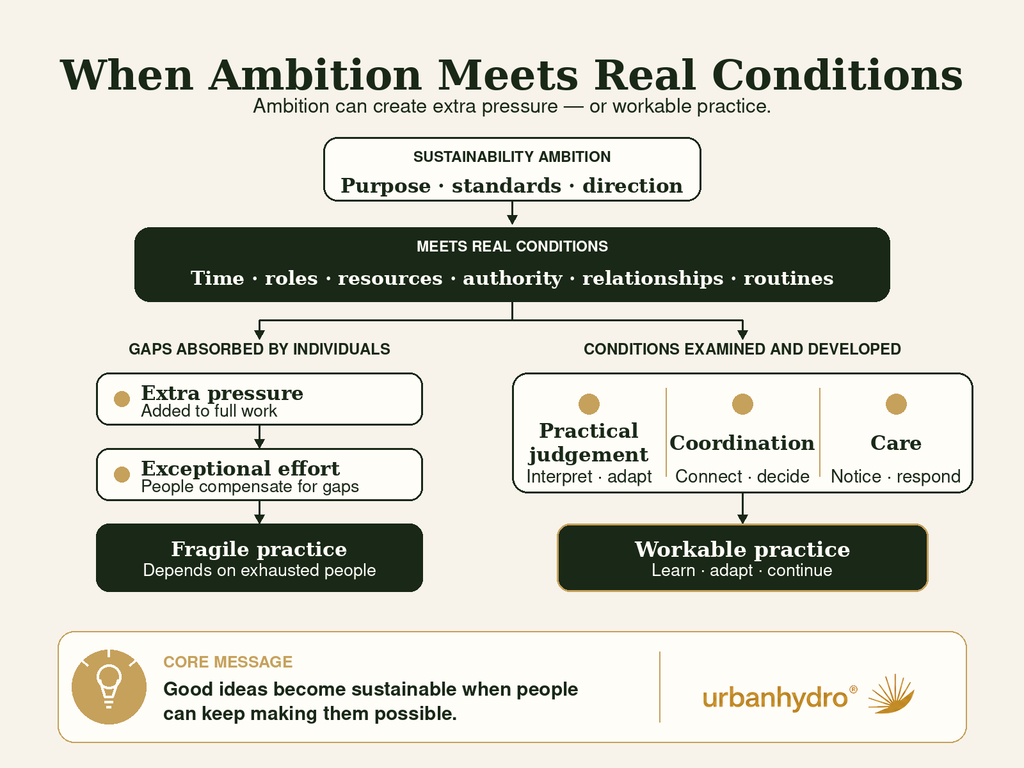
This is why my work now often begins with practical questions rather than another message about motivation:
- What are we trying to make possible in this specific situation?
- What conditions currently enable or constrain responsible action?
- Where does responsibility exceed influence, authority or available resources?
- Whose practical knowledge is missing from the way the problem has been framed?
- Where does pressure reveal fragility, poor coordination or invisible work?
- What small, responsible experiment could improve both the practice and our understanding of it?
These questions do not replace targets, technical analysis or long-term strategy. They bring those elements into contact with the situation where change must actually happen. They also prevent the opposite mistake: treating conditions as a reason for passivity. Constraints can be real while action remains possible. The task is to locate that possibility honestly and connect it to learning, coordination and the people who can change wider practice.
Together, these principles form the third route connecting my practical background with my academic and professional work. Ambition gives direction, but not control. Conditions shape agency, but do not erase responsibility. Action can be purposeful without pretending that its consequences are fully predictable. We act, attend to the response, learn and adjust.
What Sustainability Must Make Possible
Service work taught me that care is not only a disposition. It becomes visible in preparation, timing, communication, handovers, realistic expectations and attention to consequences. It is expressed when a colleague is not left carrying a system failure alone, when a concern can be raised before it becomes a crisis, and when learning from one situation improves the next.
Sustainability needs the same practical care. It cannot remain an ideal that people are expected to add on top of already full work. Nor can it rely indefinitely on a few committed individuals who translate, coordinate and compensate without sufficient mandate or support. If sustainability matters strategically, that importance must become visible in the conditions of everyday practice.
Nearly three decades in hospitality did not give me a ready-made sustainability model. They gave me a disciplined respect for the distance between a plan and a lived situation – and for the often invisible work required to bridge it.
Good ideas do not become sustainable simply because they are correct. They become sustainable when people can keep making them possible without being consumed by the work.
Sources
Bolton, R., Logan, C., & Gittell, J. H. (2021). Revisiting relational coordination: A systematic review. The Journal of Applied Behavioral Science, 57(3), 290–322. https://doi.org/10.1177/0021886321991597
Campbell, S. P. (2026). Leadership for Sustainability and the Facilitation of Participation: Professional Practices within Youth Sustainability Initiatives in Institutional Contexts in Denmark [Master’s thesis, Malmö University]. DiVA record
Demerouti, E. (2024). Burnout: A comprehensive review. Zeitschrift für Arbeitswissenschaft, 78(4), 492–504. https://doi.org/10.1007/s41449-024-00452-3
Eraut, M. (2000). Non-formal learning and tacit knowledge in professional work. British Journal of Educational Psychology, 70(1), 113–136. https://doi.org/10.1348/000709900158001
Filimonau, V., Sezerel, H., Ashton, M., Kubal-Czerwińska, M., Bhaskara, G. I., & Ermolaev, V. A. (2024). How chefs develop the practice to manage food waste in professional kitchens. International Journal of Hospitality Management, 119, 103712. https://doi.org/10.1016/j.ijhm.2024.103712
Shove, E., Pantzar, M., & Watson, M. (2012). The Dynamics of Social Practice: Everyday Life and How It Changes. SAGE. https://doi.org/10.4135/9781446250655
Suchman, L. (2007). Human-Machine Reconfigurations: Plans and Situated Actions (2nd ed.). Cambridge University Press. https://doi.org/10.1017/CBO9780511808418
Tronto, J. C. (2013). Caring Democracy: Markets, Equality, and Justice. New York University Press. Publisher page