


Meaningful participation requires more than invitations. It requires clarity, facilitation, time, trust, and a genuine connection between people’s contributions and what happens next.
Participation is one of the most frequently used words in sustainability work.
It appears in strategies, projects, workshops, community processes, educational programmes, organisational change initiatives, and public-sector plans. People are invited to participate. Stakeholders are asked for input. Employees are brought into conversations. Citizens, students, partners, or local communities are encouraged to share their perspectives.
But participation does not happen simply because people have been invited.
A meeting is not participation by itself.
A workshop is not participation by itself.
A survey is not participation by itself.
A consultation process is not participation by itself.
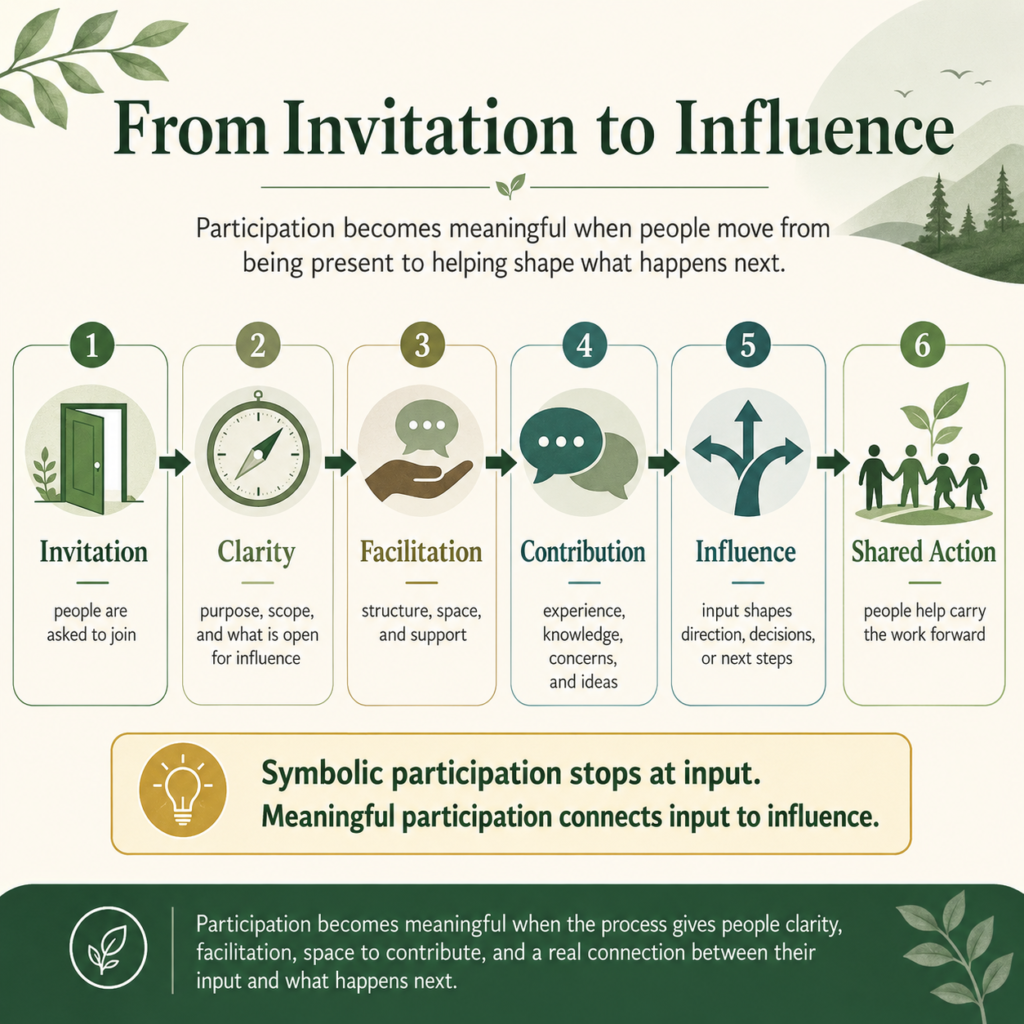
These activities may create opportunities for participation, but they can also leave people present without being heard, consulted without having influence, or included without being able to shape the direction of the work. Meaningful participation begins when people have a genuine opportunity to understand what is happening, contribute relevant knowledge, influence what remains open, and see how their contribution connects to what happens next.
That difference matters.
A process can look participatory from the outside while still feeling passive, unclear, or symbolic to the people involved. Participants may be asked to speak, but not know whether anyone is listening. They may be encouraged to share experience, but only after the central decisions have already been made.
This is not merely a communication problem – it is a design problem…
– and in sustainability work, it is a serious one.
Why Participation Matters
Sustainability challenges are rarely solved by one person, one expert, one organisation, or one plan.
They involve people, places, resources, relationships, routines, values, responsibilities, and competing priorities. They affect everyday practices as well as long-term strategies. They raise questions about what should change, who should act, who carries the costs, who receives the benefits, and what should be protected.
Expertise matters. Leadership matters. Strategy matters.
But sustainability cannot be implemented through expertise and strategy alone.
When the people affected by change are not involved in making sense of it, the connection between ambition and practice becomes weak. People may not understand what the change means for their role. They may not see how a strategic goal relates to the realities they encounter each day. They may identify barriers that are never discussed or have practical knowledge that is never used.
They may also feel that responsibility has been transferred to them without giving them the conditions needed to act. Sustainability then becomes something people are told about rather than something they help interpret, shape, and carry into practice.
Participation is therefore not decoration. It is not a checkbox. It is not a soft addition to the serious work of strategy and implementation – it is one of the conditions that can make responsible and sustained action possible.
From Reaction to Contribution
Participation is not about persuading people to agree with a plan that has already been completed – it is about creating the conditions in which people can help shape what the plan needs to become. This is the difference between symbolic and meaningful participation.
Symbolic participation asks people to react.
Meaningful participation allows people to contribute.
Symbolic participation collects opinions.
Meaningful participation works with experience, disagreement, knowledge, uncertainty, and responsibility.
Symbolic participation creates the appearance of involvement.
Meaningful participation creates a stronger basis for shared direction and action.
This does not mean that everyone must decide everything. Different processes have different boundaries. Legal requirements, budgets, deadlines, organisational responsibilities, and political decisions may limit what can be changed. Effective participation needs structure, defined responsibilities, and clear decision-making.
Participation without structure can become confusing, slow, or unfocused.
But structure without participation can become disconnected from reality.
The task is to create a process with enough clarity for people to move together and enough openness for their knowledge and experience to affect the outcome.
Meaningful participation needs both.
The Problem With Inviting People Too Late
One of the most common mistakes in participatory work is inviting people after the most important decisions have already been made. At that stage, the process may still ask for views, comments, feedback, or reactions. But the actual space for influence is limited. Participants are being asked to respond to a direction rather than take part in shaping it.
People usually recognise this quickly.
They can sense when their involvement is genuine and when they are being asked to confirm, legitimise, or improve the presentation of a decision that is already fixed.
This creates frustration and can gradually weaken trust.
People may begin to see participation as performative. They may stop contributing honestly because they do not expect their contribution to matter. They may disengage from the process or resist during implementation because their concerns were never taken seriously when there was still time to address them.
In sustainability work, this is especially damaging.
Implementation depends on people translating broad ambitions into everyday decisions, routines, and relationships. Those closest to the work often understand things that cannot be seen from a strategy document or management meeting.
They know what is likely to be difficult.
They know what has failed before.
They know where time and resources are already under pressure.
They know which language makes sense locally.
They know where there is motivation, uncertainty, resistance, or practical potential.
When participation is added only at the end, the process loses access to this knowledge at the moment when it could have made the greatest difference.
Inviting people earlier will not remove conflict – but it can make conflict more useful. It allows different needs, assumptions, and tensions to become visible while there is still time to learn from them.
Participation Does Not Organise Itself
Meaningful participation requires facilitation.
Whenever people enter a shared process, they bring different roles, expectations, experiences, levels of confidence, forms of knowledge, and degrees of influence.
Some participants are accustomed to being heard. Others are not.
Some think quickly and speak easily. Others need time to reflect before contributing.
Some hold formal authority. Others hold practical or lived knowledge but have less institutional power.
Some are comfortable with abstract strategy. Others understand the issue through concrete situations, routines, and consequences. These differences do not disappear when people enter a workshop or meeting. Without careful facilitation, they shape the process silently.
The loudest voices may dominate.
The safest ideas may survive.
The most experienced participants may assume that everyone shares their understanding.
Uncertainty may be mistaken for resistance.
Important disagreements may remain unspoken.
The process may become too controlled to produce new insight or too open to produce a usable direction. But good facilitation helps make these dynamics visible and workable. It creates a structure in which people understand why they are present, what is open for influence, how they can contribute, and what will happen with what emerges. It offers enough direction for the process to move forward while protecting enough openness for unexpected knowledge, concerns, and possibilities to appear.
Facilitation is not about making everyone comfortable at all times. Disagreement may be necessary. Tensions may contain important information. Difficult questions may need to remain open long enough for people to understand what they reveal.
The purpose of facilitation is not to remove difference – it is to make participation workable across difference.
Five Conditions for Meaningful Participation
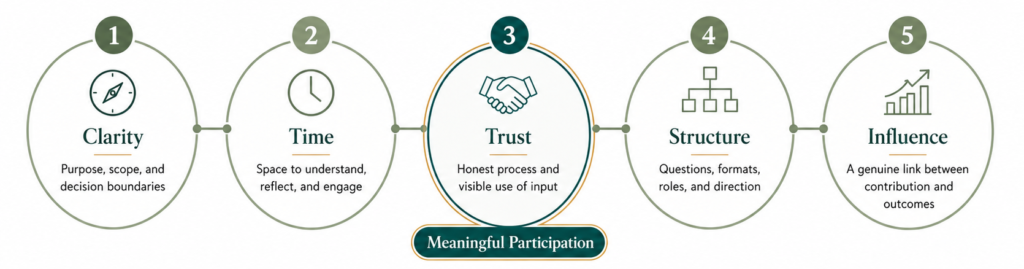
Meaningful participation requires clarity.
People need to understand the purpose of the process. Why are they being invited? What is at stake? What can they influence? What has already been decided? Who will make the final decision? What will happen afterwards? Without clarity, participation becomes vague. People may speak without knowing how their contribution relates to the work.
Meaningful participation also requires time.
This does not mean that every process must be long. It means that participants need enough time to understand the issue, reflect on their experience, hear other perspectives, and move beyond their immediate reactions. Without sufficient time, participation remains shallow.
Trust is equally important.
People need to believe that their contributions will be treated seriously. Trust grows when a process is honest about its possibilities and limitations. It grows when facilitators and decision-makers explain how input has been used, what has changed, what has not changed, and why.
Trust weakens when people contribute but never hear what happened next. Without trust, participation becomes performance.
Participation also requires structure.
Open dialogue is valuable, but openness alone is not a method. Participants need relevant questions, appropriate formats, clear roles, and a sense of direction. Some discussions need small groups. Others need individual reflection before collective conversation. Some need visual mapping, prioritisation, experimentation, or repeated rounds of feedback. The method should support the purpose rather than merely fill the agenda. Without structure, participation can become noise.
Finally, meaningful participation requires influence.
People do not need control over every part of a process, but there must be a genuine relationship between their contribution and the direction of the work. Their knowledge may change a decision, reveal a missing issue, reshape a priority, improve an implementation plan, or lead to further investigation. Without some form of influence, participation remains symbolic.
From Voice to Agency
Participation is often described as giving people a voice.
Voice matters – but voice alone is not enough. People can speak without being heard. They can be heard without being taken seriously. They can be taken seriously without having any influence on what happens next.
The deeper issue is agency.
Agency is the capacity to understand a situation, recognise possibilities, relate to others, and contribute to shaping action. It does not mean acting alone or carrying individual responsibility for problems created by larger systems.
But it is not a demand for heroic personal action. Agency is relational. It develops through the connections between people, knowledge, resources, structures, and opportunities to act. This is particularly important in sustainability work, where responsibility can easily become abstract or overwhelming. People are frequently told that everyone must contribute to the green transition. But responsibility without influence, resources, or clear possibilities for action can become a burden. It can produce guilt, passivity, or frustration rather than meaningful engagement.
Participation can help make responsibility more concrete, shared, and workable. When people participate meaningfully, they are not simply informed about sustainability.
They begin to locate themselves within the issue.
They see where their experience matters.
They understand more of the relationships and trade-offs involved.
They recognise where their responsibility begins and where responsibility must be shared with others.
They connect values and ambitions with decisions that can be made in practice.
They begin to move from concern to contribution.
That is where agency starts to develop.
Participation Improves Decisions
Meaningful participation is not only important for inclusion. It can also improve the quality of decisions.
People close to a situation often see things that strategies, models, and external experts miss. They know where routines break down. They understand local relationships. They know which assumptions are unrealistic, which words create confusion, and which practical barriers are likely to appear. They may also see opportunities that are invisible from a distance. When this knowledge is ignored, sustainability work can become elegant but impractical.
Plans may appear coherent but fail when people try to use them.
Projects may sound ambitious but lack ownership.
Workshops may create temporary energy without continuation.
Strategies may define goals without establishing the conditions needed to reach them.
Participation connects ambition to reality. It allows ideas to be tested against experience before plans become too fixed. It reveals consequences and dependencies that were not initially visible. It creates space for adaptation before difficulties become implementation failures.
Participation does not guarantee agreement, remove uncertainty, or make every decision easy. Its value lies elsewhere. It creates a stronger and more realistic foundation for deciding and acting under complex conditions.
Participation Is a Process, Not an Event
This is where my work through urbanhydro is focused.
I help individuals, teams, projects, and organisations design and facilitate processes in which participation becomes clearer, more grounded, and more closely connected to action. That work often begins with practical questions:
Who needs to be involved?
Why do they need to be involved?
At what point should they enter the process?
What can they genuinely influence?
What has already been decided?
What knowledge is missing from the room?
Which voices are usually heard?
Which voices are frequently absent or overlooked?
What tensions need to become visible?
How will contributions be documented, interpreted, and used?
How will participants learn what happened afterwards?
These questions move participation from intention to design. They also help prevent participation from being treated as an isolated event. A single workshop may be valuable, but participation usually belongs to a wider process of learning, decision-making, implementation, feedback, and adjustment.
What happens before the workshop shapes who arrives, what they understand, and whether they trust the invitation.
What happens during the workshop shapes whose knowledge becomes visible and which possibilities are explored.
What happens afterwards determines whether the participation was meaningful.
The process therefore needs to connect preparation, dialogue, decisions, action, and follow-up. Without these connections, participation produces moments – with them, participation can contribute to movement.
Designing Participation for Sustainable Change
Participation is not automatic.
It has to be designed.
It has to be facilitated.
It has to begin early enough to matter.
It has to be connected to genuine influence.
And it has to be grounded in the conditions within which people actually work and live. Meaningful participation helps people move from passive agreement to active contribution. It makes knowledge more situated, responsibility more shared, and implementation more realistic. It does not remove complexity. It helps people work with complexity together.
That is why participation should not be treated as a soft extra. It is one of the practical conditions that allows sustainable change to take root and continue beyond the initial strategy, meeting, or project. People relate differently to change when they can understand it, question it, contribute to it, and recognise part of themselves in what emerges. Participation becomes meaningful when people do not merely enter the room – but when their presence changes what the room is able to see, understand, and do.