


Leadership is often treated as a position: a title, a function, or a person at the front of the room who sets direction, makes decisions, communicates the plan, and carries responsibility for change. Sometimes leadership does look like that. Formal authority matters, particularly when priorities must be set, resources allocated, and difficult decisions made.
In sustainability work, however, much of the leadership that determines whether change can continue is less visible. It appears in how conversations are held, tensions are named, roles are clarified, participation is supported, and practical next steps are made possible. It is present when someone connects people who are working in parallel, translates an abstract ambition into everyday work, or creates enough clarity for others to act responsibly.
Leadership is therefore not only about being in charge. It is also about helping a system become more capable of responsible action. That distinction matters because sustainability challenges rarely yield to one leader, one department, one strategy, or one decision. They require learning, coordination, trust, participation, implementation, and adjustment over time. In that kind of work, leadership becomes more than authority. It becomes practice.
The Problem With Heroic Leadership
Sustainability is frequently framed as a leadership challenge, followed by a call for visionary, bold, and courageous leaders who can drive transformation and inspire others to change. There is truth in this framing. Direction, courage, and responsibility matter, and people in formal leadership positions have real power to open or close possibilities for change.
The heroic image becomes problematic when sustainability appears to depend on exceptional individuals with the right vision, charisma, or answer. It can obscure the quieter work that allows change to continue after the first speech, workshop, strategy, or decision. Most sustainability work is not carried by heroic moments but by repeated, relational, and practical efforts: keeping people connected, translating ambition into action, making participation meaningful, holding direction while allowing adaptation, noticing when energy is fading, bringing missing voices into the room, and making responsibility clearer and more shared.
This work is often difficult to see because it is distributed across roles and embedded in everyday practice. Yet without it, strategies lose contact with implementation, participation becomes symbolic, and initial energy dissipates. The visible decision may begin a process, but the less visible leadership work determines whether it can hold.
From “Who Is Leading?” to “What Leadership Work Is Needed?”
If leadership is understood as practice as well as position, the central question changes. Instead of asking only, “Who is leading this?”, we can also ask, “What leadership work is needed here?” The second question opens a wider field because it directs attention to what the situation requires rather than assuming that leadership belongs to one person.
At one moment, the work may involve setting a clear direction. At another, it may mean slowing down a process that is moving too quickly, involving people earlier, clarifying where influence lies, or protecting time for reflection. It may require translating abstract goals into practical routines, coordinating across organisational boundaries, or helping people remain with complexity instead of escaping into simple answers.
This does not make formal leadership less important. It makes leadership more precise. The issue is not merely whether someone occupies a leadership role, but whether the necessary leadership work is being performed, supported, and connected. Nor does a broader view of leadership dissolve differences in power or formal responsibility. Those with authority still carry particular obligations because they can allocate resources, establish mandates, and alter the conditions under which others are expected to act. Leadership becomes less about controlling change from above and more about strengthening the conditions that allow people to move with purpose, responsibility, and direction.
Why Direction Still Matters
A relational and facilitative understanding of leadership should not be confused with vagueness. Participation does not mean endless openness, and facilitation does not mean avoiding decisions. Sustainability work still needs direction. People need to understand what matters, why it matters, what is fixed, what remains open, and what the work is moving towards. Without sufficient direction, participation can become scattered, reflection circular, and implementation disconnected.
The point is not to remove direction but to make it liveable, workable, and connected to the people who must carry it. A sustainability strategy may define a goal, but people still need to interpret what that goal means for their work. A project may have a clear purpose, but participants need to know how their contribution matters. A team may agree that change is necessary while still requiring support to prioritise, coordinate, and act.
Good leadership therefore holds direction without pretending that the path is fully known. It creates enough clarity to move and enough flexibility to learn. Too little direction creates confusion; too much control can remove ownership and suppress relevant knowledge. Much of sustainability leadership takes place in the ongoing work between these two risks.
The Invisible Work of Change
Much of the leadership needed for sustainability is practical rather than dramatic. It can be seen in the person who notices that a project has energy but no follow-up, the facilitator who makes space for quieter voices, the coordinator who connects people working in parallel, or the manager who protects time for learning before demanding results. It also appears when a teacher turns concern into inquiry rather than fear, a project lead questions the assumptions built into a plan, a team member articulates a tension everyone can feel, or an organisation changes routines so responsible action becomes easier to repeat.
These actions may not resemble leadership in the traditional sense, yet they shape what becomes possible. They influence whether people feel included or ignored, whether responsibility is clear or diffuse, whether a project gains momentum or loses direction, and whether sustainability remains abstract or becomes part of practice. Leadership should therefore not be understood only as personality, authority, or individual influence. It should also be understood as the work that helps people act together under conditions of uncertainty.
The following practices—translation, facilitation, coordination, and capacity-building—are not separate leadership types or a checklist to be completed in sequence. They are interconnected forms of work. Translation can reveal the need for participation; facilitation can expose a coordination problem; coordination can show where people lack mandate, time, knowledge, or support. Together, they help make the conditions for responsible action visible and workable.
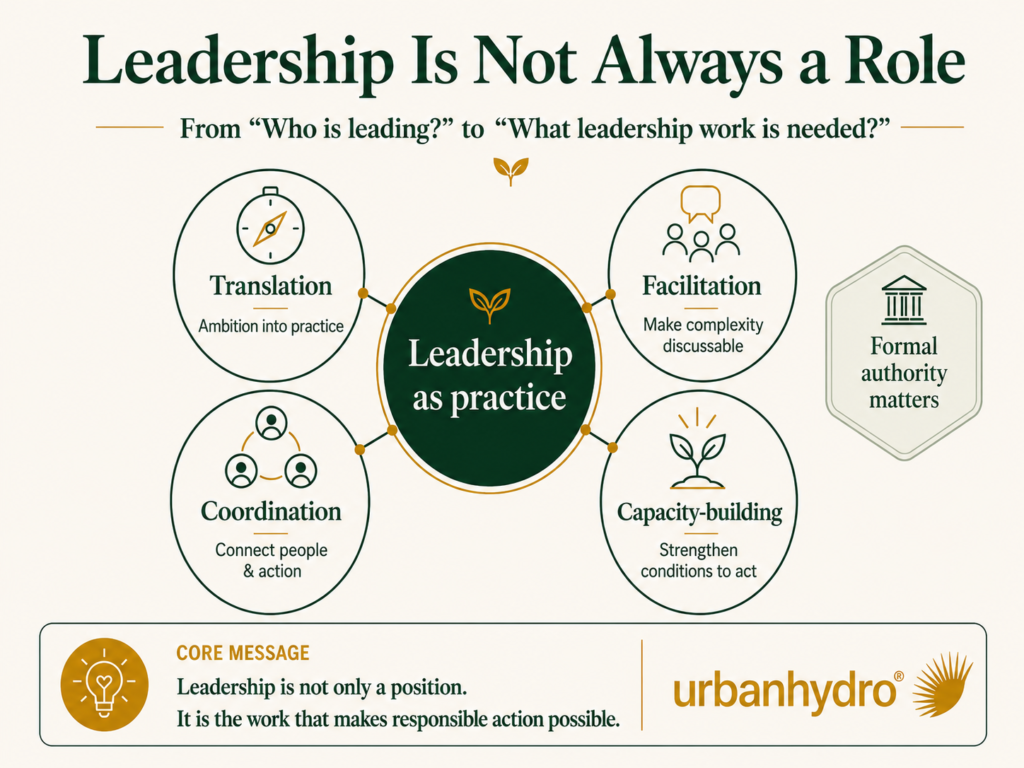
Leadership as practice. Formal authority remains important, but sustainability leadership also takes shape through translation, facilitation, coordination, and capacity-building – the practical work that strengthens conditions for responsible action.
Leadership as Translation
One of the most important forms of sustainability leadership is translation—not primarily between languages, but between levels of reality. Sustainability leadership connects vision with everyday work, strategy with practice, theory with action, values with decisions, long-term goals with immediate constraints, and stated ambitions with what the current system actually makes possible.
This work is necessary because sustainability language can easily become too abstract. Concepts such as transformation, responsibility, participation, resilience, and systems may be meaningful, but they do not automatically guide action. They must be interpreted in relation to concrete situations: What does this value mean in this meeting? What does the goal require from this team? What does participation mean in this project? What does responsibility look like in this decision? How should sustainability affect the allocation of time and resources?
Without translation, sustainability remains distant from practice. With translation, it becomes something people can interpret, discuss, test, and carry forward. Translation is therefore not a secondary communication task. It is leadership work because it creates a usable connection between ambition and action.
Leadership as Facilitation
Leadership for sustainability is also facilitative, but facilitation should not be reduced to running workshops. It involves creating structured spaces in which people can make sense of complexity together. Sustainability challenges commonly involve uncertainty, disagreement, competing priorities, and different forms of knowledge. People may care about the same overall goal while understanding the problem differently, and they may enter a process with very different levels of power, confidence, responsibility, and access to decisions.
These differences do not disappear when they remain unspoken. They continue to shape the process: some voices dominate, some concerns remain hidden, assumptions go unexamined, and decisions become disconnected from the people who must implement them. Facilitative leadership makes these dynamics more visible and workable. It provides structure for participation, supports dialogue without allowing the process to become vague, and creates room for reflection while maintaining attention to action.
Good facilitation does not remove tension. It treats tension as information. A disagreement may reveal conflicting values, an unclear mandate, a practical limit, an excluded perspective, or an assumption that needs to be tested. Questions such as “What is this tension showing us?”, “What needs to be clarified?”, and “What can be tested now?” help people move from uncertainty towards a direction they can understand and carry together.
Leadership as Coordination
Sustainability work frequently crosses boundaries between teams, organisations, disciplines, professions, generations, values, interests, and forms of knowledge. This makes coordination essential. Although coordination can look administrative, it is one of the main ways change becomes possible because it keeps purpose, people, information, resources, decisions, and next steps connected over time.
Without coordination, sustainability work fragments. People act in parallel without learning from one another. Decisions are made in one place but experienced in another. Feedback is collected but not used, energy is created but not carried forward, and responsibility is shared in language while remaining unclear in practice. Good coordination creates coherence by helping people understand where the work stands, what has changed, what requires attention, and how their contribution connects to the wider direction.
This is not minor work. It is leadership work because even strong intentions can dissolve into disconnected activity when no one maintains the relationships and connections on which implementation depends.
Leadership as Capacity-Building
Sustainability leadership is not only about completing tasks or delivering outputs. It is also about strengthening the collective conditions for learning, adapting, and acting responsibly over time. Sustainability challenges do not end with one project. New situations arise, priorities shift, consequences become visible, knowledge develops, and organisational conditions change.
A leadership approach focused only on delivery may produce a short-term result without changing what people are actually able to influence afterwards. A capacity-building approach therefore looks beyond individual knowledge or confidence. It asks whether people have the time, mandate, relationships, access to decisions, practical routines, and support needed to use what they learn. It also asks what participants, teams, and organisations will be better able to do because of the process: understand the issue more clearly, participate more meaningfully, test ideas, use feedback, coordinate across boundaries, and make responsibility clearer.
This changes how sustainability work is designed and evaluated. Completing an activity remains important, but it is no longer the only measure of progress. A process should also leave behind stronger conditions for responsible judgement and action. Capacity, in this sense, is not simply something an individual possesses. It is relational and institutional: it depends on what the surrounding system enables people to understand, influence, and sustain in practice.
Working With Uncertainty
Leadership for sustainability also requires a different relationship to uncertainty. Organisations often treat uncertainty as something that plans should remove, strategies should control, and leaders should answer. Yet sustainability work involves forms of uncertainty that cannot be eliminated in advance. Effects may be delayed, problems contested, knowledge incomplete, system responses unexpected, and definitions of success different across groups.
This does not make leadership impossible. It makes adaptive leadership necessary. An adaptive approach does not wait for perfect certainty before acting, but neither does it claim to know more than it does. It creates a way of moving forward that can learn from reality. That requires humility—not as weakness, but as recognition that no individual sees the whole system.
Humility makes it possible to listen for what a plan has missed, adjust without losing purpose, and treat feedback as part of the work rather than as a threat to authority. In sustainability work, the ability to say “we need to learn more” can be a form of leadership strength, particularly when it remains connected to responsible action rather than becoming a reason for indefinite delay.
The Practical Work of Leadership
This is where my work with urbanhydro® is focused: the space between sustainability ambition and everyday practice. Rather than beginning with an assumption that people need more motivation, stronger competencies, or a better plan, I begin by examining the conditions that shape what they can understand, influence, take responsibility for, and sustain.
The work begins with practical leadership questions rather than abstract prescriptions. What direction needs to be made clearer? What conditions are shaping the current situation? Who has influence, who needs to be involved, and where is responsibility unclear? What must be translated into practice? Where is the process stuck? What requires facilitation or coordination? What can be tested now, and what must be learned before the next step can be planned responsibly?
These questions connect leadership to the actual work of change: understanding systems, supporting participation, clarifying responsibility, coordinating action, and helping people move forward without pretending that the work is simple. They also shift attention away from searching for a single heroic actor and towards understanding how leadership is enacted across relationships, routines, decisions, and organisational conditions.
A More Workable Understanding of Leadership
Leadership is not always a role. It is also a practice that takes shape through the conditions people create, the questions they ask, the processes they influence, and the ways they help others act with greater clarity, responsibility, and direction. In sustainability work, leadership is not only about having the answer; it is about helping people work productively with the questions that matter.
Nor is leadership only about driving change. It involves creating conditions in which change can be understood, carried, tested, adjusted, and sustained. It is not only an expression of individual influence but a way of strengthening collective capacity. This is why leadership for sustainability must be practical, relational, reflective, and adaptive.
Sustainable change does not depend only on bold visions. It depends on the everyday leadership work that helps people translate vision into practice. Often, that work begins quietly: by making the next responsible step clearer, more shared, and more possible.
Sources and Further Reading
Crevani, L., Lindgren, M., & Packendorff, J. (2010). Leadership, not leaders: On the study of leadership as practices and interactions. Scandinavian Journal of Management, 26(1), 77–86. https://doi.org/10.1016/j.scaman.2009.12.003
Carroll, B., Levy, L., & Richmond, D. (2008). Leadership as practice: Challenging the competency paradigm. Leadership, 4(4), 363–379. https://doi.org/10.1177/1742715008095186
Uhl-Bien, M. (2006). Relational Leadership Theory: Exploring the social processes of leadership and organizing. The Leadership Quarterly, 17(6), 654–676. https://doi.org/10.1016/j.leaqua.2006.10.007
Cunliffe, A. L. (2009). The philosopher leader: On relationalism, ethics and reflexivity—A critical perspective to teaching leadership. Management Learning, 40(1), 87–101. https://doi.org/10.1177/1350507608099315
Ansell, C., & Gash, A. (2008). Collaborative governance in theory and practice. Journal of Public Administration Research and Theory, 18(4), 543–571. https://doi.org/10.1093/jopart/mum032
Westley, F. R., Tjornbo, O., Schultz, L., Olsson, P., Folke, C., Crona, B., & Bodin, Ö. (2013). A theory of transformative agency in linked social-ecological systems. Ecology and Society, 18(3), 27. https://doi.org/10.5751/ES-05072-180327