


Why sustainability becomes real only when ambition is connected to everyday conditions
Most sustainability strategies do not fail in the future. They lose strength when they meet everyday work: on Monday morning, during the early shift, in the meeting room, on the shop floor, in the kitchen, in the classroom, on the route, at the service counter, or in the middle of a busy project.
They meet unclear priorities, limited time, stretched resources, old routines, missing information, and decisions in which sustainability matters in principle but not enough to shape what happens next. This is rarely because people do not care. Many people care deeply, and many organisations have strong values, serious ambitions, and teams that genuinely want to work in more responsible, sustainable, and future-oriented ways.
But care alone does not redesign a system. Good intentions can start a conversation, open a door, and create commitment. If the conditions around people remain unchanged, however, most actions will remain unchanged too.
Sustainability therefore cannot be treated only as a question of awareness, motivation, or moral commitment. It must also be understood as a question of structure, relationships, learning, participation, resources, and everyday practice. The central question is not only whether people want change, but whether the conditions around them make change possible.
This is the shift: stop asking only why people are not changing, and start asking what conditions keep producing the same behaviour.
When sustainability meets real life
A person may want to act more sustainably. A team may want to work differently. An organisation may want to take greater responsibility. Intention alone will not carry the change if roles are unclear, resources are stretched, decisions are fragmented, and responsibility is spread so widely that no one can act with confidence.
This is where sustainability often becomes too abstract. We speak about transformation, responsibility, values, green transition, and better futures. These concepts matter because they create direction. Unless they are translated into routines, decisions, projects, communication, resource allocation, and follow-up, they remain suspended above the work they are meant to influence.
People may agree with sustainability in principle and still struggle to enact it in practice. That is not necessarily hypocrisy. It often shows that the ambition has not yet been connected to the conditions under which people actually work.
A sustainability goal does not change behaviour by itself. A workshop does not change a culture by itself, and a strategy document does not change an organisation by itself. Change becomes more likely when people understand what the ambition means in their own context, participate in shaping the process, and work within structures that support the desired direction.
Why guilt is a weak strategy
Sustainability is often communicated through guilt, urgency, or fear. This can create attention, but attention is not the same as sustained action. When sustainability feels overwhelming, moralising, distant, or impossible to influence, people may become defensive, tired, or quietly resigned. They may still care, but caring becomes heavy because it is not connected to a realistic path forward.
This does not mean responsibility should be softened until it means nothing. It means responsibility must be made workable.
People are more likely to remain engaged when they understand why something matters, feel capable of contributing, and experience that they are not acting alone. Sustainability work therefore has to support purpose, competence, connection, and practical agency. It must help people see possible next steps, not only the scale of the problem.
Responsibility without support becomes burden. Responsibility connected to the right conditions becomes agency.
From intention to practice
The conditions that support change are often simple to describe but difficult to establish. They include clearer direction, so people know what matters most when everything cannot be done at once. They include participation, so people are not only informed about change but involved in shaping it. They include realistic awareness of resources, because sustainability work always depends on time, money, knowledge, capacity, energy, and organisational limits.
They also include reflection, because people need space to examine assumptions, habits, and patterns before rushing into familiar solutions. They include feedback, because projects need to be tested, adjusted, and improved as reality responds. They require structured flexibility: enough structure to create direction and coordination, but not so much rigidity that people cannot adapt when conditions change.
Without structure, change fragments. Without flexibility, it becomes rigid. Sustainable implementation requires both.
This is where practical methods matter. Not because one framework contains the answer, but because people often need ways to make change tangible. Sometimes that means starting with a vision and working backwards to the conditions it requires. Sometimes it means understanding the people affected by a problem before designing a response. Sometimes it means testing a limited idea, learning from what happens, and adjusting the next step.
The common thread is that people do not wait for perfect certainty. They begin with what they know, what they have, and what they can learn next. These approaches do not solve sustainability alone, but they help move the conversation from “we should” towards “what can we do next, with what we have, in the situation we are actually in?”
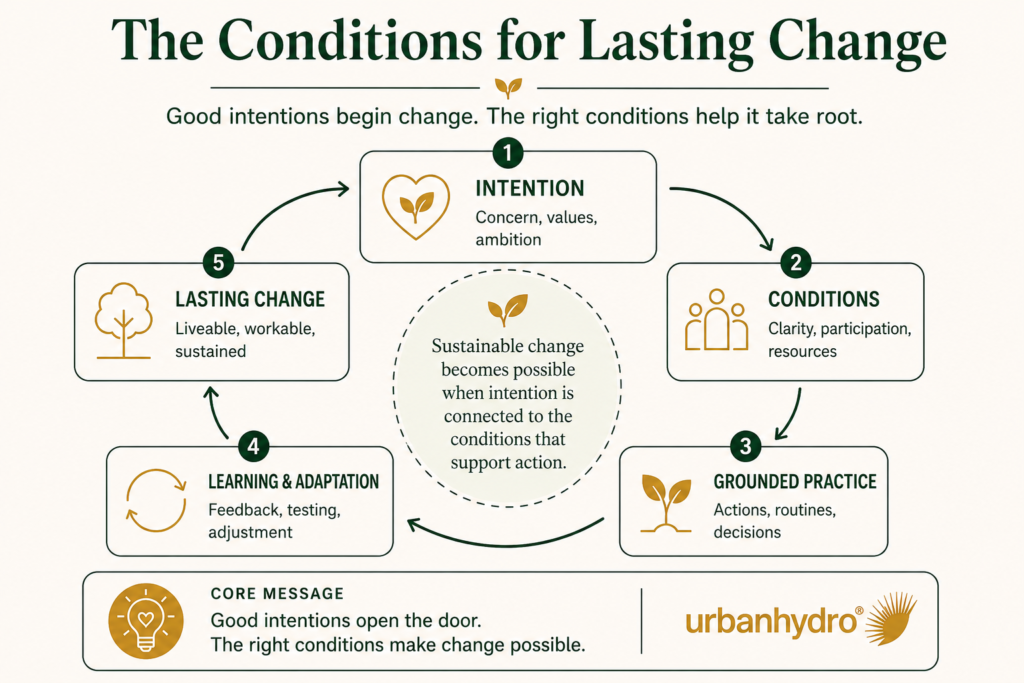
The conditions for lasting change. Sustainable change depends not only on intention, but on the conditions that connect ambition to grounded practice, learning, adaptation, and sustained action.
That movement matters because ambition becomes useful only when it can enter practice.
Participation must become real
Sustainability requires more than expert solutions delivered from the outside. People are not passive recipients of change. They are part of the system that must change, and their experience, constraints, knowledge, habits, concerns, and relationships shape what becomes possible.
Participation cannot therefore be decorative. It is not enough to ask for input after the important decisions have already been made. It is not enough to invite people into a room and call it co-creation. Participation has to be designed, facilitated, supported, and connected to real influence.
When participation is meaningful, people can see that their perspective matters. They can understand the trade-offs involved, contribute to direction rather than merely respond to it, and begin to carry the work because they have helped shape it.
That is when learning becomes deeper, responsibility becomes more shared, and action becomes more realistic.
The practical work of change
This is where my work through urbanhydro is focused. Through coaching, workshops, facilitation, consultancy, learning design, and implementation support, I help people and organisations connect sustainability ambitions to grounded practice.
The work often begins with practical questions: What are we actually trying to change? What conditions are shaping the problem? Who needs to be involved? What resources are genuinely available? What assumptions are we making? Where is energy already present? What small step could create useful learning? What needs structure, and what needs flexibility?
These questions are not abstract. They help people slow down enough to see the situation more clearly, but not so much that action disappears. Reflection without movement can become paralysis, while action without reflection can reproduce the same patterns under a new name.
The work is to connect reflection and action so that each strengthens the other.
A more workable understanding of sustainability
For me, sustainability must be liveable, workable, and connected to the realities of everyday life and work. It is not about guilt or perfection, and it is not only about ideals, strategies, or future visions. It is about developing decisions, relationships, routines, and projects that can be carried, examined, and improved over time.
That requires learning, participation, systems thinking, and practical design. It requires the courage to act before everything is certain and the humility to adjust when reality teaches us something new.
Good intentions may open the door. The right conditions help people walk through it together.
Sustainable change begins when ideas become connected to people, practice, responsibility, and the conditions that allow better futures to take root.
Sources and further reading
Meadows, D. H. (1999). Leverage Points: Places to Intervene in a System. The Sustainability Institute.
Ryan, R. M., & Deci, E. L. (2020). Intrinsic and extrinsic motivation from a self-determination theory perspective: Definitions, theory, practices, and future directions. Contemporary Educational Psychology, 61, 101860.
Deci, E. L., Olafsen, A. H., & Ryan, R. M. (2017). Self-determination theory in work organizations: The state of a science. Annual Review of Organizational Psychology and Organizational Behavior, 4, 19–43.
Durlak, J. A., & DuPre, E. P. (2008). Implementation matters: A review of research on the influence of implementation on program outcomes and the factors affecting implementation. American Journal of Community Psychology, 41(3–4), 327–350.
Wiltsey Stirman, S., Kimberly, J., Cook, N., Calloway, A., Castro, F., & Charns, M. (2012). The sustainability of new programs and innovations: A review of the empirical literature and recommendations for future research. Implementation Science, 7, 17.
United Nations. (2015). Transforming our world: The 2030 Agenda for Sustainable Development.