

Co-creation is often described as a way of bringing people into the development of an idea, project, service, or initiative. Instead of designing something entirely from the outside, we invite people with relevant experience to contribute their knowledge and perspectives.
That matters in sustainability. People connected to change often know things that are difficult to see from a strategy document, project plan, or external analysis. They understand routines, constraints, relationships, pressures, histories, and practical possibilities from inside the situations where change is expected to happen.
But inviting people to contribute does not automatically make a process co-created. A workshop can collect useful perspectives while leaving the fundamental direction unchanged. A consultation can happen after the important decisions have already been made. Feedback can improve an existing idea without giving participants influence over the assumptions or problem definition behind it.
These forms of participation can still be valuable. The problem arises when we call them co-creation without being clear about what participants can actually shape.
Input becomes co-creation when it can change the work.
That change may concern a proposed solution, but it can also go deeper. Participation may reveal that the problem has been framed too narrowly, that an important relationship has been overlooked, or that something which looks workable from one position is difficult to sustain from another. Co-creation therefore involves more than gathering knowledge. It requires keeping enough of the process open for relevant knowledge and experience to affect what happens next.
From Participation to Co-Creation
Participation and co-creation are closely related, but they ask different questions.
In an earlier urbanhydro® Insight, I argued that participation becomes meaningful when people are not simply invited to speak but have a credible possibility of influencing what follows. Co-creation adds another layer: if participants have influence, what is that influence actually allowed to shape?
It may concern relatively contained design choices, or it may extend to questions about purpose, problem definition, priorities, implementation, or direction. Different situations require different forms and degrees of involvement.
Research uses several related terms in this field, including co-creation, co-design, co-development, and knowledge co-production. They overlap, but they are not interchangeable. I use co-creation here as a broad, practice-oriented term for developing understanding and possible responses with people whose knowledge, experience, decisions, or actions matter to what is being created.
This does not require unlimited openness. Organisations still operate within legislation, budgets, mandates, professional responsibilities, strategic commitments, and decisions that may already have been taken. Expertise remains important.
What co-creation does require is clarity about those boundaries. Participants need to understand why they are being involved, what remains genuinely open, what is fixed, who ultimately decides, and how their contribution can affect the process.
The relevant question is therefore not simply whether people participated, but whether the structure of participation created a meaningful relationship between contribution and influence.
Not Every Form of Co-Creation Is the Same
It is tempting to turn co-creation into another best-practice formula: involve people early, facilitate well, test ideas, collect feedback, and iterate. These are useful principles, but there is no single form of co-creation that fits every sustainability challenge.
Different forms of knowledge co-production serve different purposes. Some processes are primarily concerned with developing shared understanding. Others bring together scientific, professional, policy, organisational, or local knowledge around a particular decision. Some aim to develop a concrete intervention, while others focus more on reframing an issue or building relationships that make later action possible.
The appropriate form therefore depends on the situation. A technical decision may require expert authority combined with focused participation rather than broad co-design. A local initiative may depend heavily on knowledge, relationships, and legitimacy within a particular place. An organisational change may require participation across functions because decisions taken in one part of the organisation create consequences in another.
Evidence from environmental governance also cautions against assuming that participation automatically improves outcomes. Process design, context, participant selection, institutional conditions, and the relationship between participation and actual decision-making all matter.
The goal should therefore not be maximum co-creation. It should be an appropriate relationship between the issue, the knowledge required, the people involved, the decisions that remain open, and the conditions under which the resulting practice will have to work.
Keeping the Problem Open Long Enough
One of the most important possibilities in co-creation appears before a solution has been fully formed.
Projects often move quickly from identifying a problem to developing a response. The problem seems clear, an attractive solution emerges, a plan develops around it, resources are allocated, and increasingly polished language gives the project momentum. Momentum can be useful, but it becomes problematic when confidence in the response grows faster than understanding of the situation.
This is particularly relevant in sustainability work. Sustainability challenges involve interconnected social, ecological, organisational, economic, and institutional conditions. An intervention that appears sensible from one perspective may create additional work, dependencies, or unintended consequences elsewhere. A technically strong solution may rely on capacities or decision-making authority that do not exist where it is supposed to operate.
The issue is therefore not only that designers sometimes misunderstand users. Sometimes the initial definition of the problem itself needs to change.
Co-creation can expose this while there is still room to respond. Someone close to everyday practice may reveal that what looked like a motivation problem is actually a conflict between priorities. Another participant may show that a seemingly simple change depends on a decision made elsewhere in the organisation.
The point is not that lived experience should automatically override professional or scientific expertise. The value lies in allowing different forms of knowledge to encounter one another before the problem and response become too fixed.
This also changes how we understand the people involved. Design language often speaks about users, which is useful in many contexts. Sustainability work, however, frequently involves people who are more than recipients of something being designed. They may implement, interpret, coordinate, adapt, resist, or take responsibility for what follows.
Seeing people primarily as users asks whether an intervention fits them. Seeing them as participants also asks what their position can teach us about the situation itself. The question becomes not only whether something will work for people, but what people can help us understand about what “working” would mean here.
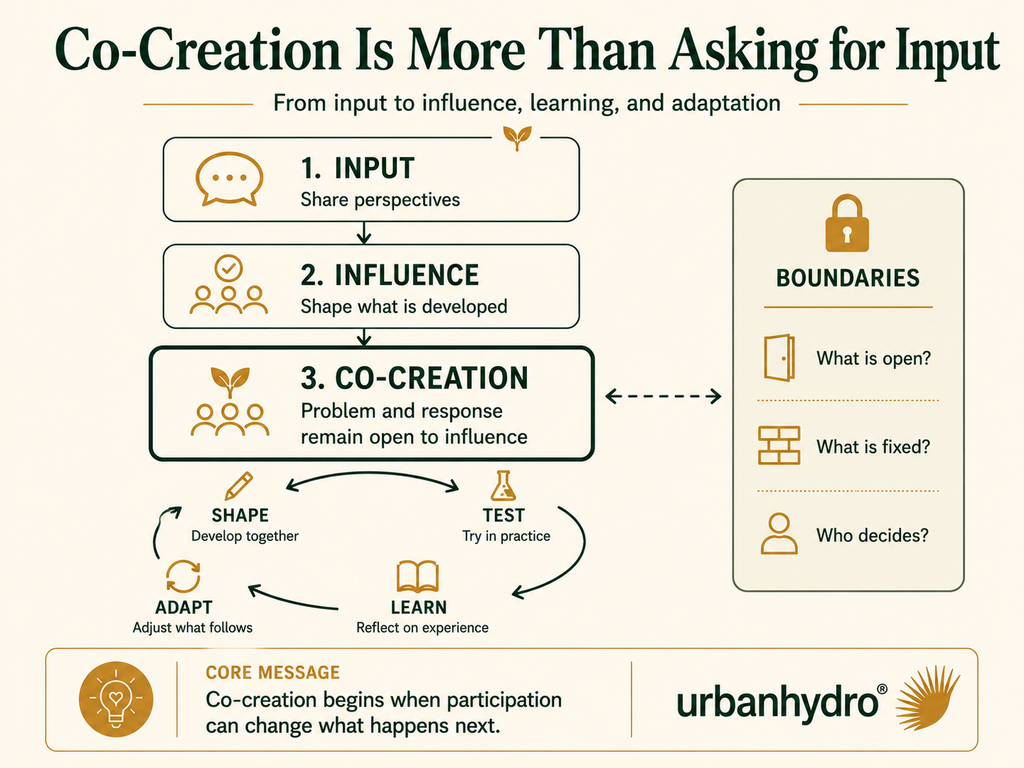
Co-Creation as Iterative Learning
Keeping a process open does not mean remaining indefinitely in discussion. Co-creation becomes more useful when interpretations and possible responses encounter practice.
An idea can appear clear in discussion and become much less clear when someone tries to use it. A proposed process may seem simple until it meets an ordinary working day. A sustainability initiative may appear realistic until it encounters limited time, existing routines, competing priorities, or unclear responsibility. Drafts, prototypes, pilots, and small-scale experiments make these assumptions visible by giving participants something concrete to experience, question, and learn from.
The point of testing is not to defend the original idea, but to learn while it can still change.
This creates a different relationship between design and implementation. Implementation is no longer only the stage where a finished idea is transferred into practice. Early enactment can become part of how the idea itself is understood and developed.
The useful questions after a test therefore go beyond whether it “worked.” Where did the proposed practice fit existing conditions, and where did it not? What was understood differently than expected? What demanded more time or coordination? Which conditions supported action, and which constrained it?
Tension can provide similar information. Participants may disagree because they hold different values or interests, but disagreement may also reveal costs, dependencies, unclear responsibilities, or different experiences of the same proposed change. Trying to remove these tensions too quickly can erase useful information.
Facilitation can instead help examine whether disagreement concerns values, interpretation, resources, responsibility, practical feasibility, or the distribution of consequences and influence. Its role is therefore not simply to make participation run smoothly, but to create enough structure for different forms of knowledge to meet while assumptions remain open to examination and the work retains direction.
Research on co-developed professional learning in sustainability-oriented education provides a useful example of this iterative relationship. In Mathie and colleagues’ work, participants contribute not only through discussion but through a process in which dialogue, experience, reflection, feedback, enactment, and evaluation inform subsequent development. The significance is not the educational setting itself, but the underlying relationship between participation and iteration: experience is allowed to alter the process rather than merely evaluate a finished intervention. The work also connects professional learning to leadership and institutional development, illustrating how learning can extend beyond individual participants into the conditions surrounding practice.
That broader principle travels well: co-creation becomes stronger when participation, action, reflection, and adjustment remain connected.
Co-Creation, Agency, and Responsibility
Co-creation also raises a more difficult question about responsibility.
When people genuinely help shape an initiative, it can be reasonable for responsibility to become more shared. Participants are no longer merely responding to a finished decision; they may have contributed to understanding the problem and developing the response.
But participation cannot, by itself, justify shifting responsibility. Someone may contribute ideas while having no control over resources. Employees may help develop a new practice but remain dependent on management decisions about time, staffing, budgets, or priorities. A team may be asked to take ownership of implementation without being able to alter the organisational conditions that repeatedly undermine it.
In these situations, describing responsibility as shared can hide an important asymmetry.
Agency should not be assumed simply because somebody participated.
This reflects a broader tenet in my work. People act from within relationships, organisations, institutions, material conditions, and distributions of power. Their possibilities for action are shaped by access to decisions, resources, knowledge, time, support, and the ability to adjust when circumstances change.
Meaningful co-creation therefore requires attention not only to whether participants can influence development, but also to what becomes possible afterwards. Who has authority to make the resulting change? Are the necessary resources available? Does someone carry responsibility without the mandate required to act? Can the practice be adjusted when experience shows that something needs to change? Is there support for carrying the work beyond the participatory process?
These questions protect against a subtle form of responsibility shifting in which organisations invite participation, describe the resulting initiative as shared, and then expect people to carry outcomes whose determining conditions remain outside their influence.
People do not need equal power over everything for co-creation to be meaningful. But differences in power, responsibility, and possibility should be made visible rather than hidden behind the language of participation.
Co-Creation Under Real Conditions
This is where co-creation connects directly with my work at urbanhydro® and with the space between sustainability ambition and everyday practice.
Its practical value is not simply that more voices enter the process. It is that the process can become better able to understand the situation it is trying to change. That involves examining both the emerging idea and the conditions around it: what we are trying to create, what problem we believe we are addressing, whose knowledge is missing, what has already been decided, what remains open, and which assumptions should be tested before further commitments are made.
As the work moves into practice, attention shifts towards what can be tried, what is being learned, which conditions support movement, where friction repeatedly appears, and what participants can influence themselves versus what requires action elsewhere.
I examine these questions through five conditions: frames, learning, influence, adaptation, and support.
Frames shape what is possible and what is fixed. Learning allows experience to revise understanding. Influence determines whether participation can affect relevant decisions. Adaptation makes it possible for learning to change what happens next. Support connects ambition with the time, relationships, resources, and organisational backing required to carry action forward.
Co-creation can strengthen these conditions, but it also depends on them. A process cannot remain genuinely iterative if there is no room to adapt. Participation cannot become consequential when all important decisions are closed. People cannot sustain a new practice indefinitely without time, resources, mandate, or support.
There are practical limits as well. Meaningful co-development takes time, facilitation, coordination, and often sustained relationships. It may require financial resources and institutional backing rather than a single workshop. Co-creation is therefore not automatically appropriate for every decision or every stage of a project, and recognising those limits makes the concept more useful.
Sometimes co-creation improves an existing idea. Sometimes it simplifies it or reveals that different organisational conditions are needed before it can work. Sometimes it changes the direction of the project itself. And sometimes the most responsible result is discovering that the original idea should not proceed.
A More Workable Understanding of Co-Creation
Co-creation is not the absence of leadership, expertise, boundaries, or decisions. Nor is it a guarantee of consensus or better outcomes. It is a way of keeping relevant parts of a problem and response open long enough for different forms of knowledge and experience to affect their development.
At its best, co-creation connects participation with influence, experience with learning, testing with adaptation, and responsibility with realistic possibilities for agency. It allows ideas to encounter the situations on which they depend before those ideas become too difficult to change.
This matters particularly in sustainability, where solutions rarely move intact from strategy into everyday practice. They meet existing systems, relationships, routines, priorities, capacities, histories, and constraints. People interpret them, negotiate them, adjust them, resist them, support them, or find ways to make them workable.
A co-creative approach takes that reality seriously from the beginning. It does not assume that people closest to a situation have every answer, nor that expertise from outside the situation is sufficient on its own. Instead, it creates a relationship between different forms of knowledge and allows that relationship to continue through testing and learning.
That requires more than asking for input. It requires enough influence for participation to matter, enough openness for learning to alter the work, and enough organisational capacity for what is learned to affect what happens next.
The real test of co-creation is not whether people were invited into the process, but whether their participation could meaningfully shape what became possible.
Sources and Further Reading
Carrick, J., Bell, D., Fitzsimmons, C., Gray, T., & Stewart, G. (2023). Principles and practical criteria for effective participatory environmental planning and decision-making. Journal of Environmental Planning and Management, 66(14), 2854–2877. https://doi.org/10.1080/09640568.2022.2086857
Chambers, J. M., Wyborn, C., Ryan, M. E., et al. (2021). Six modes of co-production for sustainability. Nature Sustainability, 4, 983–996. https://doi.org/10.1038/s41893-021-00755-x
Mathie, R. G. P., Eikeland, I., Sinnes, A. T., & Wals, A. E. J. (2026). Co-developing professional learning practices in support of a whole school approach to sustainability-oriented education. Environmental Education Research. https://doi.org/10.1080/13504622.2025.2606805
Newig, J., Jager, N. W., Challies, E., & Kochskämper, E. (2023). Does stakeholder participation improve environmental governance? Evidence from a meta-analysis of 305 case studies. Global Environmental Change, 82, 102705. https://doi.org/10.1016/j.gloenvcha.2023.102705
Norström, A. V., Cvitanovic, C., Löf, M. F., West, S., Wyborn, C., Balvanera, P., et al. (2020). Principles for knowledge co-production in sustainability research. Nature Sustainability, 3, 182–190. https://doi.org/10.1038/s41893-019-0448-2
Sanders, E. B.-N., & Stappers, P. J. (2008). Co-creation and the new landscapes of design. CoDesign, 4(1), 5–18. https://doi.org/10.1080/15710880701875068
Wyborn, C., Datta, A., Montana, J., Ryan, M., Leith, P., Chaffin, B., Miller, C., & van Kerkhoff, L. (2019). Co-Producing Sustainability: Reordering the Governance of Science, Policy, and Practice. Annual Review of Environment and Resources, 44, 319–346. https://doi.org/10.1146/annurev-environ-101718-033103